

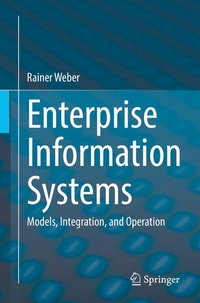
Enterprise Information Systems
Description

This textbook presents the fundamentals of both transactional and analytical enterprise information systems, including their operation and integration in a system landscape. Its particular concern is to establish a close connection between business and computer science topics, e.g. related to the modeling of business objects and business data, or for the integration of enterprise information systems.
The book is structured in three parts. "System Models" deals with the two types of enterprise information systems, transactional and analytical systems. It also introduces the various platforms, ranging from the "classic" three-tier client-server architecture to newer developments like in-memory computing, and discusses deployment options like pairs on-premises and cloud on the one hand, and monolithic systems and microservices on the other. Next, "Integration" deals with technical aspects for the combination of several enterprise information systems, describing a variety of techniques: integration via the user interface, through data exchange, through message brokers and Web services, or via process management systems. Eventually "Operations" covers topics related to the whole system lifecycle from selection and implementation to access control and administration.
The book is primarily aimed at bachelor students in information systems, who deal with the architecture of enterprise information systems. It can also be used by practitioners in industry for either self-study or to gain insight into information systems. To illustrate concepts, realizations in selected enterprise information systems such as SAP, Microsoft Dynamics 365 Business Central, Vtiger CRM and Pentaho are described.
More details
Other editions
Additional editions
Person
Rainer Weber is Professor for Information Systems at Technische Hochschule Nürnberg Georg Simon Ohm. Prior to this, he was with the IBM European Networking Center in Heidelberg and with SAP AG in Walldorf. His fields of interest are enterprise software (in particular SAP software), workflow systems, and modeling and design of business processes.
Content
1. Introduction.- Part I: System Models.- 2. Overview of Part I.- 3. Transactional Systems.- 4. Analytical Systems.- 5. Application Platform.- 6. Deployment Forms.- Part II: Integration. 7. Overview of Part II.- 8. System Landscape.- 9. Integration via the User Interface.- 10. Integration through Data Exchange.- 11. Integration through Function Call.- 12. Integration through Process Management Systems.- Part III: Operation.- 13. Overview of Part III.- 14. Selection and Implementation of Business Standard Software.- 15. Adaptation of Standard Software.- 16. Access Control.- 17. System Administration.- 18. Summary and Outlook.
