

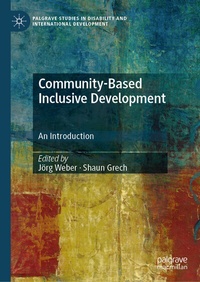
Community-Based Inclusive Development
Description

This edited book responds to the theoretical vacuum on Community Based Inclusive Development (CBID) and accommodates the learning needs of students, researchers and practitioners looking to understand the conceptual underpinnings and practice dimensions of CBID, while developing new theoretical ground on CBID. Bringing together established and emerging scholars and practitioners, this edited volume seeks to:
· Offer a theoretical, critical and interdisciplinary introduction for students, academics and practitioners working in CBID in the Global South.
· Build new theory and knowledge that can inform research and practice.
· Explore in-depth a range of issues through a critical lens and connect these with CBID.
· Contribute evidence-based material for CBID programming and advocacy and inform the work of mainstream community development practitioners.
More details
Other editions
Additional editions
Persons
Jörg Weber (PhD) is Senior Global Advisor in Community Based Inclusive Development (CBID) for CBM Christian Blind Mission, and Honorary Research Affiliate at the University of Cape Town, South Africa. He has over 20 years of experience advising community programmes as well as UN bodies, professional organizations and government agencies in inclusive community development, rehabilitation, education and inclusive livelihoods.
Shaun Grech (PhD) is Global Technical Lead on Inclusive Social Protection for CBM Christian Blind Mission, Honorary Associate Professor at the University of Cape Town, South Africa and Affiliate Associate Professor in International Relations at the University of Malta. He is also editor-in-chief of the international journal 'Disability and the Global South' (DGS).
Content
Chapter 1: Community-Based Inclusive Development: Foundations, Evolution, and Contemporary challenges .- Chapter 2: Policies, rights and the need to decentralise inclusive development .- Chapter 3: From community to community practice: The place of disability .- Chapter 4: Adopting three mind-shifts to accelerate community-based inclusive youth development .- Chapter 5: 'I Know Why the Caged Bird Sings': Community-Based Inclusive Development and Disability Studies .- Chapter 6: Disability-Inclusive Development: A Critical Reading .- Chapter 7: Decolonising 'special' and inclusive education through community-based inclusive development .- Chapter 8: Neglected Tropical Diseases and Community Development .- Chapter 9: CBID workers on the ground: Key competencies .- Chapter 10: The role of Organisations of People with Disabilities (OPDs) in Community Based Inclusive Development (CBID) and the need to build alliances: practitioner perspectives .- Chapter 11: Why families matter: caregiving in CBID.- Chapter 12: A Disability Livelihoods Approach to Including Communities Meaningfully in Development .- Chapter 13: When Communities are Part of the Problem.
