

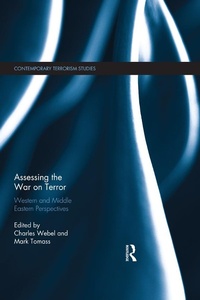
Assessing the War on Terror
Western and Middle Eastern Perspectives
Published on 17. February 2017
302 pages
978-1-315-46916-4 (ISBN)
Description

This volume is a collection of articles that critically examine the efficacy, ethics, and impact of the War on Terror as it has evolved since 9/11.
During the decade and a half of the Global War on Terror (GWOT), numerous books have considered the political, psychosocial, and economic impacts of terrorism. However, there has been little systematic effort to examine the effectiveness of the GWOT in achieving its goals. Furthermore, there is virtually nothing that presents a comparative analysis of the GWOT by the people most directly affected by it-citizens and scholars from conflict zones in the Middle East. There is, therefore, great need for a book that analyzes the strategies, tactics, and outcomes of the GWOT and that also presents facts and ideas that are missing or underrepresented in the dominant public narratives. The contributions in this volume were chosen to specifically address this need. In doing so, it uniquely provides not only Western perspectives of the GWOT, but also importantly includes perspectives from the Middle East and those most directly affected by it, including contributions from scholars and policy makers. Overall, the contributions demonstrate how views differ based on geographical location, and how views have changed during the course of the still-evolving War on Terror.
The book will be of much interest to students and scholars of terrorism and counter-terrorism, foreign policy, Middle Eastern politics, security studies and IR, as well as policy makers.
During the decade and a half of the Global War on Terror (GWOT), numerous books have considered the political, psychosocial, and economic impacts of terrorism. However, there has been little systematic effort to examine the effectiveness of the GWOT in achieving its goals. Furthermore, there is virtually nothing that presents a comparative analysis of the GWOT by the people most directly affected by it-citizens and scholars from conflict zones in the Middle East. There is, therefore, great need for a book that analyzes the strategies, tactics, and outcomes of the GWOT and that also presents facts and ideas that are missing or underrepresented in the dominant public narratives. The contributions in this volume were chosen to specifically address this need. In doing so, it uniquely provides not only Western perspectives of the GWOT, but also importantly includes perspectives from the Middle East and those most directly affected by it, including contributions from scholars and policy makers. Overall, the contributions demonstrate how views differ based on geographical location, and how views have changed during the course of the still-evolving War on Terror.
The book will be of much interest to students and scholars of terrorism and counter-terrorism, foreign policy, Middle Eastern politics, security studies and IR, as well as policy makers.
Reviews / Votes
'This impressive work demonstrates that the Global War On Terror (GWOT) is both ineffective and inhumane, and that there are better, more ethical ways to deal with political violence. Especially praiseworthy is the variety of voices the book contains: prominent academics and activists, as well as victims. It should be required reading for anyone seeking a critical understanding of our present dilemma.' -- Charles Lindholm, Boston University, USA'This is a timely work that combines insight with style. It offers a fine example of engaged scholarship. It is a book well worth reading!' -- Stephen Eric Bronner, Rutgers University, USA
More details
Series
Language
English
Place of publication
London
United Kingdom
Publishing group
Taylor & Francis Ltd
Target group
College/higher education
Professional and scholarly
Illustrations
5 Tables, black and white
File size
2,40 MB
ISBN-13
978-1-315-46916-4 (9781315469164)
Copyright in bibliographic data and cover images is held by Nielsen Book Services Limited or by the publishers or by their respective licensors: all rights reserved.
Schweitzer Classification
Other editions
Additional editions
Book
09/2020
1st Edition
Routledge
€51.98
Shipment within 15-20 days
Book
02/2017
1st Edition
Routledge
€230.27
Shipment within 10-20 days
Persons
Charles Webel is the Delp-Wilkinson Chair and Professor of Peace Studies at Chapman University, USA, and Professor of International Economic Relations at the University of New York in Prague, Czech Republic. He is author/editor of eights books, including Terror, Terrorism, and the Human Condition (2007) and Peace and Conflict Studies, 3rd edition (with D. Barash, 2014).
Mark Tomass is an economist and instructor at Harvard University, USA, and author of The Religious Roots of the Syrian Conflict: The Remaking of the Fertile Crescent (2016).
Contributors: Noam Chomsky, Oliver Richmond, Ioannis Tellidis, Sarton Weinraub, Buthaina Shaaban, Anwar Said al-Haidari, Sher M. Khan, John Arnaldi, William Cohn, Laurie Calhoun, Scott Atran, Johan Galtung, Casey Douglas Carr and Audrey Kurth Cronin.
Mark Tomass is an economist and instructor at Harvard University, USA, and author of The Religious Roots of the Syrian Conflict: The Remaking of the Fertile Crescent (2016).
Contributors: Noam Chomsky, Oliver Richmond, Ioannis Tellidis, Sarton Weinraub, Buthaina Shaaban, Anwar Said al-Haidari, Sher M. Khan, John Arnaldi, William Cohn, Laurie Calhoun, Scott Atran, Johan Galtung, Casey Douglas Carr and Audrey Kurth Cronin.
Content
Introduction, Charles Webel
Section I: Framing and Assessing the War on Terror
Section Overview, Mark Tomass
1. The Evil Scourge of Terrorism, Noam Chomsky
2. Realizing Hegemony? Symbolic Terrorism and the Roots of Conflict, Oliver P. Richmond
3. Trauma and the City: The Psychology of America's Terrorism Trauma, Sarton Weinraub
Section II: Hearing from the Victims of Terror-Inflicted Regions
Section Overview, Mark Tomass
4. The Syrian Tragedy: The Role of the West, A Government Insider's Account, Buthaina Shaaban
5. Iraq: A Victim of Terror and the War on Terror, Anwar Said al-Haidari
6. The Ideological Origins of ISIS: Fighting Terror with Facts and Common Sense, Mark Tomass
7. Winning the Hearts and Minds of the Pukhtuns of Afghanistan and Northwest Pakistan with Altruism, Public Health and Development, Not by Terrorism and Counterterrorism, Sher M. Khan
Section III: Calculating the Costs of the War on Terror
Section Overview, Mark Tomass
8. The Global War on Terrorism: How Ethical and Effective?, Charles Webel and John Arnaldi
9. Led Astray: Legal and Moral Blowback from The Global War on Terror, William Cohn
10. Terror from Above and Within: The Hidden Cultural and Political Costs of Lethal Drones, Laurie Calhoun
Section IV: Analyzing, Negotiating with, and Ending Terror Groups
Section Overview, Mark Tomass
11. A Dialogue on Why Western Youth are Attracted to ISIS, Scott Atran and Mark Tomass
12. Negotiating with the Taliban, Johan Galtung
13. A Tale of Two CTs: A Ground-level Counterinsurgency Perspective on Belgian Counter-Terrorism Measures, Casey Douglas Carr
14. The War on Terrorism What Does it Mean to Win?, Audrey Kurth Cronin
Conclusion, Charles Webel
Section I: Framing and Assessing the War on Terror
Section Overview, Mark Tomass
1. The Evil Scourge of Terrorism, Noam Chomsky
2. Realizing Hegemony? Symbolic Terrorism and the Roots of Conflict, Oliver P. Richmond
3. Trauma and the City: The Psychology of America's Terrorism Trauma, Sarton Weinraub
Section II: Hearing from the Victims of Terror-Inflicted Regions
Section Overview, Mark Tomass
4. The Syrian Tragedy: The Role of the West, A Government Insider's Account, Buthaina Shaaban
5. Iraq: A Victim of Terror and the War on Terror, Anwar Said al-Haidari
6. The Ideological Origins of ISIS: Fighting Terror with Facts and Common Sense, Mark Tomass
7. Winning the Hearts and Minds of the Pukhtuns of Afghanistan and Northwest Pakistan with Altruism, Public Health and Development, Not by Terrorism and Counterterrorism, Sher M. Khan
Section III: Calculating the Costs of the War on Terror
Section Overview, Mark Tomass
8. The Global War on Terrorism: How Ethical and Effective?, Charles Webel and John Arnaldi
9. Led Astray: Legal and Moral Blowback from The Global War on Terror, William Cohn
10. Terror from Above and Within: The Hidden Cultural and Political Costs of Lethal Drones, Laurie Calhoun
Section IV: Analyzing, Negotiating with, and Ending Terror Groups
Section Overview, Mark Tomass
11. A Dialogue on Why Western Youth are Attracted to ISIS, Scott Atran and Mark Tomass
12. Negotiating with the Taliban, Johan Galtung
13. A Tale of Two CTs: A Ground-level Counterinsurgency Perspective on Belgian Counter-Terrorism Measures, Casey Douglas Carr
14. The War on Terrorism What Does it Mean to Win?, Audrey Kurth Cronin
Conclusion, Charles Webel
