

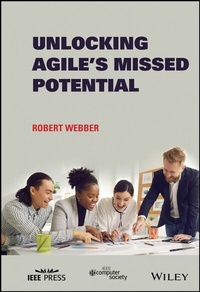
Unlocking Agile's Missed Potential
Description

Agile has not delivered on its promises. The business side expected faster time to market, but they still experience the long delays of bloated releases. Engineers thought they would be given time to build the product right the first time, but they are rushed under pressure to deliver new features within impossible schedules. What went wrong?
The culprit is feature-based waterfall release planning perpetuated in a vain attempt to achieve business predictability. Agile didn't address the business need for multi-year financial predictability. The Agile community's answer was the naïve response, 'The business needs to be more Agile.' Waterfall release planning with fixed schedules undercuts a basic tenet of Agile development – the need to adjust content delivered within a timebox to account for evolving requirements and incorporation of feedback. Agile without flexible content is not Agile.
This book introduces a novel solution that enables product teams to deliver higher value within shorter cycle times while meeting the predictability needs of the business. Organizations today want product teams that break down walls between product management and engineering to achieve schedule and financial objectives. Until now they haven’t had a way to implement product teams within the rigid constraints of traditional organizational structures.
The Investment planning approach described in this book supports small development increments planned and developed by product teams aligned by common schedule and financial goals. It uses Cost of Delay principles to prioritize work with the highest value and shortest cycle times. Investments provide a vehicle for collaboration and innovation and fulfill the promise of highly motivated self-directed Agile development teams.
This book is for engineers, product managers and project managers who want to finally do Agile the way it was envisioned. This book is also for leaders who want to build high-performance teams around the inherent motivational environment of Agile when done right.
Foreword by Steve McConnell, author of More Effective Agile: A Roadmap for Software Leaders (Construx Press, 2019).
ROBERT WEBBER'S executive experience as VPs of engineering and product management and as a CEO, combined with years of consulting with Fortune 500 companies, provide the broad perspective to create a win-win solution for business and product development that finally achieves the promises of Agile development. Organizations can increase R&D ROI by over 25% using existing Agile development capabilities. Break the chains of waterfall planning!
More details
Other editions
Additional editions
Person
ROBERT WEBBER'S executive experience as VPs of engineering and product management and as a CEO, combined with years of consulting with Fortune 500 companies, provide the broad perspective to create a win-win solution for business and product development that finally achieves the promises of Agile development. Organizations can increase R&D ROI by over 25% using existing Agile development capabilities. Break the chains of waterfall planning!
Content
Foreword 11
Preface 13
Introduction 16
The Lost Potential of Agile Development 16
Missed Business Expectations 18
A New Approach to Agile Planning 19
Addressing Traditional Software Development Challenges 21
Motivation and Innovation 22
Your Organization 22
Chapter 1: The Persistence of Waterfall Planning 23
Introduction to AccuWiz 23
The New COO 24
Product Management 24
PMO 25
Engineering 25
Customer Perspective 26
Synopsis 26
Summary 27
Chapter 2 - Why Agile has Struggled 29
Agile Development Fundamentals 30
The Agile Revolution 30
Scrum 31
Kanban 34
Barriers to Real Agile 35
Schedule Pressure 35
The "Motivation" Factor 37
The Mythical Product Owner 39
Feature Planning 40
Agile Scaling Frameworks 41
Summary 42
Chapter 3: Embracing Software Development Variance 43
The Cone of Uncertainty 43
Software Development Estimation Variance Explained 44
Making and Meeting Feature Commitments 45
How Other Departments Meet Commitments 47
Agile Development Implications 48
Summary 48
Chapter 4: Cost of Delay 49
Weighted Shortest Job First (WSJF) 50
Cost of Delay Basics 50
Example 52
WSJF Proof 54
CoD and Net Present Value (NPV) Prioritization Methods 56
Non-linear Income Profiles 57
CoD for Non-Linear Cumulative Income Profiles 58
Payback Period CoD Method 58
Third-year Income Slope CoD Method 58
CoD NPV Method 63
CoD Computation Method 64
WSJF and Traditional Finance 66
ROI 66
Investment Rate of Return (IRR) 67
WSJF versus ROI Prioritization 67
Summary 69
Chapter 5: Investment Fundamentals 70
Investments, Initiatives and Programs 70
Investment Hierarchy 71
AccuWiz Investment Examples 74
Portfolio Allocation 75
Investment Forecasts 76
Development Effort and Cost 76
Investment Income Forecasts 78
Investment Backlogs 81
Investment WIP 82
Investment Backlog WIP 82
Investment WIP 83
Technical Debt Investments 84
Summary 86
Chapter 6: Maximizing Investment Value 87
Great Products 87
Business Model Value Considerations 89
Stakeholder Value Analysis 90
Gilb Stakeholder Definition 90
Ford's Big Mistake 92
Trucking Fleet Management Example 93
Five Whys 95
User Scenarios 96
Summary 97
Chapter 7: Planning High-Value Investment Features 99
Avoiding the Feature Pit 99
Feature ROI 100
Summary 104
Chapter 8: Releasing Investments 105
Release Opportunity Cost 105
Investment Release Bundling 108
Investment Pricing 108
Lack of Customer Acceptance 110
Release Overhead Costs 111
Overcoming Modular Release Challenges 113
Architecture for Modular Deployment 113
Configuration Management 113
Release Investment Prioritization 114
Reducing Software Inventory Costs 115
Summary 118
Chapter 9: Meeting Investment Targets 120
Meeting Commitments 120
Investment Teams 120
Managing Investment Scope 123
Managing Sales Requests 127
Summary 129
Chapter 10: Investment Planning Template 130
Investment Description 130
Proxy Business Case 130
Product Stakeholder Analysis 132
Customer Product Stakeholders 132
Internal Product Stakeholders 132
Constraints 132
Competition 133
Acceptance Criteria 133
Go-to-Market Plan 134
Pricing Model 134
Deployment Model 134
Sales Channels 134
Investment Targets 134
Development Cost 134
Cycle Time 134
Income Projections 134
WSJF 136
Assumption Validation 136
Summary 138
Chapter 11: Managing the Agile Roadmap 139
The Agile Roadmap Management Database 139
The Agile Technology Roadmap 141
Stages of Technology Acquisition 142
Investment Technology Roadmaps 143
Summary 143
Chapter 12: Maximizing Investment Development Productivity 145
Measuring Software Productivity 145
Cost of Quality (CoQ) 146
Cost of Quality and Software Productivity 147
Sources of Software Rework 149
Agile Cost of Quality 150
Reducing Agile User Story Rework 152
Reducing Agile Defect Rework 153
Agile Cost of Quality Example 154
Summary 155
Chapter 13: Motivating Agile Teams 156
Background 156
Why You're the Only Smart One in Your Organization 157
Consequences and Behavior 158
Performance and Organizational Culture 159
Behavior and Software Quality 163
Intrinsic Motivation 164
Agile and Motivation 165
Measuring Motivation 167
Motivation Advice 169
Summary 171
Chapter 14: Innovating with Investments 173
Innovation - A Working Definition 174
Investments as an Innovation Vehicle 175
Why Your Organization Can't Innovate 176
An Organizational Behavior Model of Innovation 178
An Innovation Tale of Two Companies 181
Creating a Culture of Innovation 184
Summary 188
Chapter 15: AccuWiz Gets it Together 189
The Founder Meeting 189
The Announcement 190
Product Stakeholder Analysis 191
Creating the Investment Backlog 192
Customer Management 195
Investment Development 195
Project Management 196
Managers 197
Executive Team 198
Innovation is Revived 199
Synopsis 199
Chapter 16: Getting it Together in your Company: A Practical Guide 200
Step 1: Organizational Support 200
Influence Strategy 204
Step 2: Stakeholder Value Analysis 205
Step 3: Stakeholder Research 206
Step 4: Stakeholder Interviews 207
Step 5: Investments 207
User Scenarios 208
Feature Definition 209
WSJF Screening 209
Step 6: Initial Roadmap 210
Resource Allocation 211
Step 7: Investment Planning 214
Agile Roadmap Alignment Meeting 215
Program Review 216
Step 8: Consequence Alignment 217
Summary 220
Appendix 1: General Cost of Delay Formula 221
Reinertsen WSJF 222
Income Curve Approximation 223
Summary 225
Appendix 2: Investment Income Profile Forecasts 226
Appendix 3: Release Cycle Productivity Formula 228
Appendix 4: Rework and Productivity 232
Appendix 5: Innovation Behavior Survey 233
Glossary 238
Index 246
Introduction
The Lost Potential of Agile Development
I wrote this book because I want to see Agile development fulfill its promises. My assertion is that organizations that retain Waterfall planning have not obtained the true benefits of Agile. I found that organizations often referred to their software development frameworks as a "hybrid" approach. After almost a decade of software development consulting, I learned to recognize that the term "hybrid" was a sure sign of a failed Agile implementation. It meant that engineering was still held to fixed schedule and release content commitments. This book will show that Waterfall planning is the antithesis of Agile. However, product managers can now adopt new planning methods that support Agile development while meeting the business need for predictability. Engineering can finally do Agile with content flexibility.
After a successful career in software development, I joined Construx Software as a consultant. I gave seminars on requirements, innovation, and project management. I also conducted software development organizational assessments, which included many Fortune 500 companies. I reviewed their practices and organizational structures to recommend how to improve software development productivity and predictability, and to reduce time-to-market. I had the opportunity to see what was really happening "under the hood" in Agile.
While at Construx, I also had the opportunity to moderate group sessions at the annual Construx Leadership Summit where software executives shared their challenges and solutions. I heard the same concerns over and over. Engineering was still being held accountable for schedule, scope and budget commitments made during the release planning stage. Many reported that they had not been able to deliver on the expectations of Agile because of the continued use of Waterfall planning.
In this book, we will consider "Waterfall planning" to be any development framework where release development cost, schedule, and scope are fixed during an initial planning period. Scope is typically defined in terms of features. Development may be split up into several increments of release functionality, but the overall release schedule and scope have already been determined.
Waterfall planning with fixed schedule, scope, and resources undermines the fundamental Agile principles of evolving requirements to incorporate feedback and additional knowledge during development. Agile teams were supposed to pull work from queues at their own pace to ensure they can incorporate feedback and new requirements during the development cycle. Variable content was supposed to give teams time to correct defects to maintain "potentially shippable" software instead of building up mounds of defects that had to be corrected near the end of Waterfall projects. Agile teams were supposed to deploy software faster, with the ultimate goal of continuous delivery. However, planning begins with the assumption of large releases that are then "filled up" with myriad features of questionable value.
This book mainly addresses issues observed in larger organizations with separate product management departments. I've seen many cases where Agile works great with small teams under the guidance of a knowledgeable product owner who truly understands customers and the market. However, something seems to go wrong when silos go up around formalized product management departments. There is a major disconnect between the Waterfall planning perpetuated by product managers and the variable content necessary for Agile development. Product managers have not been provided alternatives to Waterfall planning that meet the predictability needs of the business and the schedule and/or content flexibility required by engineering.
I've also observed that there are common characteristics of the Agile examples touted by the Agile community. They are mostly in companies with a Business to Consumer (B-C) business model where the engineers have a solid understanding of the domain. Consider Facebook or Apple versus a medical device company serving international patients. The second characteristic of these example companies is the ability to attract the top percentiles of engineering talent. The third is that engineers are not constrained by Waterfall planning mandated to try to meet quarterly and annual financial targets.
Engineers with deep domain knowledge, especially when they are potential consumers of the product, can work effectively with little guidance. They can fill in the blanks of high-level user stories without frequent interaction with product owners. The Business to Business (B-B) companies that I assessed have complex domains and were never able to convey the necessary requirements detail through user stories alone. As an example, I worked with a company where Indian engineers were implementing highly regulated casino management software from user stories when they had never been in a casino in their lives! It wasn't Agile development - just code and fix.
Talent is another critical factor. I've worked with teams of talented engineers that can deliver software with little or no software development framework or methodology. These are the top 15% of self-motivated engineers who will overcome anything in their way. And they can write virtually error-free code. Who gets this demographic? The "cream of the crop" goes to startups or fashionable companies like Google, Microsoft, Facebook, and Spotify. The rest of the industry is left with average engineers who need a solid development framework and detailed requirements.
The third Agile success element is the main subject of this book. The example companies have abandoned Waterfall release planning and embraced Agile planning, often because they are dominant in their markets and can set their own schedules. They are probably not like your company with a demanding sales team committed to quarterly revenue based on what is available for them to sell. I have not seen an effective Agile implementation where Waterfall planning persists.
Putting these three Agile success elements together, one realizes that most of the "ideal Agile" examples and literary advice is based on a small fraction of the software industry comprised of startups and sexy B-C companies that have embraced Agile planning and are loaded with engineering talent. I always felt bad for the Construx summit attendees who listened with envy about amazing Agile implementations and wondered what was wrong with them. It is not them. They could be making the same presentations given the same ideal conditions discussed above.
This book is for the frustrated "silent majority" of software development organizations where Agile has not met expectations. It addresses the typical large company with complex domains and average talent. These companies can now adopt Agile planning and deployment and improve predictability for the business. This book describes how highly motivated Agile product teams can be built around business problems with quantified value. Engineers are provided with the problem to solve instead of trying to convey detailed implementation requirements through user stories with an uninvolved or uninformed product owner.
The word Agile in this book refers to methods other than just Scrum, like Kanban. I use Scrum terminology in this book, but the same investment planning principles and methods apply to any Agile method using iterative development with evolving requirements where self-directed teams pull their work from backlogs.
There is one other term used throughout this book that needs to be clarified for those of you with some knowledge of company financials. When I use the term "income" I am referring to "Net Income," which is the income received with product cost, expenses and taxes removed.
Missed Business Expectations
Agile has not addressed the real-world need for financial predictability in business. We do know that roadmap commitments were usually not met with Waterfall development. We learned there is a limit to the accuracy of software development effort and schedule estimation. With the advent of Agile, engineering was now expected to make commitments even before requirements were developed, exacerbating the predictability problem.
The Agile community response of, "The business needs to be more Agile" did nothing to help product and project managers who were still held accountable for long-term commitments of schedule, scope, and cost. This widened the division between product management and engineering. Engineering is frustrated by not being able to do Agile development the way they were taught, having to resort to "hybrid" methods. Product and project management are frustrated because of the reluctance of engineering to make release commitments.
Certainly, there are organizations that have been able to manage variable content with Waterfall planning by reserving software development contingency. But these organizations are rare because contingency doesn't typically survive the pressure to commit during release planning.
I don't blame product management for the continued use of Waterfall planning. They weren't provided with an alternative. Product managers were left out of Agile because, in the view of the Agile community, they could be replaced with product owners who sit with a team to provide verbal clarification for everything they need to know. And, according to the Agile community,...
