

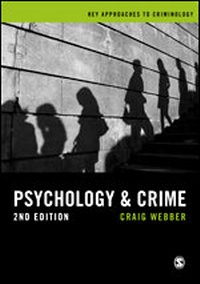
Psychology and Crime
A Transdisciplinary Perspective
2nd Edition
Published on 30. September 2019
352 pages
978-1-4739-4407-7 (ISBN)
Description

'Criminologists have been waiting a very long time for a psychology of crime that speaks their language. Finally it has arrived.' - Dr David Gadd, Keele University
Now in an updated second edition, this book explores the links between psychology and crime, taking the reader through psychological explanations of crime and the use of psychology within the criminal justice system. The book aims to demystify some of the myths of psychological criminology and situates the subject within its historical and theoretical foundations, whilst maintaining a contemporary outlook and critical awareness of the field's advantages and limitations.
This second edition includes:
Four new chapters, on Psychological perspectives and their approach to crime, Mentally disordered offenders, The Criminal Courts and the role of the Jury, and Victims, Fear of Crime and Offender Management.
Improved coverage of the issues around interpersonal violence, sexual violence and deviancy, the psychology of crime in groups, and war crimes.
Increased analysis of psychology and the criminal justice system.
Essential reading for students in criminology, sociology and psychology.
Now in an updated second edition, this book explores the links between psychology and crime, taking the reader through psychological explanations of crime and the use of psychology within the criminal justice system. The book aims to demystify some of the myths of psychological criminology and situates the subject within its historical and theoretical foundations, whilst maintaining a contemporary outlook and critical awareness of the field's advantages and limitations.
This second edition includes:
Four new chapters, on Psychological perspectives and their approach to crime, Mentally disordered offenders, The Criminal Courts and the role of the Jury, and Victims, Fear of Crime and Offender Management.
Improved coverage of the issues around interpersonal violence, sexual violence and deviancy, the psychology of crime in groups, and war crimes.
Increased analysis of psychology and the criminal justice system.
Essential reading for students in criminology, sociology and psychology.
Reviews / Votes
This second edition retains all the strengths of the first while adding fresh insight to contemporary issues. Craig Webber's knowledge of the field and his openness to a wide range of approaches has resulted in an indispensable guide to criminological psychology. Psychology & Crime provides a lively, thought provoking and authoritative introduction to a rapidly growing area and succeeds in stretching thinking beyond current orthodoxies. -- Eamonn Carrabine Craig Webber has achieved a rare feat; a book that connects psychology and crime in a way that honours the rich history of sociological approaches to crime with current insights from psychology. It reads well, is well structured and combines the fields of criminology and psychology in a most engaging fashion. The many students who take a combination of psychology with criminology will thank him for this book.-- Francis Pakes Praise for the previous edition:
Criminologists have been waiting a very long time for a psychology of crime that speaks their language. Finally it has arrived. Craig Webber brings together a wealth of psychological research that students of criminology ignore at their peril. He also documents the significant in-roads criminologists are now making with regard to matters of the mind too often treated as 'off-limits' by many social scientists, psychologists included.
Dr David Gadd
Keele University
Webber has pulled off a unique feat by writing a book on the psychology of crime that will appeal equally to sociologists and criminologists. The book provides up-to-date and scholarly coverage of the investigative psychology literature on policing serial offending and mass murderers, but also integrates sophisticated discussions of Stan Cohen's theory of denial, the Birmingham School of cultural studies, and Green Criminology. This exciting theoretical integration bodes very well for the future of criminal psychology.
Professor Shadd Maruna
Queen's University Belfast
Craig Webber's Psychology and Crime does a good job of opening up psychology to criminologists...Webber's book is 'criminological' in its starting position and psychology is not approached as the stand-alone discipline it is often thought to be. That sets it apart from other texts. For that reason criminologists may well find this one particularly accessible... The book as a whole does a good job in cautiously welcoming psychology into the criminological mainstream. For those initially apprehensive of psychology, this is a good choice of text that should find its way onto readings lists in particular for psychology-related modules within criminology courses. That is a readership for whom this text should be particularly valuable.
Dr Francis Pakes
Internet Journal of Criminology -- Reviews
More details
Series
Edition
Second Edition
Language
English
Place of publication
London
United Kingdom
Target group
College/higher education
ISBN-13
978-1-4739-4407-7 (9781473944077)
Copyright in bibliographic data and cover images is held by Nielsen Book Services Limited or by the publishers or by their respective licensors: all rights reserved.
Schweitzer Classification
Other editions
Additional editions
Book
10/2019
2nd Edition
SAGE Publications Ltd
€86.00
Shipment within 15-20 days
Person
Dr Craig Webber is Associate Professor in Criminology within Sociology at the University of Southampton.
Content
Psychology, Sociology and Crime: Mapping the Historical Terrain
Psychological Perspectives on Crime
Mentally Disordered Offenders
Psychological Theories of Interpersonal Violence and Investigatory Psychology
Investigating Sexual Violence
Crimes in Groups: Explaining Subcultures, Groups and Gangs
Mass Murder, Political Murder and War Crimes
Terrorism: From Pathology to Normality
Interviewing Eyewitnesses and Suspects
Psychology, The Courts and the Role of the Jury
After Crime: Victims, Fear of Crime and Offender Management
The Futures of Criminological Psychology
References
Glossary
Index
Psychological Perspectives on Crime
Mentally Disordered Offenders
Psychological Theories of Interpersonal Violence and Investigatory Psychology
Investigating Sexual Violence
Crimes in Groups: Explaining Subcultures, Groups and Gangs
Mass Murder, Political Murder and War Crimes
Terrorism: From Pathology to Normality
Interviewing Eyewitnesses and Suspects
Psychology, The Courts and the Role of the Jury
After Crime: Victims, Fear of Crime and Offender Management
The Futures of Criminological Psychology
References
Glossary
Index
