

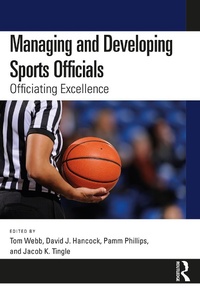
Managing and Developing Sports Officials
Officiating Excellence
1st Edition
Published on 1. August 2024
248 pages
978-1-040-09021-3 (ISBN)
Description

This book offers an evidence-based guide to the development, management, and retention of sports officials. Drawing on research at all levels of sport, from grassroots to professional, this book focuses on best practices for sports officials and for anybody involved in the management or training of sports officials.
This book is divided into three parts. The first takes a close look at who sports officials are, their motivations, and the formal and informal organizational relationships that define an official's position in sport. The second examines the factors that can keep an official engaged in their sport, from building healthy cultures and good physical preparation to mentoring and mental health. The final part looks at the development of officials to elite level, including effective communication, improving decision-making, interpreting rules and laws, and career pathways. With case studies, real-life examples, and the voices of practicing officials included throughout this book, it introduces core concepts and best practices applicable across sports and different national and international contexts.
This is an essential reference for all sports officials and for practitioners and policymakers working in sports organizations at all levels.
This book is divided into three parts. The first takes a close look at who sports officials are, their motivations, and the formal and informal organizational relationships that define an official's position in sport. The second examines the factors that can keep an official engaged in their sport, from building healthy cultures and good physical preparation to mentoring and mental health. The final part looks at the development of officials to elite level, including effective communication, improving decision-making, interpreting rules and laws, and career pathways. With case studies, real-life examples, and the voices of practicing officials included throughout this book, it introduces core concepts and best practices applicable across sports and different national and international contexts.
This is an essential reference for all sports officials and for practitioners and policymakers working in sports organizations at all levels.
More details
Edition
1. Auflage
Language
English
Place of publication
London
United Kingdom
Publishing group
Taylor & Francis Ltd
Target group
College/higher education
Professional and scholarly
Illustrations
4 Tables, black and white; 9 Line drawings, black and white; 3 Halftones, black and white; 12 Illustrations, black and white
ISBN-13
978-1-040-09021-3 (9781040090213)
Copyright in bibliographic data and cover images is held by Nielsen Book Services Limited or by the publishers or by their respective licensors: all rights reserved.
Schweitzer Classification
Other editions
Additional editions
Tom Webb | David J. Hancock | Pamm Phillips
Managing and Developing Sports Officials
Officiating Excellence
Book
08/2024
1st Edition
Routledge
€61.30
Shipment within 10-20 days
Tom Webb | David J. Hancock | Pamm Phillips
Managing and Developing Sports Officials
Officiating Excellence
Book
08/2024
1st Edition
Routledge
€206.40
Shipment within 10-20 days
Persons
Tom Webb is Associate Professor in the Centre for Business in Society at Coventry University, UK. His research focuses on abuse, aggression, and maltreatment of sports officials, the mental health and well-being of sports officials, and the governance and careers of officials. He is also the founder of the Referee and Match Official Research Network.
David J. Hancock is Associate Professor in the School of Human Kinetics and Recreation at Memorial University of Newfoundland, Canada. His primary research interest is centered on understanding the psychology of sport officiating, including group dynamics, mental health, and decision-making.
Pamm Phillips is Professor at the Deakin Business School in the Faculty of Business and Law at Deakin University, Australia. She is a member of the Centre for Sport Research and the Women in Sport and Exercise group. Prof. Phillip's research is focused on volunteers (including referees) and sport development.
Jacob K. Tingle is Associate Professor in the Michael Neidorff School of Business at Trinity University, USA. His research explores organizational systems and structures that enhance or detract from the experiences of sport volunteers and contract staff. Sports officials (referees and umpires) are a population of significant interest.
David J. Hancock is Associate Professor in the School of Human Kinetics and Recreation at Memorial University of Newfoundland, Canada. His primary research interest is centered on understanding the psychology of sport officiating, including group dynamics, mental health, and decision-making.
Pamm Phillips is Professor at the Deakin Business School in the Faculty of Business and Law at Deakin University, Australia. She is a member of the Centre for Sport Research and the Women in Sport and Exercise group. Prof. Phillip's research is focused on volunteers (including referees) and sport development.
Jacob K. Tingle is Associate Professor in the Michael Neidorff School of Business at Trinity University, USA. His research explores organizational systems and structures that enhance or detract from the experiences of sport volunteers and contract staff. Sports officials (referees and umpires) are a population of significant interest.
Content
1 Introduction
Tom Webb, David J. Hancock, Jacob K. Tingle, and Pamm Phillips
PART I
Sports Officiating History, Governance, and Workforce
2 Historical and Sociological Perspectives of Officiating
Aaron Smith and Lynn L. Ridinger
3 Coordination of Officials, Governing Bodies, and On-Field Personnel
Sarah B. Williams, Brittany Jacobs, and Adie L. Hughes
4 Profiling the Official Workforce
Lochlin Hamer, Pamm Phillips, Jonathan Robertson, and Steve Swanson
5 Part I Editor's Conclusion
Pamm Phillips, Jacob K. Tingle, Tom Webb, and David J. Hancock
PART II
Recruiting, Retaining, and Supporting Sports Officials
6 Inclusive, Equitable, and Supportive Environments Are Essential to the Recruitment and Retention of Sports Officials
Lori A. Livingston and Susan L. Forbes
7 Career Development of Officials
Clare MacMahon and Juanita R. Weissensteiner
8 Building Community and Culture for Sports Officials
Stacy Warner and Vanessa Bright
9 Mentoring in Officiating
April Flint, Jacob K. Tingle, and Zachery Klotz
10 Mental Health in Sports Match Officials
Tom Lishman, Noel E. Brick, Gavin Breslin, and Stephen Shannon
11 Part II Editor's Conclusion
Jacob K. Tingle, Pamm Phillips, Tom Webb, and David J. Hancock
PART III
Developing and Testing Sports Officials' Skills
12 Building Knowledge of the Game to Make Effective Decisions
Duncan R. D. Mascarenhas
13 The Acquisition of Perceptual-Cognitive Expertise in Sports Officials: Can We Make the Human Brain Smarter and Faster?
Werner F. Helsen, Sasho Danevski, Joao Dias,
Dan Monea, Milovan Ristic, and Javier Sanchez Sanchez
14 Sports Officials' Decision-Making Biases
Paul Larkin, Aden Kittel, and Ian Cunningham
15 Movement, Positioning, and Awareness for Officials
Nathan Elsworthy and Matthew R. Blair
16 Fitness Testing and Preparation for Performance
Carlo Castagna
17 Group Dynamics and Managing Interactions
Kyle F. Paradis
18 Mental Toughness and Resilience in Officiating
Minjung Kim, Claire C. Zvosec, Brent D. Oja, and Paul Yuseung Doh
19 Part III Editor's Conclusion
David J. Hancock, Jacob K. Tingle, Pamm Phillips, and Tom Webb
20 Conclusion
Tom Webb, David J. Hancock, Jacob K. Tingle, and Pamm Phillips
Tom Webb, David J. Hancock, Jacob K. Tingle, and Pamm Phillips
PART I
Sports Officiating History, Governance, and Workforce
2 Historical and Sociological Perspectives of Officiating
Aaron Smith and Lynn L. Ridinger
3 Coordination of Officials, Governing Bodies, and On-Field Personnel
Sarah B. Williams, Brittany Jacobs, and Adie L. Hughes
4 Profiling the Official Workforce
Lochlin Hamer, Pamm Phillips, Jonathan Robertson, and Steve Swanson
5 Part I Editor's Conclusion
Pamm Phillips, Jacob K. Tingle, Tom Webb, and David J. Hancock
PART II
Recruiting, Retaining, and Supporting Sports Officials
6 Inclusive, Equitable, and Supportive Environments Are Essential to the Recruitment and Retention of Sports Officials
Lori A. Livingston and Susan L. Forbes
7 Career Development of Officials
Clare MacMahon and Juanita R. Weissensteiner
8 Building Community and Culture for Sports Officials
Stacy Warner and Vanessa Bright
9 Mentoring in Officiating
April Flint, Jacob K. Tingle, and Zachery Klotz
10 Mental Health in Sports Match Officials
Tom Lishman, Noel E. Brick, Gavin Breslin, and Stephen Shannon
11 Part II Editor's Conclusion
Jacob K. Tingle, Pamm Phillips, Tom Webb, and David J. Hancock
PART III
Developing and Testing Sports Officials' Skills
12 Building Knowledge of the Game to Make Effective Decisions
Duncan R. D. Mascarenhas
13 The Acquisition of Perceptual-Cognitive Expertise in Sports Officials: Can We Make the Human Brain Smarter and Faster?
Werner F. Helsen, Sasho Danevski, Joao Dias,
Dan Monea, Milovan Ristic, and Javier Sanchez Sanchez
14 Sports Officials' Decision-Making Biases
Paul Larkin, Aden Kittel, and Ian Cunningham
15 Movement, Positioning, and Awareness for Officials
Nathan Elsworthy and Matthew R. Blair
16 Fitness Testing and Preparation for Performance
Carlo Castagna
17 Group Dynamics and Managing Interactions
Kyle F. Paradis
18 Mental Toughness and Resilience in Officiating
Minjung Kim, Claire C. Zvosec, Brent D. Oja, and Paul Yuseung Doh
19 Part III Editor's Conclusion
David J. Hancock, Jacob K. Tingle, Pamm Phillips, and Tom Webb
20 Conclusion
Tom Webb, David J. Hancock, Jacob K. Tingle, and Pamm Phillips
