

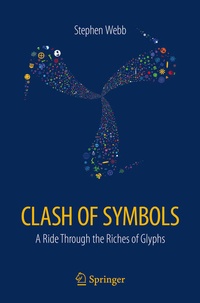
Clash of Symbols
Description

Yet, who would be readily able to answer any question like: 'who chose p to represent the ratio of a circle's diameter to its circumference?' or 'what's the reasoning behind having a ? key on my computer keyboard?' This book is precisely for those who have always asked themselves this sort of questions.
So, here are the stories behind one hundred glyphs, the book being evenly divided into five parts, with each featuring 20 symbols. Part 1, called Character sketches , looks at some of the glyphs we use in writing. Part 2, called Signs of the times , discusses some glyphs used in politics, religion, and other areas of everyday life. Some of these symbols are common; others are used only rarely. Some are modern inventions; others, which seem contemporary, can be traced back many hundreds of years. Part 3, called Signs and wonders , explores some of the symbols people have developed for use in describing the heavens. These are some of the most visually striking glyphs in the book, and many of them date back to ancient times. Nevertheless their use - at least in professional arenas - is diminishing. Part 4, called It's Greek to me , examines some symbols used in various branches of science. A number of these symbols are employed routinely by professional scientists and are also familiar to the general public; others are no longer applied in a serious fashion by anyone - but the reader might still meet them, from time to time, in older works. The final part of the book, Meaningless marks on paper , looks at some of the characters used in mathematics, the history of which one can easily appreciate with only a basic knowledge of mathematics.
There are obviously countless others symbols. In recent years the computing industry has developed Unicode and it currently contains more than 135 000 entries. This book would like to encourage the curious reader to take a stroll through Unicode, to meet many characters that will delight the eye and, researching their history, to gain some fascinating insights.
More details
Other editions
Additional editions
Person
His most recent book is All the Wonder that Would Be - Exploring Past Notions of the Future (2017), again published as part of Springer's Science and Fiction series.
