

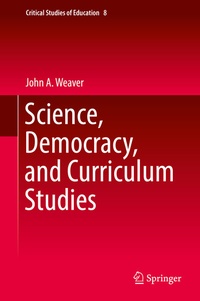
Science, Democracy, and Curriculum Studies
Description

In this book John A. Weaver suggests curriculum studies scholars need to engage more in science matters. It offers a review of science studies writing from Ludwick Fleck and Thomas Kuhn to Philip Mirowski. The volume includes chapters on the rhetoric of science with a focus on the history of rhetoric and economics then on the rhetoric of models, statistics, and data, a critique of neoliberalism and its impact on science policy and the foundations of democracy, Harry Collin's and Robert Evans' theory of expertise followed by chapters on feminism with a focus on the work of Sharon Traweek, Karen Barad, and Vinciane Despret, postcolonial thought, with attention paid to the work of Daniela Bleichmar, Londa Schiebinger, Judith Carney, Sylvia Wynter, Paul Gilroy, and Sandra Harding, and a final chapter on Nietzsche's philosophy of science. Each section is introduced by an interlude drawing on autobiographical connections between curriculum studies and science studies.
More details
Other editions
Additional editions
Content
Chapter One Introduction: Science, Democracy, and Curriculum Studies: Why (Not) Science Matters?.- Chapter Two From Kuhn to the Economics of Science: Curriculum Studies and Science Studies.- Chapter Three Homo Economicus, Rhetoric, and Curriculum Studies.- Chapter Four Observing Economics: The Rhetoric of Data, Models, and Statistics.- Chapter Five The Economics of Science, Neoliberal thought, and the Loss of Democracy.- Chapter Six (Post)Colonial Science.- Chapter Seven Working Our Way Back: Colonial Science in light of Postcolonial Thought.- Chapter Eight Of Hierarchies, Cultures of no Culture, Ontology, Protocols, and Anecdotes: (Re-Writing).- Chapter Nine Nietzsche's Science.
