

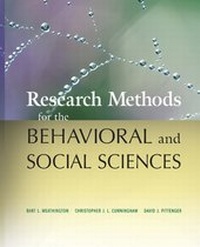
Research Methods for the Behavioral and Social Sciences
Description

More details
Other editions
Additional editions
Persons
Content
Preface xv
Acknowledgments xix
Part I Overview of the Research Process 1
Chapter 1 Research and the Social Sciences 3
Introduction 3
Why Is Understanding Research Methods So Important? 6
The Role of Science in Everyday Life 6
The Scientific Method 8
Brief History of the Science of Behavior 8
Bacon's Legacy 13
Other Important Historical Figures 13
Assumptions of Science 16
Requirements for Scientific Research 17
Research in Action: The Case of Facilitated Communication 23
Chapter Summary 26
Chapter Glossary for Review 29
Chapter References 30
Chapter 2 Ethics and Research 32
Introduction 32
What Is Ethics? 34
Approaches to Ethical Analysis 36
Making Ethical Decisions 41
The Ethical Code of the American Psychological Association 42
Seeking Approval for Research: The Institutional Review Board 44
Milgram's Experiment Revisited 52
Research with Animals 56
Research in Action: Ethical Dilemmas 58
Chapter Summary 62
Chapter Glossary for Review 64
Chapter References 64
Chapter 3 The Foundations of Research 66
Introduction 66
The Hypothesis in Research 67
Types of Hypotheses 72
Measurement 78
Reliability of Measurement 84
Validity of Measurement 87
Populations and Samples 90
Research in Action: Measuring Sexism 94
Chapter Summary 96
Chapter Glossary for Review 97
Chapter References 100
Chapter 4 An Overview of Empirical Methods 101
Introduction 101
Internal, Statistical Conclusion, and External Validity 102
Survey of Empirical Methods 113
Intact Groups Designs and Quasi-Experimental Studies 117
Surveys 120
Correlational Studies 121
Single-Participant Research Methods 122
Meta-Analysis 124
Computers and Statistics 126
Research in Action: Effectiveness of Psychotherapy 128
Chapter Summary 133
Chapter Glossary for Review 135
Chapter References 137
Part II Nuts and Bolts of Research 139
Chapter 5 Writing the Research Report 141
Introduction 141
What Do Readers Appreciate in Good Writing? 143
Elements of APA Style 143
Special Grammatical Issues 147
Academic Integrity 152
Parts of the Research Report 156
Proofreading 173
Chapter Summary 174
Chapter References 174
Chapter 6 Reviewing the Literature and Forming Hypotheses 175
Introduction 175
Bibliographic Research 175
The Internet 179
Developing a Search Strategy 181
Searching the Literature: The Library 182
Research in Action: Does Listening to Mozart Make You Smarter? 186
Statistical Inference and Testing Hypotheses 190
Chapter Summary 193
Chapter Glossary for Review 194
Chapter References 194
Chapter 7 Sampling: The First Steps in Research 196
Introduction 196
The Nature of Samples 197
Probability Sampling 199
Sampling Methods 201
Nonprobability Sampling 205
Central Limit Theorem 207
Applications of the Central Limit Theorem 211
Sources of Bias and Error: A Reprise 217
Research in Action: Trends in HIV-Related Risk Behaviors 220
Chapter Summary 224
Chapter Glossary for Review 225
Chapter References 227
Chapter 8 Creating and Using Assessments, Surveys, and Objective Measures 228
Introduction 228
Purpose of Measurement 228
Caveat Assessor 229
Creating a Measurement Scale and Developing a Data Collection Strategy 231
Interviews, Questionnaires, and Attitude Surveys 232
Question Response Formats 236
Writing Good Questionnaire and Survey Items 241
Determining the Sample Size for a Survey 246
Naturalistic Observation 249
Research in Action: Analysis of Assaults 255
Chapter Summary 260
Chapter Glossary for Review 261
Chapter References 262
Chapter 9 A Model for Research Design 265
Introduction 265
A Model for Research Design 266
What Is the Independent Variable? 272
What Is the Dependent Variable? 274
Are There Any Confounding Variables? 277
What Are the Research Hypotheses? 279
Mathematical Hypotheses 280
Evaluating Hypotheses 282
Evaluating Hypotheses: Practical Matters 284
Research in Action: Sex Differences and Memory for Emotional Events 289
Research in Action: Changing Attitudes by Writing Essays 290
Chapter Summary 291
Chapter Glossary for Review 293
Chapter References 295
Part III Common Research Designs 297
Chapter 10 Correlational Research 299
Introduction 299
Conceptual Review of Correlation 300
Pearson's r 302
Interpreting the Correlation Coefficient 302
Factors That Corrupt a Correlation Coefficient 304
Sample Size and the Correlation Coefficient 308
Applications of the Correlation Coefficient 310
Regression Analysis 315
Introduction to Mediation and Moderation 317
Regression to the Mean 318
Research in Action: Searching Short-Term Memory 321
Statistics behind the Research 323
Chapter Summary 331
Chapter Glossary for Review 333
Chapter References 334
Chapter 11 Between-Subjects Designs 335
Introduction 335
Student's t-Ratio for Independent Groups 336
Review of Hypothesis Testing 338
Testing Statistical Hypotheses 340
Common Errors in the Interpretation of p 348
The Power of a Test 350
Estimating Sample Size 355
Research in Action: Word Meaning and Memory 357
Statistics behind the Research 359
Chapter Summary 368
Chapter Glossary for Review 369
Chapter References 369
Chapter 12 Single-Variable Between-Subjects Research 371
Introduction 371
Independent Variable 372
Cause and Effect 374
Gaining Control over the Variables 375
The General Linear Model 379
Components of Variance 382
The F-Ratio 384
H0 and H1 387
F-Ratio Sampling Distribution 388
Summarizing and Interpreting ANOVA Results 389
Effect Size and Power 391
Multiple Comparisons of the Means 392
Research in Action: Detecting Lies 396
Statistics behind the Research 398
Chapter Summary 403
Chapter Glossary for Review 404
Chapter References 406
Chapter 13 Between-Subjects Factorial Designs 407
Introduction 407
The Logic of the Two-Variable Design 408
Advantages of the Two-Variable Design 409
Factorial Designs: Variables, Levels, and Cells 413
Examples of Factorial Designs 414
Main Effects and Interaction 418
Designing a Factorial Study 426
Identifying Samples and Estimating Sample Size 429
Interpreting the Interaction: Advanced Considerations 431
Research in Action: Reinforcing Creativity 432
Statistics behind the Research 434
Chapter Summary 441
Chapter Glossary for Review 441
Chapter References 442
Chapter 14 Correlated-Groups Designs 443
Introduction 443
Logic of the Correlated-Groups Research Design 444
Repeated-Measures Design 445
Matched-Groups Design 455
Mixed-Model Design 460
Research in Action: Memory for Related Words 461
Statistics behind the Research 463
Chapter Summary 465
Chapter Glossary for Review 468
Chapter References 469
Part IV Special Research Designs 471
Chapter 15 Single-Participant Experiments, Longitudinal Studies, and Quasi-Experimental Designs 473
Introduction 473
Single-Participant Experiments 475
Research in Action: Treatment for Panic Disorder 484
Longitudinal Designs 487
Research in Action: Onset of Bulimia 491
Quasi-Experiments 493
Research in Action: Traffic Laws and Safety 496
Chapter Summary 498
Chapter Glossary for Review 499
Chapter References 499
Chapter 16 Research with Categorical Data 502
Introduction 502
Goodness-of-Fit Test 504
x2 Test of Independence 508
x2 Test of Homogeneity 511
Further Analysis of the x2 513
McNemar Test 516
Research in Action: Long-Term Effects of Childhood Abuse 519
Chapter Summary 522
Chapter Glossary for Review 523
Chapter References 523
Chapter 17 Qualitative and Mixed-Methods Research 525
Introduction 525
Qualitative versus Quantitative Research 526
Theory and Perspectives Guiding Qualitative Research 527
Mixing Methods: Quantitative and Qualitative Combined 528
Qualitative and Mixed-Methods Data Collection and Analysis 530
Benefits and Challenges of Mixed-Methods Research 537
Sources of Published Qualitative and Mixed-Methods Research 541
Research in Action: Gender- and Job-Based Differences in Work Stress 542
Chapter Summary 545
Chapter Glossary for Review 545
Chapter References 546
Appendix A Statistics behind the Research or, "What Was I Supposed to Remember from My Statistics Class Anyway?" 548
Appendix B Statistical Tables 566
Appendix C Answers to Knowledge Check Questions 606
Author Index 637
Subject Index 641
Preface
The pursuit of knowledge requires no justification.
-David J. Pittenger
Ditto.
-Bart L. Weathington & Christopher J. L. Cunningham
Philosophy for Writing This Book
For those of us who teach research methods, one of the most gratifying experiences is watching students develop a passion for conducting research and an understanding of the practical value of systematic information gathering and decision making. These students discover that they can convert their natural curiosity about behavior into testable hypotheses. Moreover, they learn that studying research methodology is not arcane and irrelevant. Indeed, they come to appreciate the fundamental value and importance of empirical research. Because the vitality of science depends on the passion to learn more about behavior, it is our belief that a course in research methods is one of the most important courses that any student can take. Therefore, we wrote a book that we hoped would be attractive to students and convey to them our enthusiasm for research. To reach those goals, we strove to incorporate several features in our book.
Style
We wanted the book to be inviting and easily accessible for the reader. Therefore, we gladly used and active narrator voice to make the textbook as engaging and interesting as possible. There is a clear and conversational style to the text, but that does not reflect lack of rigor in the material. Throughout the text, we provide comprehensive accounts of scientists' best ideas and research methods.
Examples
Another strategy we used was to select familiar and contemporary examples. We based many of our examples on well-known social phenomena and on research that examines interesting topics. Our goal in selecting these examples was to illustrate important topics covered in the chapter and to show how researchers use research tools to answer complex and important questions.
Assumptions
Those familiar with parametric statistics know that they come with many mathematical strings attached. If the researcher cannot ensure that the data and the design of the data collection methods meet these basic assumptions, then the inferences derived from the statistical analysis may be suspect. In some cases, the statistic is extremely robust to violations of its assumptions. Other statistics fail to withstand even minor deviations from the requirements.
An assumption we made in writing this book is that that the reader using this book will have completed at least a general Introduction to Statistics course. Consequently, a certain level of statistical knowledge is assumed, especially the more basic concepts such as measures of central tendency, measures of dispersion, or standard scores. Nonetheless, many students seem to forget much after completing the final exam of their statistics course. This unfortunate phenomenon may mean that a single course in statistics is not enough to develop in students a sufficiently stalwart schema to ensure more efficient and durable encoding and retrieval of material. Therefore, this text does review critical statistical concepts as they relate to specific methodological techniques. Additionally, we included an appendix that can act as a statistics review.
A text should challenge students beyond their current ability. If education is not to extend the grasp of our students, then what is an education for? Thus, while we labored to write as clearly as we could, we also labored to ensure that we challenge students to extend beyond the bounds of their comfort and present to them the tools needed to understand contemporary behavioral research. In doing so, we hope that the instructor recognizes that he or she is not bound to teach every chapter or every topic in each chapter. This is a fairly thick book, and we hope that both student and instructor will recognize that it is a resource from which to draw information.
Integration of Research Methods and Statistical Concepts
It has been our common experience that many students begin a research methods course with only a vague notion of how the statistics they had studied in the prerequisite statistics course are related to research design. Over time, we found ourselves teaching concepts related to statistical analysis along with traditional concepts related to research methods. Indeed, a careful review of statistical techniques requires discussion of research methodology. Similarly, discussions of research design require a review of statistical principles.
Therefore, in writing this book, we wanted to ensure that students receive a comprehensive and detailed review of the best techniques for studying behavior and social phenomena. Consequently, where appropriate our chapters provide a comprehensive review of research methods and the statistical concepts that support them. The review of the statistical principles, while comprehensive, is conceptual and nontechnical. Students who have completed a course in statistics will find these sections to be a useful review of important topics. Students who have not studied statistics will find these sections a suitable and readable introduction to these topics.
For example, the review of sampling procedures examines the different methods researchers use to create representative samples and demonstrates how the Central Limit Theorem allows one to make valid inferences using sample statistics. Other topics receive recurring attention throughout the book, including the important concept of statistical power. The goal is to show students that they can control power by adjusting sample size and by gaining control over specific types of variance-increasing variance due to the independent variable and decreasing variance due to random or sampling error.
Order of Chapters
We arranged the sequence of chapters to both match the steps in conducting research and to aid readers in learning how to design and implement a research project. Consequently, the first few chapters present background information, ethics, and an overview of various research methods. Subsequent chapters review such topics as bibliographic research and methods for generating samples. The next set of chapters reviews how to create reliable and valid measurement instruments. Thus, there are separate chapters on creating tests and using correlation statistics to evaluate the reliability and validity of any measurement. The lessons learned in these chapters set the stage for all types of psychological research.
The subsequent chapters examine the issues and steps common to all single-factor and multifactor studies, as well as single-subject and non-experimental methods. Relatively early in the text is a chapter on how to prepare a paper that follows the editorial guidelines of the American Psychological Association. In most texts it is common to reserve this chapter for the end of the book. However, it has been our experience that waiting until the end of a course to talk about the most common form of final outcome (i.e., a written report) is simply too late for this material to take root. A concrete understanding of what the finished project should look like aids student researchers in learning about and planning a research project.
In writing this text, one of our goals was to allow instructors the flexibility to rearrange the order of the chapters without a loss of continuity. Ultimately the goal of a research methods course is to produce both informed consumers of existing research and informed producers of new or refined knowledge. We believe that the order of chapters aids in the completion of this goal, but some instructors may find that a different order of chapters better fits their style.
Pedagogy
Each chapter uses multiple methods to present the material, including clearly written text, familiar and interesting examples, and visual illustrations to help the reader understand complex and abstract concepts. The specific pedagogical features include:
- Research in Action: Each chapter includes case studies and critical thinking exercises. The goal of these exercises is to help the reader apply critical concepts to a research scenario.
- Knowledge Check: Each chapter contains several Knowledge Check questions, which consist of a series of questions that require the reader to apply the material to objective problems. These questions require more than rote memorization because they ask the reader to apply the material. Answers to these questions are provided in Appendix C.
- Multiple Presentations of Concepts: Throughout the book, the reader will find a combination of text, pictures, and examples to illustrate various concepts.
- Glossary: Each chapter contains definitions of important terms.
- Statistical Review and Integration: Appendix A is a statistics review designed to help students remember and understand basic statistical concepts. Additionally, many chapters have a section that deals with the statistics underlying the topics covered in that chapter.
- Statistical tables: Appendix B contains a comprehensive list of commonly used statistical tables.
Supplementary Materials
No textbook is complete without ancillary materials to aid the instructor in introducing course material to students. This is especially important for a text on research methods. Accordingly, a full set of PowerPoint slides, a Test Bank, and an instructor's manual are available to instructors through this book's website on Wiley's Higher Education site at www.wiley.com. Of particular note is the...
