

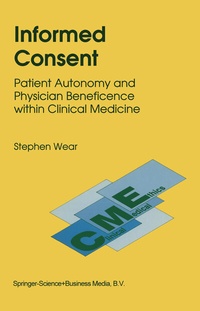
Informed Consent
Patient Autonomy and Physician Beneficence within Clinical Medicine
Published on 6. December 2012
XIII, 169 pages
978-94-015-8122-6 (ISBN)
Description

Substantial efforts have recently been made to reform the physician-patient relationship, particularly toward replacing the `silent world of doctor and patient' with informed patient participation in medical decision-making. This 'new ethos of patient autonomy' has especially insisted on the routine provision of informed consent for all medical interventions. Stronly supported by most bioethicists and the law, as well as more popular writings and expectations, it still seems clear that informed consent has, at best, been received in a lukewarm fashion by most clinicians, many simply rejecting what they commonly refer to as the `myth of informed consent'.
The purpose of this book is to defuse this seemingly intractable controversy by offering an efficient and effective operational model of informed consent. This goal is pursued first by reviewing and evaluating, in detail, the agendas, arguments, and supporting materials of its proponents and detractors. A comprehensive review of empirical studies of informed consent is provided, as well as a detailed reflection on the common clinician experience with attempts at informed consent and the exercise of autonomy by patients.
In the end, informed consent is recast as a management tool for pursuing clinically and ethically important goods and values that any clinician should see as meriting pursuit. Concurrently, the model incorporates a flexible, anticipatory approach that recognizes that no static, generic ritual can legitimately pursue the quite variable goods and values that may be at stake with different patients in different situations. Finally, efficiency of provision is addressed by not pursuing the unattainable and ancillary. Throughout, the traditional principle of beneficence is appealed to toward articulating an operational model of informed consent as an intervention that is likely to change outcomes at the bedside for the better.
The purpose of this book is to defuse this seemingly intractable controversy by offering an efficient and effective operational model of informed consent. This goal is pursued first by reviewing and evaluating, in detail, the agendas, arguments, and supporting materials of its proponents and detractors. A comprehensive review of empirical studies of informed consent is provided, as well as a detailed reflection on the common clinician experience with attempts at informed consent and the exercise of autonomy by patients.
In the end, informed consent is recast as a management tool for pursuing clinically and ethically important goods and values that any clinician should see as meriting pursuit. Concurrently, the model incorporates a flexible, anticipatory approach that recognizes that no static, generic ritual can legitimately pursue the quite variable goods and values that may be at stake with different patients in different situations. Finally, efficiency of provision is addressed by not pursuing the unattainable and ancillary. Throughout, the traditional principle of beneficence is appealed to toward articulating an operational model of informed consent as an intervention that is likely to change outcomes at the bedside for the better.
Reviews / Votes
` Stephen Wear, in this fine monograph, understands fully the problems with patient autonomy and informed consent. In fact he outlines with clarity the problems with complete informed consent ... In addition to Wear's informed consent process and the studies either supporting or not supporting its prevalence this book offers the reader a basic outline of medical ethics in regard to informed consent ... I recommend this book with great enthusiasm. 'The Journal of Medical Humanities, 16:2, 1995
More details
Series
Language
English
Place of publication
Dordrecht
Netherlands
Publishing group
Springer Netherland
Target group
Professional and scholarly
Product notice
Reflowable
Illustrations
XIII, 169 p.
File size
19,90 MB
ISBN-13
978-94-015-8122-6 (9789401581226)
DOI
10.1007/978-94-015-8122-6
Schweitzer Classification
Other editions
Additional editions
Book
12/1992
Kluwer Academic Publishers
€106.99
Shipment within 15-20 days
Content
I: The Sources of a Model of Informed Consent.- One: The Legal Doctrine of Informed Consent.- Two: The New Ethos of Patient Autonomy.- Three: The Clinical Experience of Patient Autonomy and Informed Consent.- Four: The Potential Benefits of Informed Consent.- II: A Model of Informed Consent.- Five: Toward a Model of Informed Consent - Theoretical and Programmatic Considerations.- Six: The Informed Consent Event.- Seven: The Issue of Competence.- Eight: Exceptions to Informed Consent.- Nine: The Enterprise of Informed Consent.
