

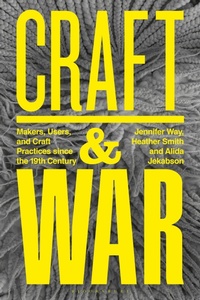
Craft and War
Makers, Users, and Craft Practices Since the 19th Century
1st Edition
Published on 14. May 2026
352 pages
978-1-350-34550-8 (ISBN)
Description

Examining the diverse ways in which craft has participated in wars from the mid-19th century to the present day, this book brings together a wealth of scholarship to redress an understudied area of modern craft history. Craft and War explores issues of fabrication, makers, objects, uses and users throughout conflicts across the world to provide a critical understanding of the relationship between craft and contexts of war.
Chapters look at the impact of colonization on making practices and acts of preserving cultural heritage in times of dislocation and migration. Authors provide insights into repurposing tools of oppression and the appropriation of material culture as a device of warfare, in addition to embroidery and tactics of resistance, and the role of craft and folk art in international feminist peace activism. Organized into four thematic sections, this book reveals how craft developed in different regions during and after armed conflicts, including research on trench art and objects, quilts and rugs commissioned in wartime, and ceramics and the art of commemoration. Craft and War also provides a breadth of analysis on crafting as a rehabilitative activity and traces government initiatives across different countries for postwar healing involving crafts.
This important contribution to modern craft history addresses multiple facets of a rich and complex subject to provide cross-national, cultural and chronological comparisons of craft's participation in situations of conflict and stages of war.
Chapters look at the impact of colonization on making practices and acts of preserving cultural heritage in times of dislocation and migration. Authors provide insights into repurposing tools of oppression and the appropriation of material culture as a device of warfare, in addition to embroidery and tactics of resistance, and the role of craft and folk art in international feminist peace activism. Organized into four thematic sections, this book reveals how craft developed in different regions during and after armed conflicts, including research on trench art and objects, quilts and rugs commissioned in wartime, and ceramics and the art of commemoration. Craft and War also provides a breadth of analysis on crafting as a rehabilitative activity and traces government initiatives across different countries for postwar healing involving crafts.
This important contribution to modern craft history addresses multiple facets of a rich and complex subject to provide cross-national, cultural and chronological comparisons of craft's participation in situations of conflict and stages of war.
More details
Edition
1. Auflage
Language
English
Place of publication
London
United Kingdom
Publishing group
Bloomsbury Publishing PLC
Target group
College/higher education
Professional and scholarly
Illustrations
59 colour illus.
ISBN-13
978-1-350-34550-8 (9781350345508)
Copyright in bibliographic data and cover images is held by Nielsen Book Services Limited or by the publishers or by their respective licensors: all rights reserved.
Schweitzer Classification
Other editions
Additional editions
Jennifer Way | Heather Smith | Alida Jekabson
Craft and War
Makers, Users, and Craft Practices since the 19th Century
Book
approx. 06/2026
Bloomsbury Visual Arts
€31.50
Not yet published
Persons
Jennifer Way is a scholar and educator in art history at the University of North Texas, USA. Her current research explores craft history and intersections of art with conflict, gender, race, caring, and healing, especially in U.S. and transnational settings from the 19th century to the present. She recently published chapters in Craft in Extremis: Survival and Creativity in Modern War and Genocide c. 1890-1950 (2026); Medical Care, Humanitarianism, and Intimacy in the Long Second World War, 1931-1953 (2025); Fallingwater: Living with and in Art (2025); Modernism, Art, Therapy (2024); and Boundaries: Transnational Exchanges through Art, Architecture, and Design from 1945 (2023).
Heather Smith has 30 years of experience working in art and history museums and art galleries in Canada. She organized numerous travelling exhibitions such as Quilting for a Cause: Red Cross Quilts for the Great War (2019); Vaughan Grayson an Artist in the Canadian Rockies (2006); Keepsakes of Conflict: Trench Art and Other Canadian War-Related Craft (2006); and Fred Strickland's War Sketches (2002). In 2013, she won the publisher of the year award from the Saskatchewan Book Awards for Hansen Ross Pottery: Pioneering Fine Craft on the Canadian Prairies (2012).
Alida R. Jekabson is a PhD Candidate in the History of Art and Architecture at the University of California, Santa Barbara, USA. Her research explores histories of modern craft and consumer culture in the United States and occupied territories, exploring textiles and their role as mediators of value.
Heather Smith has 30 years of experience working in art and history museums and art galleries in Canada. She organized numerous travelling exhibitions such as Quilting for a Cause: Red Cross Quilts for the Great War (2019); Vaughan Grayson an Artist in the Canadian Rockies (2006); Keepsakes of Conflict: Trench Art and Other Canadian War-Related Craft (2006); and Fred Strickland's War Sketches (2002). In 2013, she won the publisher of the year award from the Saskatchewan Book Awards for Hansen Ross Pottery: Pioneering Fine Craft on the Canadian Prairies (2012).
Alida R. Jekabson is a PhD Candidate in the History of Art and Architecture at the University of California, Santa Barbara, USA. Her research explores histories of modern craft and consumer culture in the United States and occupied territories, exploring textiles and their role as mediators of value.
Content
List of Figures
Acknowledgements
Introduction
Part I. Reviving Presence
1. Eco-critical Entanglements: San Pottery, Genocide, Historical Archaeology, and Indigenous Knowledge, Wendy Gers (Hanze University of Applied Sciences, the Netherlands)
2. Material Recovery through Hand-Built Talismans and Other Sensing Objects, Cindy Mochizuki (Independent Scholar, Canada)
Part II. Making Do
3. Crafting War, Handling Conflict: Trench Art, from Object to Embodied World, Nicholas J. Saunders (University of Bristol, UK)
4. Textile Handicrafts as Tactics of Resistance in and after Auschwitz: The Example of Lisa Pinhas in Context, Anne Röhl (University of Siegen, Germany)
5. An Aesthetic Ecosystem in Adrian Pepe's Untitled Braided Shearlings: Art and Resilience in Lebanon, Jessica Gershultz (University of St Andrews, UK)
Part III. Craft in Displacement
6. Passing the Thread: Craft and Latvian National Dress in Post-War Displaced Communities, Alida Jekabson (University of California, Santa Barbara, USA)
7. Memory, Mediation, and Affordances in Colombia's Mampuján Tapestries, Antonio Sánchez Gómez (Parsons School of Design, The New School, USA)
Part IV. Organizing Women
8. Intermediaries of Craft in 20th Century Morocco and Algeria, Maia Nichols (University of California, San Diego, USA)
9. Quilting for a Cause: Forgetting and Remembering First World War Signature Fundraising Quilts in Canada, Heather Smith (Western University, Canada)
10. Another History of Indian Handicraft: Partition of India, Rehabilitation, and Women's Work, Chandan Bose (Indian Institute of Technology, India)
Part V. Craft and Healing
11. Modern Craft in the Aftermath of War: The Case of the Disabled Soldiers' Embroidery Industry, 1918-1971, Joseph McBrinn (Ulster University, UK)
12. Craft Therapy, Imperialism, and the Second World War: From Cairo Military Hospitals to MoMA, New York, Imogen Wiltshire (University of Lincoln, UK)
13. Clay and Combat: Exploring the Embodied Experience of War through Ceramic Practice, Christopher McHugh (Ulster University, UK)
Part VI. Politics of Friendship
14. A Rose-Colored Reunion: Craft in White-Civil War Veteran Reconciliation, Sarah Ann Burgos (Museum of the Virginia National Guard, USA)
15. Women's Caravan of Peace, 1958: Craft, Folk art, and sisterhood fighting the Cold War Divide, Valeria Fulop-Pochon (University of Bristol, UK)
16. Exhibiting Diplomacy in Cold War North Korea: The Role of Craft and Juche in North Korea's International Friendship Exhibition, Karlee Bergendorff (Duke University, USA)
List of Contributors
Index
Acknowledgements
Introduction
Part I. Reviving Presence
1. Eco-critical Entanglements: San Pottery, Genocide, Historical Archaeology, and Indigenous Knowledge, Wendy Gers (Hanze University of Applied Sciences, the Netherlands)
2. Material Recovery through Hand-Built Talismans and Other Sensing Objects, Cindy Mochizuki (Independent Scholar, Canada)
Part II. Making Do
3. Crafting War, Handling Conflict: Trench Art, from Object to Embodied World, Nicholas J. Saunders (University of Bristol, UK)
4. Textile Handicrafts as Tactics of Resistance in and after Auschwitz: The Example of Lisa Pinhas in Context, Anne Röhl (University of Siegen, Germany)
5. An Aesthetic Ecosystem in Adrian Pepe's Untitled Braided Shearlings: Art and Resilience in Lebanon, Jessica Gershultz (University of St Andrews, UK)
Part III. Craft in Displacement
6. Passing the Thread: Craft and Latvian National Dress in Post-War Displaced Communities, Alida Jekabson (University of California, Santa Barbara, USA)
7. Memory, Mediation, and Affordances in Colombia's Mampuján Tapestries, Antonio Sánchez Gómez (Parsons School of Design, The New School, USA)
Part IV. Organizing Women
8. Intermediaries of Craft in 20th Century Morocco and Algeria, Maia Nichols (University of California, San Diego, USA)
9. Quilting for a Cause: Forgetting and Remembering First World War Signature Fundraising Quilts in Canada, Heather Smith (Western University, Canada)
10. Another History of Indian Handicraft: Partition of India, Rehabilitation, and Women's Work, Chandan Bose (Indian Institute of Technology, India)
Part V. Craft and Healing
11. Modern Craft in the Aftermath of War: The Case of the Disabled Soldiers' Embroidery Industry, 1918-1971, Joseph McBrinn (Ulster University, UK)
12. Craft Therapy, Imperialism, and the Second World War: From Cairo Military Hospitals to MoMA, New York, Imogen Wiltshire (University of Lincoln, UK)
13. Clay and Combat: Exploring the Embodied Experience of War through Ceramic Practice, Christopher McHugh (Ulster University, UK)
Part VI. Politics of Friendship
14. A Rose-Colored Reunion: Craft in White-Civil War Veteran Reconciliation, Sarah Ann Burgos (Museum of the Virginia National Guard, USA)
15. Women's Caravan of Peace, 1958: Craft, Folk art, and sisterhood fighting the Cold War Divide, Valeria Fulop-Pochon (University of Bristol, UK)
16. Exhibiting Diplomacy in Cold War North Korea: The Role of Craft and Juche in North Korea's International Friendship Exhibition, Karlee Bergendorff (Duke University, USA)
List of Contributors
Index
