

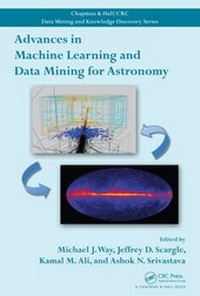
Advances in Machine Learning and Data Mining for Astronomy
1st Edition
Published on 29. March 2012
744 pages
978-1-4398-4174-7 (ISBN)
Description

Advances in Machine Learning and Data Mining for Astronomy documents numerous successful collaborations among computer scientists, statisticians, and astronomers who illustrate the application of state-of-the-art machine learning and data mining techniques in astronomy. Due to the massive amount and complexity of data in most scientific disciplines
Reviews / Votes
"The volume is a well-organised collection of articles presenting the importance of modern data mining and machine learning techniques in application to analysis of astronomical data. ... A major strength of the volume is its very impressive collection of real examples that can be both inspirational and educational. ... The book is particularly successful in showing how collaboration between computer scientists and statisticians on one side and astronomers on the other is needed to search for a scientific discovery in the abundance of data generated by instrumentation and simulations."-Krzysztof Podgorski, International Statistical Review, 2014
More details
Series
Edition
1. Auflage
Language
English
Place of publication
London
United Kingdom
Publishing group
Taylor & Francis Ltd
Target group
College/higher education
Astronomers, solar physicists, space scientists, astrophysicists, planetary scientists, cosmologists, computer scientists, statisticians, earth scientists, and remote sensing specialists.
Illustrations
177 s/w Abbildungen, 33 farbige Abbildungen, 15 s/w Tabellen
177 b/w images, 33 color images, 15 tables and 450-550 equations
File size
18,63 MB
ISBN-13
978-1-4398-4174-7 (9781439841747)
Copyright in bibliographic data and cover images is held by Nielsen Book Services Limited or by the publishers or by their respective licensors: all rights reserved.
Schweitzer Classification
Other editions
Additional editions
Michael J. Way | Jeffrey D. Scargle | Kamal M. Ali
Advances in Machine Learning and Data Mining for Astronomy
Book
11/2016
CRC Press
€128.40
Shipment within 10-20 days
Michael J. Way | Jeffrey D. Scargle | Kamal M. Ali
Advances in Machine Learning and Data Mining for Astronomy
Book
03/2012
1st Edition
Chapman & Hall/CRC
€184.50
Shipment within 15-20 days
Persons
Michael J. Way, PhD, is a research scientist at the NASA Goddard Institute for Space Studies in New York and the NASA Ames Research Center in California. He is also an adjunct professor in the Department of Physics and Astronomy at Hunter College. His research focuses on understanding the multiscale structure of our universe, modeling the atmospheres of exoplanets, and applying kernel methods to new areas in astronomy.
Jeffrey D. Scargle, PhD, is an astrophysicist in the Space Science and Astrobiology Division of the NASA Ames Research Center. His main interests encompass the variability of astronomical objects, including the Sun, sources in the Galaxy, and active galactic nuclei; cosmology; plasma astrophysics; planetary detection; and data analysis and statistical methods.
Kamal M. Ali, PhD, is a research scientist in machine learning and data mining. He has a consulting practice and is cofounder of the start-up Metric Avenue. He has carried out research at IBM Almaden, Stanford University, Vividence, Yahoo, and TiVo, where he worked on the Tivo Collaborative Filtering Engine. His current research focuses on combining machine learning in conditional random fields with linguistically rich features to make machines better at reading web pages.
Ashok N. Srivastava, PhD, is the principal scientist for Data Mining and Systems Health Management and leader of the Intelligent Data Understanding group at NASA Ames Research Center. His research includes the development of data mining algorithms for anomaly detection in massive data streams, kernel methods in machine learning, and text mining algorithms.
Jeffrey D. Scargle, PhD, is an astrophysicist in the Space Science and Astrobiology Division of the NASA Ames Research Center. His main interests encompass the variability of astronomical objects, including the Sun, sources in the Galaxy, and active galactic nuclei; cosmology; plasma astrophysics; planetary detection; and data analysis and statistical methods.
Kamal M. Ali, PhD, is a research scientist in machine learning and data mining. He has a consulting practice and is cofounder of the start-up Metric Avenue. He has carried out research at IBM Almaden, Stanford University, Vividence, Yahoo, and TiVo, where he worked on the Tivo Collaborative Filtering Engine. His current research focuses on combining machine learning in conditional random fields with linguistically rich features to make machines better at reading web pages.
Ashok N. Srivastava, PhD, is the principal scientist for Data Mining and Systems Health Management and leader of the Intelligent Data Understanding group at NASA Ames Research Center. His research includes the development of data mining algorithms for anomaly detection in massive data streams, kernel methods in machine learning, and text mining algorithms.
Content
Part I Foundational Issues. Part II Astronomical Applications: Source Identification. Classification. Signal Processing (Time-Series) Analysis. The Largest Data Sets. Part III Machine Learning Methods. Index.
