

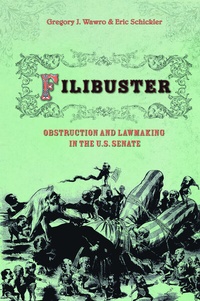
Filibuster
Obstruction and Lawmaking in the U.S. Senate
1st Edition
Published on 24. October 2013
328 pages
978-1-4008-4947-5 (ISBN)
Description

Parliamentary obstruction, popularly known as the "filibuster," has been a defining feature of the U.S. Senate throughout its history. In this book, Gregory J. Wawro and Eric Schickler explain how the Senate managed to satisfy its lawmaking role during the nineteenth and early twentieth century, when it lacked seemingly essential formal rules for governing debate.
What prevented the Senate from self-destructing during this time? The authors argue that in a system where filibusters played out as wars of attrition, the threat of rule changes prevented the institution from devolving into parliamentary chaos. They show that institutional patterns of behavior induced by inherited rules did not render Senate rules immune from fundamental changes.
The authors' theoretical arguments are supported through a combination of extensive quantitative and case-study analysis, which spans a broad swath of history. They consider how changes in the larger institutional and political context--such as the expansion of the country and the move to direct election of senators--led to changes in the Senate regarding debate rules. They further investigate the impact these changes had on the functioning of the Senate. The book concludes with a discussion relating battles over obstruction in the Senate's past to recent conflicts over judicial nominations.
What prevented the Senate from self-destructing during this time? The authors argue that in a system where filibusters played out as wars of attrition, the threat of rule changes prevented the institution from devolving into parliamentary chaos. They show that institutional patterns of behavior induced by inherited rules did not render Senate rules immune from fundamental changes.
The authors' theoretical arguments are supported through a combination of extensive quantitative and case-study analysis, which spans a broad swath of history. They consider how changes in the larger institutional and political context--such as the expansion of the country and the move to direct election of senators--led to changes in the Senate regarding debate rules. They further investigate the impact these changes had on the functioning of the Senate. The book concludes with a discussion relating battles over obstruction in the Senate's past to recent conflicts over judicial nominations.
More details
Edition
Course Book
Language
English
Place of publication
Princeton, NJ
United States
Publishing group
De Gruyter
Target group
Professional and scholarly
Edition type
Digital original
Illustrations
26 line illus. 35 tables.
File size
1,55 MB
ISBN-13
978-1-4008-4947-5 (9781400849475)
Schweitzer Classification
Other editions
Additional editions
Book
09/2007
Princeton University Press
€39.50
Article not available at the moment
Book
03/2006
Princeton University Press
€55.71
Article exhausted; check different version
Persons
Gregory J. Wawro is Associate Professor of Political Science at Columbia University. He is the author of Legislative Entrepreneurship in the U.S. House of Representatives. Eric Schickler is professor of political science at the University of California, Berkeley. He is the author of Disjointed Pluralism: Institutional Innovation and the Development of the U.S. Congress and coauthor of Partisan Hearts and Minds: Political Parties and the Social Identity of Voters.
Content
FrontMatter, pg. i
Contents, pg. v
List of Tables, pg. vii
List of Figures, pg. ix
Preface, pg. xi
Chapter 1. Introduction, pg. 1
Chapter 2. Obstruction in Theoretical Context, pg. 25
Chapter 3. The Mutability of Senate Rules, pg. 61
Chapter 4. Where's the Pivot?, pg. 89
Chapter 5. Dilatory Motions and the Success of Obstruction, pg. 109
Chapter 6. Obstruction and the Tariff, pg. 127
Chapter 7. Slavery and Obstruction in the Antebellum Senate, pg. 159
Chapter 8. Obstruction and Institutional Change, pg. 181
Chapter 9. Cloture Reform Reconsidered, pg. 211
Chapter 10. The Impact of Cloture on the Appropriations Process, pg. 237
Chapter 11. Conclusion, pg. 259
Bibliography, pg. 285
Index, pg. 303
Contents, pg. v
List of Tables, pg. vii
List of Figures, pg. ix
Preface, pg. xi
Chapter 1. Introduction, pg. 1
Chapter 2. Obstruction in Theoretical Context, pg. 25
Chapter 3. The Mutability of Senate Rules, pg. 61
Chapter 4. Where's the Pivot?, pg. 89
Chapter 5. Dilatory Motions and the Success of Obstruction, pg. 109
Chapter 6. Obstruction and the Tariff, pg. 127
Chapter 7. Slavery and Obstruction in the Antebellum Senate, pg. 159
Chapter 8. Obstruction and Institutional Change, pg. 181
Chapter 9. Cloture Reform Reconsidered, pg. 211
Chapter 10. The Impact of Cloture on the Appropriations Process, pg. 237
Chapter 11. Conclusion, pg. 259
Bibliography, pg. 285
Index, pg. 303
