

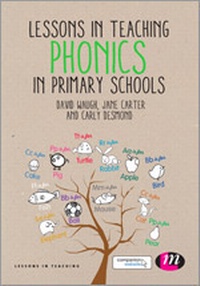
Lessons in Teaching Phonics in Primary Schools
1st Edition
Published on 26. September 2015
176 pages
978-1-4739-2707-0 (ISBN)
Description

Lesson planning in line with the new Primary National Curriculum!
Phonics is taught every day in primary schools across England. It is fully embedded in the National Curriculum and is a huge part of teaching children to read. How do you ensure that you understand both what and how to teach? How do you separate good phonics teaching from the many phonics schemes that are used? What does a good phonics lesson look like? This text provides exemplar lessons in phonics and supports you to teach tricky words, alternative spellings, and pronunciation as well as addressing other phonics teaching challenges. It explores the most popular phonics schemes and shows you how good phonics teaching works across schemes. The adaptable and inspired lesson plans included, highlight how phonics teaching can be fun, offering ideas for teaching phonics outdoors, whole class phonics teaching and nonsense words. Did you know that this book is part of the Lessons in Teaching series?
WHAT IS THE LESSONS IN TEACHING SERIES?
Suitable for any teacher at any stage of their career, the books in this series are packed with great ideas for teaching engaging, outstanding lessons in your primary classroom. The Companion Website accompanying the series includes extra resources including tips, lesson starters, videos and Pinterest boards.
Books in this series: Lessons in Teaching Grammar in Primary Schools, Lessons in Teaching Computing in Primary Schools, Lessons in Teaching Number and Place Value in Primary Schools, Lessons in Teaching Reading Comprehension in Primary Schools, Lesson in Teaching Phonics in Primary Schools
Phonics is taught every day in primary schools across England. It is fully embedded in the National Curriculum and is a huge part of teaching children to read. How do you ensure that you understand both what and how to teach? How do you separate good phonics teaching from the many phonics schemes that are used? What does a good phonics lesson look like? This text provides exemplar lessons in phonics and supports you to teach tricky words, alternative spellings, and pronunciation as well as addressing other phonics teaching challenges. It explores the most popular phonics schemes and shows you how good phonics teaching works across schemes. The adaptable and inspired lesson plans included, highlight how phonics teaching can be fun, offering ideas for teaching phonics outdoors, whole class phonics teaching and nonsense words. Did you know that this book is part of the Lessons in Teaching series?
WHAT IS THE LESSONS IN TEACHING SERIES?
Suitable for any teacher at any stage of their career, the books in this series are packed with great ideas for teaching engaging, outstanding lessons in your primary classroom. The Companion Website accompanying the series includes extra resources including tips, lesson starters, videos and Pinterest boards.
Books in this series: Lessons in Teaching Grammar in Primary Schools, Lessons in Teaching Computing in Primary Schools, Lessons in Teaching Number and Place Value in Primary Schools, Lessons in Teaching Reading Comprehension in Primary Schools, Lesson in Teaching Phonics in Primary Schools
More details
Other editions
Additional editions
David Waugh | Jane Carter | Carly Desmond
Lessons in Teaching Phonics in Primary Schools
Book
08/2015
1st Edition
Learning Matters Ltd
€124.20
Shipment within 15-20 days
Persons
Author
University of Durham
David Waugh is a Senior Teaching Fellow at the the School of Education, University of Durham where he is also the subject leader for primary English.
David Waugh is a Senior Teaching Fellow at the the School of Education, University of Durham where he is also the subject leader for primary English.
University of the West of England, Bristol, UK
Jane is a former deputy head teacher and literacy consultant for the National Strategies in Bristol. She is now a senior lecturer in primary education at the University of the West of England. She was recently awarded the Higher Education Academy Teaching Fellowship Award.
Jane is a former deputy head teacher and literacy consultant for the National Strategies in Bristol. She is now a senior lecturer in primary education at the University of the West of England. She was recently awarded the Higher Education Academy Teaching Fellowship Award.
Carly Desmond is an expert primary school teacher. Carly recently presented at a national conference on the new National Curriculum for English.
Content
Introduction
Why phonics?
Phonics in context
Reception: Developing phonemic awareness
Reception: Beginning to read and write using CVC words
Year 1: Teaching grapheme-phoneme correspondences
Year 1: Long vowel digraphs
Year 1: Decoding and encoding text
Years 1 and 2: Morphemes - prefixes, suffixes and root words
Year 2: Homophones and contractions
Year 2: Phonics into spelling
Teaching tricky or common exception words
Moving on
Why phonics?
Phonics in context
Reception: Developing phonemic awareness
Reception: Beginning to read and write using CVC words
Year 1: Teaching grapheme-phoneme correspondences
Year 1: Long vowel digraphs
Year 1: Decoding and encoding text
Years 1 and 2: Morphemes - prefixes, suffixes and root words
Year 2: Homophones and contractions
Year 2: Phonics into spelling
Teaching tricky or common exception words
Moving on
