

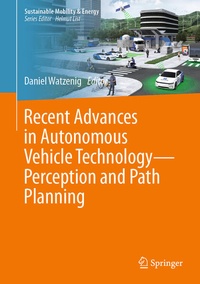
Recent Advances in Autonomous Vehicle Technology-Perception and Path Planning
Description

In autonomous vehicles, perception and planning are core systems enabling safe, efficient navigation. Perception interprets surroundings using data from sensors like cameras, radar, and LiDAR to detect and classify objects, traffic signs, road boundaries, and environmental conditions. Advances in machine learning and computer vision continue to improve perception accuracy and reliability. Planning determines the vehicle's actions via route, behavioral, and motion planning to safely reach its destination. Seamless integration of perception and planning is essential, relying on fast, reliable data exchange through low-latency, high-dependability frameworks. This book presents the latest technologies in perception and planning, emphasizing their integration and highlighting innovations. It serves researchers, students, engineers, ICT professionals, and industry leaders alike.
More details
Other editions
Additional editions
Person
Daniel Watzenig , born in Austria, holds a PhD in electrical engineering and habilitation from Graz University of Technology, where he is Full Professor of Multi-Sensor Perception of Autonomous Systems. He is CTO at Virtual Vehicle Research, Graz. His work focuses on robotics, sensor fusion, continual learning, and decision-making under uncertainty. Author of 200+ publications, he is Editor-in-Chief of the SAE JCAV, guest lecturer at Stanford and Tongji Universities, founder of Autonomous Racing Graz Team, IEEE Austria Vice Chair, and defense robotics consultant to Austria's military.
Content
Scenario-based quantification of the impact of automated vehicles on traffic.- Adversial exapmles in environment perception for automated driving.- Stable resampling strategies for radar-based dynamic occupancy grids.- Local point cloud features for LiDAR self-supervised representation learning.- On torque-vectoring control for the obstacle avoidance scenario.- Performance evaluation of path tracking controllers for scaled robotic cars.- A nonlinear dead-time compensation method for path tracking control.
