

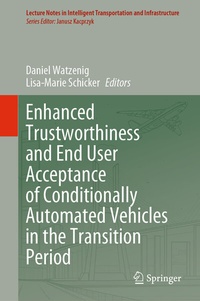
Enhanced Trustworthiness and End User Acceptance of Conditionally Automated Vehicles in the Transition Period
Description

A key factor for the introduction of (conditionally) automated vehicles is a high level of trust in and acceptance of these vehicles by the end-user. To bring such so-called TrustVehicles on the road, the end-users and their expectations have to be strongly taken into consideration by, for instance, developing driver interfaces as well as reliable and robust automated driving controllers. The main topics of the book are ranging from the question of how these TrustVehicles should behave and interact with users, the development of reliable sense-plan-act approaches, the whole verification procedures starting with simulation to studies on the driving simulator and the verification on a test track. All these steps together provide an overall picture and pave the way to trustworthy and reliable automated vehicles - so-called TrustVehicles.
More details
Other editions
Additional editions
Persons
Daniel Watzenig was born in Austria. He received his Master's degree in electrical engineering and the doctoral degree in technical science from Graz University of Technology, Graz, Austria, in 2002 and 2006, respectively. In 2009 he received the venia docendi (habilitation) for Electrical Measurement and Signal Processing. Since 2017 he is a Full Professor of Automated Driving at the Institute of Automation and Control, Graz University of Technology, Austria. In addition, he is Divisional Director and Scientific Head of the Automotive Electronics and Software Department of the Virtual Vehicle Research Center in Graz. Since 2015, he is Vice President of the ARTEMIS Industry Association (European Research Association on Embedded Control Systems). His research interests focus on sense & control of automated vehicles, signal processing, sensor fusion, and uncertainty estimation. He is author or co-author of over 170 peer-reviewed papers, book chapters, patents, and articles. In2016, he published the book "Automated Driving - safer and more efficient future driving" describing the state-of-the-art of this emerging technology. He is a member of the editorial board of the Journal Inverse Problems in Science and Engineering and Editor-in-Chief of the SAE Int. Journal on Connected and Automated Vehicles (SAE JCAV). He is IEEE Senior Member of the IEEE Control Systems, Signal Processing and Instrumentation & Measurement Societies.
Lisa-Marie Schicker was born in Austria. After obtaining her Master's degree in Global Studies from the University of Graz in 2015, she started working for the department of E/E & Software at the Virtual Vehicle Research Center in Graz. In 2019, she is received her Master's degree in European Project and Public Management at FH Joanneum, Graz. She is responsible for managing and disseminating Horizon 2020 projects mainly in the field of automated driving.
