

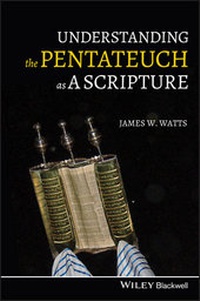
Understanding the Pentateuch as a Scripture
Description

More details
Other editions
Additional editions
Person
Content
PREFACE
The title of this book, Understanding the Pentateuch as a Scripture, requires some explanation. Chapter 1 will give attention to defining the nouns, "Pentateuch" and "scripture," and their relationship to another name for this literature, "the Torah." Here I need to explain why I chose this phrase for the title of this book, and particularly why "scripture" is preceded by the indefinite article, "a."
Biblical studies is an ancient and flourishing field. Scholars put great effort into explaining the language, meaning, and history of biblical books down to their tiniest detail. They have done so for more than 2,000 years and continue to do so today. The published literature on the Pentateuch is vast, and keeps growing.
Yet little of this research focuses on how the Bible, much less the Pentateuch, functions as a scripture. Biblical scholars tend to concentrate on the meaning of biblical texts within the literary contexts of individual books and within their original historical settings in ancient Israel, Second Temple Judaism, and early Christianity.
Forty years ago, the historian of religions Wilfred Cantwell Smith criticized biblical scholars for focusing only "on the Bible in its pre-scriptural phase." He wanted to position biblical studies within research on religions generally, rather than just within the study of Judaism and Christianity. Smith called for studying "the Bible as scripture" in comparison with other religious scriptures, such as the Qur'an, the Vedas, the Bhagavad Gita, the Buddhist sutras, and the Sikh's Guru Granth Sahib. He understood that a religious studies context would draw more attention to how people in various times and places have interpreted the Bible. It would also highlight how they have used it in their personal and communal rituals, in their art and theater, in their economic activities, and in their politics.
One of Smith's students, William Graham, took such a religious studies approach to scriptures by comparing their oral performances in various traditions. Noting the importance of oral recitation to Muslims' veneration of the Qur'an and to Hindu Brahmins' use of the Vedas, Graham also observed the prominent role that reading scripture aloud plays in Jewish and Christian worship. He thought that modern publishing had obscured the importance of oral performance of scriptures. He argued that oral performance, more than interpretation, established and maintained a text's status as scripture within a religious community.1
Another academic movement that takes seriously the Bible's function as scripture is canonical criticism, which is oriented towards theology rather than religious studies. Brevard Childs wrote a book with a title similar to this one, Introduction to the Old Testament as Scripture (1979), in which he advocated a canonical approach to biblical interpretation. Childs argued that reading the Bible "as scripture" should focus on its theological meaning within the context of the Jewish or Christian canons as a whole. While he employed the full range of historical tools to understand the development of biblical texts, Childs emphasized that its final canonical form should be decisive for its religious meaning. Childs has been much more influential than Smith on biblical scholarship. It is fair to say, however, that neither Child's nor Smith's approaches dominate the field.2
What has changed in biblical research over the past 30 years is that more attention is being directed at the history of the Bible's interpretation. Such studies often include not only its interpretation by theologians and preachers, but also its use by artists and creative writers of poetry, novels, plays, and films. This trend has spawned several new journals in the field, such as Biblical Interpretation, Postscripts: The Journal of Sacred Texts and Contemporary Worlds, and Biblical Reception. Prominent book series, such as the Blackwell Bible Commentaries, focus on reception history. Some of this research takes a theological interest in the history of Jewish and Christian religious traditions that resembles Childs' canonical approach. But much of this research abstains from theological commitments, and discusses instead the cultural influence of the Bible in religious and secular contexts.
Nevertheless, biblical scholarship remains focused on interpretation, that is, on how people have understood the meaning of the Bible's words and utilized them in various ways. Much less research focuses on how people perform those words in religious and secular contexts, and even less on how they make use of the physical books of Jewish and Christian scriptures: Torah scrolls, tanaks and bibles. Performance Criticism has gained a foothold among biblical scholars, but still tends to reconstruct the original performance settings of particular books more than the history of biblical performances. Outside of biblical scholarship, the rise of book history as an academic discipline has drawn attention to the history of religious publishing and reading since the adoption of mass printing in the fifteenth century. But very little has been done to integrate these strands into a unified account of how the Bible functions in religious and secular cultures as a scripture.
I was a student of Brevard Childs during my PhD studies. I was drawn to his work because he focused on scripture as the defining characteristic of the Bible. Like him, I think biblical scholars should give more attention to the Bible's status as Jewish and Christian scripture, because that is what attracts people's attention in the first place. Were it not for the Bible's contemporary prestige and influence, the field of biblical studies would be a minor part of the study of ancient Middle Eastern literature rather than a subject of popular and scholarly interest around the world.
I have, however, spent my teaching career in departments of religious studies, first at Hastings College and then at Syracuse University. That context has shown me the benefits of comparing the Bible's scriptural status with the scriptures of other religions. Comparison reveals similar strategies for using sacred texts across cultures, even when the literary contents and theological meaning of the books differ dramatically.
For the past 15 years, I have engaged with a growing number of collaborators in a research project on the social uses of books and other written texts. Originally called the Iconic Books Project, it has more recently evolved into a scholarly association, the Society for Comparative Research on Iconic and Performative Texts (SCRIPT). We do research on how physical books get manipulated and depicted as well as on oral performances and their artistic illustration, and the social effects of these activities. The early results of this research were brought together in several journal issues and then in the collection Iconic Books and Texts (2013). This collaboration continues to produce innovative research by scholars working on a wide variety of religions, cultures, and time periods.3
Understanding the Pentateuch as a Scripture brings this comparative research on textual performances and iconic books into Pentateuchal studies. Applying comparative scripture studies to the Pentateuch is productive because the Pentateuch was the first part of the Bible to function as a scripture and its example has influenced the use of all subsequent scriptures in Western religious traditions. In this book, I bring historical and literary biblical criticism and the history of the Bible's cultural reception into interaction with the comparative study of scriptures. The results integrate what we know about the Pentateuch as an ancient Middle Eastern document with what we know about its material, oral, artistic, ritual, and interpretive uses today.
So I use an indefinite pronoun in the title of this book, ". as a Scripture," to indicate a comparative perspective on the Pentateuch's scriptural function. This, then, is not the canonical approach to scripture that I learned from Professor Childs. I am very grateful for his instruction and support, and I do not discount the importance of theological interpretation of the Bible for Jewish and Christian audiences. I simply think that a comparative analysis allows us to understand its influence and function in ways that theological interpretation does not.
This book introduces innovative ways of thinking about biblical literature as well as surveying established conclusions in the field. That combination might seem strange in an introductory textbook. In the field of biblical studies, however, an "introduction" has long served to provide a critical evaluation of the state of the field. It shows how biblical studies should go forward as well as surveys where it has been. This book follows in that tradition by demonstrating how the study of the Pentateuch can be re-envisioned from a religious studies perspective on comparative scriptures. It show that research on the Pentateuch's scriptural function can integrate investigations of its origins with its cultural history. The results illuminate its contemporary interpretation in the academy as well as in synagogues, in churches, and in the wider culture.
I hope this book will be read with interest by people in many different settings. It has, however, been organized with classroom instruction in mind. Instructors might use this book at the beginning...
