

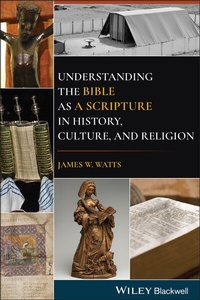
Understanding the Bible as a Scripture in History, Culture, and Religion
Description

The Bible is a popular subject of study and research, yet biblical studies gives little attention to the reason for its popularity: its religious role as a scripture. Understanding the Bible as a Scripture in History, Culture, and Religion integrates the history of the religious interpretation and ritual uses of biblical books into a survey of their rhetoric, composition, and theology in their ancient contexts. Emphasizing insights from comparative studies of different religious scriptures, it combines discussion of the Bible's origins with its cultural history into a coherent understanding of its past and present function as a scripture.
A prominent expert on biblical rhetoric and the ritualization of books, James W. Watts describes how Jews and Christians ritualize the Bible by interpreting it, by expressing it in recitations, music, art, and film, and by venerating the physical scroll and book. The first two sections of the book are organized around the Torah and the Gospels--which have been the focus of Jewish and Christian ritualization of scriptures from ancient to modern times--and treat the history of other biblical books in relation to these two central blocks of the Hebrew Bible and New Testament. In addition to analyzing the semantic contents of all the Bible's books as persuasive rhetoric, Watts describes their ritualization in the iconic and expressive dimensions in the centuries since they began to function as a scripture, as well as in their origins in ancient Judaism and Christianity. The third section on the cultural history and scriptural function of modern bibles concludes by discussing their influence today and the controversies they have fueled about history, science, race, and gender.
Innovative and insightful, Understanding the Bible as a Scripture in History, Culture, and Religion is a groundbreaking introduction to the study of the Bible as a scripture, and an ideal textbook for courses in biblical studies and comparative scripture studies.
More details
Other editions
Additional editions
Person
Content
Preface 7
Chapter 1: Scripture and Ritual 10
The Three Dimensions of Written Texts 13
Ritualizing Scriptures in Three Dimensions 15
Jewish and Christian Scriptures 18
Manuscripts and Printing 21
Section 1: The Torah as a Scripture 24
Chapter 2: Torah and Pentateuch 25
The Pentateuch in Three Dimensions 26
Scripturalizing Torah in the Time of Ezra 29
Chapter 3: The Torah's Rhetoric 34
The Torah's Rhetoric of Origins 35
Authority, Sanctions, Readers 48
The Rhetoric of the Deuteronomistic History 62
Chapter 4: The Torah's Iconic Dimension 70
The Pentateuch's Iconic Dimension After Ezra 72
The Pentateuch's Iconic Dimension Before Ezra 92
Ancient Lost-and-Found Books 100
Chapter 5: The Torah's Expressive Dimension 105
Reading Torah after Ezra 109
Songs and Poetry in the Hebrew Bible 123
Expressing the Covenant: the Prophets 128
Expressing Torah Before Ezra 130
Chapter 6: The Torah's Semantic Dimension 138
Interpreting Life: Wisdom Literature 138
The Tanak as a Scripture 141
Promises, Threats, and Apocalyptic 146
Scripturalizing Prophets, Psalms and Wisdom 153
Interpreting Scripture: Scribes and Rabbis 160
Identifying with Israel 171
The Pentateuch Before Ezra 180
Section 2: The Gospels as a Scripture 192
Chapter 7: Rhetoric about Jesus 192
Jesus in the Gospels
Paul and his Letters
Chapter 8: The Rhetoric of the Gospels
The Gospel According to Mark
The Gospel According to Matthew
The Gospel According to Luke
The Gospel According to John
Chapter 9: The Gospels' Iconic Dimension
Irenaeus and the Four Gospels
Iconic Gospels and Bibles
Chapter 10: The Gospels' Expressive Dimension
Christian Lectionaries
Singing Christian Scriptures
The Languages of Christian Scriptures
Expert Translators
Portraying Jesus in Visual Art and Media
Chapter 11: The Gospels' Semantic Dimension
Interpreting Jesus's Death
Other Ancient Gospels
Women in the Gospels and Ancient Cultures
The Gospel before the Gospels
Writing Paul's Letters
The Search for the Historical Jesus
Section 3: The Bible as a Scripture 248
Chapter 12: The Bible's Iconic Dimension 248
Publishing Tanaks and Bibles 248
Relic Books 255
Decalogue Tablets 261
Chapter 13: The Bible's Expressive Dimension 264
The Bible in Art 264
Illustrated Bibles 267
Bible Maps 270
The Bible in Theater and Film 272
Chapter 14: The Bible's Semantic Dimension 277
Biblical Law and Authority 277
Modern Controversies about Genesis 288
Chapter 15: The History of the Bible as a Scripture 303
Scripturalization and Canonization 303
Understanding the Bible as a Scripture 304
Cited Works and Further Reading 307
