

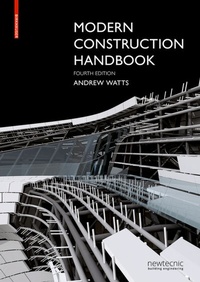
Modern Construction Handbook
Description

Das "Modern Construction Handbook" hat sich zu einem Klassiker der Baukonstruktions-Literatur entwickelt. In den USA ist es die Grundlage vieler Architektur-Studiengänge. Systematisch erschließt es in den Kapiteln "Material", "Wand", "Dach", "Tragwerk", "Umwelt" und "Anwendungen" die Materie und ermöglicht dem Leser eine effiziente und klare Orientierung.
Für die vierte Auflage wurde ein Großteil der 3D Darstellungen aktualisiert, ebenso sind die technischen Informationen auf den neuesten Stand gebracht. "Anwendungen" zeigt aktuelle Entwicklungen, etwa über die individualisierte Fabrikation von Bauteilen, und stellt Konstruktions- und Materialinnovationen vor.
Ein kompaktes, systematisches, mit Informationen prall gefülltes Handbuch, das sich an Studenten wie an junge Praktiker richtet.
More details
Other editions
New editions
Additional editions
Person
Andrew Watts, Spezialist für Gebäudehüllen, gründete Newtecnic und unterrichtet in Cambridge und der Univ. of Westminster.
Content
- Intro
- CONTENTS
- INTRODUCTION
- Introduction to fourth edition
- Structure and envelope
- Parametric design
- 1. MATERIALS
- 1. Steel
- Production
- Performance
- Applications
- 2. Aluminium
- Production
- Performance
- Applications
- 3. Copper, zinc and lead
- Production
- Performance
- Applications
- 4. Stone
- Production
- Performance
- Applications
- 5. Glass
- Production
- Performance
- 6. Concrete
- Production
- Performance
- Applications
- 7. Fibre reinforced concrete
- Production
- Performance
- Applications
- 8. Ceramics
- Production
- Performance
- Applications
- 9. Timber
- Production
- Performance
- Applications
- 10. Polymers
- Production
- Performance
- 11. Material testing
- Testing of building materials
- 2. WALLS
- Trends in facade design
- Generic wall types
- Metal
- 1. Sheet metal
- 2. Profiled cladding
- 3. Composite panels
- 4. Rainscreens
- 5. Mesh screens
- 6. Louvre screens
- Glass systems
- 1. Stick systems
- 2. Unitised glazing
- 3. Clamped glazing
- 4. Bolt fixed glazing
- 5. Glass blocks and channels
- 6. Steel windows
- 7. Aluminium windows
- 8. Timber windows
- 1. Cast in-situ
- 2. Storey height panels
- 3. Small precast panels
- Masonry
- 1. Loadbearing walls
- 2. Cavity walls Brick
- Stone and block
- 3. Cladding
- 4. Rainscreens
- Fibre reinforced polymers
- 1. FRP cladding
- 2. FRP rainscreens
- Timber
- 1. Timber frame
- 2. Cladding panels
- 3. ROOFS
- Trends in roof design
- Metal roofs
- 1. Metal standing seam
- 2. Profiled metal sheet
- 3. Composite panels
- 4. Rainscreens
- 5. Metal louvres
- Glass roofs
- 1. Greenhouse glazing and capped systems
- 2. Silicone-sealed glazing and rooflights
- 3. Bolt fixed glazing
- 4. Bonded glass rooflights
- Concrete roofs
- 1. Concealed membrane
- 2. Exposed membrane
- 3. Planted roof
- Timber roofs
- 1. Flat roof: mastic asphalt coverings
- 2. Flat roof: bitumen-based sheet
- 3. Pitched roof: tiles
- Fibre reinforced polymer roofs
- 1. FRP rooflights
- 2. FRP panels and shells
- Fabric systems
- 1. ETFE cushions
- 2. Single membrane: cone-shaped roof
- 3. Single membrane: barrel-shaped roof
- 4. STRUCTURE
- Material systems for structures
- Elements of structures
- Braced frames
- 1. Reinforced concrete
- 2. Steel
- 3. Timber
- Portal frames
- Loadbearing boxes
- 1. Reinforced concrete
- 2. Brick
- 3. Glass
- Trusses
- Arches and shells
- Space grids
- Floor structures
- 1. Cast in-situ / cast-in-place concrete
- 2. Precast concrete
- 3. Steel and steel mesh
- 4. Timber
- 5. Glass
- Stairs
- 1. Concrete
- 2. Steel
- 3. Timber
- 4. Glass
- 5. ENVIRONMENT
- Environmental studies for envelopes
- Analysis for design
- 1. Solar radiation
- 2. Daylight
- 3. Thermal performance
- 4. Wind
- 5. Solar shading
- 6. Double skin facades
- 7. Natural ventilation
- 8. Thermal mass
- Low energy material systems
- 1. Embodied energy
- 2. Green walls
- Active design
- 1. Liquid based heating/cooling systems
- 2. Mechanical heating/cooling systems
- 3. Electrical lighting
- 4. Raised floors
- 5. Internal ceilings
- Support services
- 1. Sanitation and drainage
- 1. Maintenance and cleaning
- 2. Lifts
- Performance testing of facade material systems
- Performance testing of roof material systems
- 6. APPLICATIONS
- 1. Working with industry
- 2. Triangular panels for twisted facades
- 3. Twisted panels with flat glass for curved facades
- 4. Solar shading louvres
- 5. Double-skin facades
- 6. Precast concrete panels for facades of complex geometry
- 7. Exoskeleton facades of complex geometry
- 8. Diagrid structures
- 9. Hybrid systems forming facades of complex geometry
- 10. Opaque cladding interface with full-height glazing
- 11. Complex curved glazed roofs
- 12. Large-scale glazed facades
- 13. Panelisation of complex building surface geometry
- 14. Opaque rainscreen cladding
- 15. Full-height glazing with GRP-clad structural frame
- 16. GRC cladding interfaces
- 17. Full-height entrance glazing
- 18. GRP louvres on stick glazing system
- 19. GRC cladding
- 20. Windows in GRC cladding
- 21. Windows and unitised glazing with GRC cladding
- 22. Unitised glazing with GRC cladding
- 23. Complex glazed roofs with supporting steel structure
- 24. Glazed roofs with complex geometry
- 25. Louvres and stick glazing
- REFERENCES
- Glossary of terms
- Authorship
- Photo credits
- Index
