

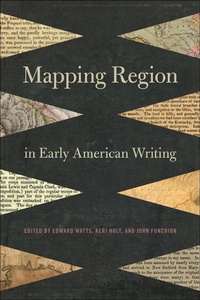
Mapping Region in Early American Writing
Description

Mapping Region in Early American Writing is a collection of essays that study how early American writers thought about the spaces around them. The contributors reconsider the various roles regions-imagined politically, economically, racially, and figuratively-played in the formation of American communities, both real and imagined. These texts vary widely: some are canonical, others archival; some literary, others scientific; some polemical, others simply documentary. As a whole, they recreate important mental mappings and cartographies, and they reveal how diverse populations imagined themselves, their communities, and their nation as occupying the American landscape.
Focusing on place-specific, local writing published before 1860, Mapping Region in Early American Writing examines a period often overlooked in studies of regional literature in America. More than simply offering a prehistory of regionalist writing, these essays offer new ways of theorizing and studying regional spaces in the United States as it grew from a union of disparate colonies along the eastern seaboard into an industrialized nation on the verge of overseas empire building. They also seek to amplify lost voices of diverse narratives from minority, frontier, and outsider groups alongside their more well-known counterparts in a time when America's landscapes and communities were constan
More details
Other editions
Additional editions
Persons
EDWARD WATTS is a professor of English at Michigan State University.
Keri Holt (Editor)
KERI HOLT is an associate professor of English and American studies at Utah State University.
John Funchion (Editor)
JOHN FUNCHION is associate professor of English and American Studies at the University of Miami.
Content
- Cover
- Contents
- Acknowledgments
- Introduction. Bordering Establishments: Mapping and Charting Region before 1860
- Section 1. Chartings: Colonies and Countries
- Chapter 1. "To plant himself in with soveranity": Welsh Indians and the Early West, 1576-1812
- Chapter 2. Reading the Routes: Early American Nature Writing and Critical Regionalism before the "Postfrontier"
- Chapter 3. The "Humor of the Old Southwest" and National Regionality
- Chapter 4. West Indian Emancipation and the Time of Regionalism in the Hemispheric 1850s
- Section 2. Mappings: Creating Places
- Chapter 5. The Labor of Regions: A Comparative Analysis of the Economic and Literary Production of Three Southern Regions in the Eighteenth- Century Atlantic World
- Chapter 6. Captive in Mexico: Zebulon Pike and the New American Regionalism
- Chapter 7. On the Hudson River Line: Postrevolutionary Regionalism, Neo- Tory Sympathy, and "A Lady of the State of New York"
- Chapter 8. "I Was Now Living in a New World": Frederick Douglass, Herman Melville, and New Bedford's Cosmopolitan Locality
- Section 3. Countermappings: New Spaces in Old Places
- Chapter 9. Tribal Christianity: The Second Great Awakening and William Apess's Backwoods Methodism
- Chapter 10. "We, Too, the People": Rewriting Resistance in the Cherokee Nation
- Chapter 11. African American Literature of the Gold Rush
- Postscript. Creole Adjudication: Governing New Orleans and Regional Provisionality in the Long Nineteenth Century
- Works Cited
- Contributors
- Index
- A
- B
- C
- D
- E
- F
- G
- H
- I
- J
- K
- L
- M
- N
- O
- P
- Q
- R
- S
- T
- U
- V
- W
- Y
- Z
