

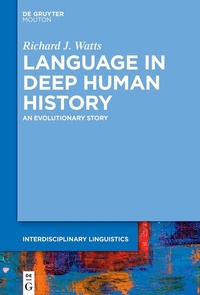
Language in Deep Human History
Description

Understanding the evolution of language within the context of deep human history requires interdisciplinary work between linguists and scientists from a wide range of academic disciplines (e. g. archaeology, molecular biology, anthropology, genetics, biochemistry, etc.). The book aims to calibrate work on human evolution with current linguistic theory in an attempt to trace out a scientific story of how human language emerged and developed that has plausibility while remaining open to change through new linguistic and non-linguistic research.
More details
Other editions
Additional editions
Person
Richard J. Watts , Emeritus Professor in Modern English Linguistics, University of Bern, Switzerland.
Content
- Intro
- Preface
- Contents
- Introduction. Medawar leaps
- Chapter 1 Story-telling, Lane's story, and epigenetic inheritance
- Chapter 2 Language and conceptual integration
- Chapter 3 Homo as a container, life in the Great Rift Valley and human bonding
- Chapter 4 The brain, the larynx and mirror neuron systems
- Chapter 5 Homo habilis and the beginning of symbolic communication
- Chapter 6 The dispersal of Homo erectus: The "muddle in the middle"
- Chapter 7 Building a language: From concepts and functions to constructions without rules
- Chapter 8 Language, fire and symbolic containers of ritual
- Chapter 9 The linguistic worlds of H. heidelbergensis: language and "Theory of Mind"
- Chapter 10 The counterfactual worlds of early modern humans: H. sapiens's sorties into real and unreal worlds
- Chapter 11 H. sapiens, the rolling stone that gathered moss
- Chapter 12 The reunion that wasn't and the challenge that is
- Glossary
- References
- Person index
- Subject index
