
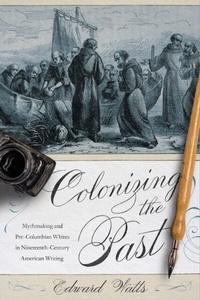
Colonizing the Past
Description
Alles über E-Books | Antworten auf Fragen rund um E-Books, Kopierschutz und Dateiformate finden Sie in unserem Info- & Hilfebereich.
After the Revolution, Americans realized they lacked the common, deep, or meaningful history that might bind together their loose confederation of former colonies into a genuine nation. They had been conquerors yet colonials, now politically independent yet culturally subordinate to European history and traditions. To resolve these paradoxes, some early republic "historians" went so far as to reconstruct pre-Columbian, transatlantic adventures by white people that might be employed to assert their rights and ennoble their identities as Americans.
In Colonizing the Past, Edward Watts labels this impulse "primordialism" and reveals its consistent presence over the span of nineteenth-century American print culture. In dozens of texts, Watts tracks episodes in which varying accounts of pre-Columbian whites attracted widespread attention: the Welsh Indians, the Lost Tribes of Israel, the white Mound Builders, and the Vikings, as well as two ancient Irish interventions. In each instance, public interest was ignited when representations of the group in question became enmeshed in concurrent conversations about the nation's evolving identity and policies. Yet at every turn, counternarratives and public resistance challenged both the plausibility of the pre-Columbian whites and the colonialist symbolism that had been evoked to create a sense of American identity. By challenging the rhetoric of primordialism and empire building, dissenting writers from Washington Irving to Mark Twain exposed the crimes of conquest and white Americans' marginality as ex-colonials.
All prices
More details
Other editions
Additional editions
Person
Edward Watts is Professor of English at Michigan State University and author of In This Remote Country: Colonial French Culture and the Anglo-American Imagination, 1780-1860, among other books.
Content
- Cover Page
- Title Page
- Copyright Page
- Contents
- Acknowledgments
- Introduction: The Primordial Nation
- 1. Welsh Indians in the Early Republic
- 2. The Lost Tribes and the Found Nation
- 3. White Mound Builders and the Lessons of Prehistory
- 4. Dwarf Epics and the Ancient Irish
- 5. The Norse Forefathers of the American Empire
- Notes
- Bibliography
- Index

System requirements
File format: ePUB
Copy protection: Adobe-DRM (Digital Rights Management)
System requirements:
- Computer (Windows; MacOS X; Linux): Install the free reader Adobe Digital Editions prior to download (see eBook Help).
- Tablet/smartphone (Android; iOS): Install the free app Adobe Digital Editions or the app PocketBook before downloading (see eBook Help).
- E-reader: Bookeen, Kobo, Pocketbook, Sony, Tolino and many more (not Kindle).
The file format ePub works well for novels and non-fiction books – i.e., „flowing” text without complex layout. On an e-reader or smartphone, line and page breaks automatically adjust to fit the small displays.
This eBook uses Adobe-DRM, a „hard” copy protection. If the necessary requirements are not met, unfortunately you will not be able to open the eBook. You will therefore need to prepare your reading hardware before downloading.
Please note: We strongly recommend that you authorise using your personal Adobe ID after installation of any reading software.
For more information, see our ebook Help page.
File format: PDF
Copy-Protection: Adobe-DRM (Digital Rights Management)
System requirements:
- Computer (Windows; MacOS X; Linux): Install the free reader Adobe Digital Editions prior to download (see eBook Help).
- Tablet/smartphone (Android; iOS): Install the free app Adobe Digital Editions or the app PocketBook before downloading (see eBook Help).
- E-reader: Bookeen, Kobo, Pocketbook, Sony, Tolino and many more (only limited: Kindle).
The file format PDF always displays a book page identically on any hardware. This makes PDF suitable for complex layouts such as those used in textbooks and reference books (images, tables, columns, footnotes). Unfortunately, on the small screens of e-readers or smartphones, PDFs are rather annoying, requiring too much scrolling.
This eBook uses Adobe-DRM, a „hard” copy protection. If the necessary requirements are not met, unfortunately you will not be able to open the eBook. You will therefore need to prepare your reading hardware before downloading.
Please note: We strongly recommend that you authorise using your personal Adobe ID after installation of any reading software.
For more information, see our eBook Help page.
File format: ePUB
Copy protection: without DRM (Digital Rights Management)
System requirements:
- Computer (Windows; MacOS X; Linux): Use a reader that can handle the file format ePUB, such as Adobe Digital Editions or FBReader – both free (see eBook Help).
- Tablet/Smartphone (Android; iOS): Install the free app Adobe Digital Editions or the app PocketBook (see eBook Help).
- E-reader: Bookeen, Kobo, Pocketbook, Sony, Tolino and many more (not Kindle).
The file format ePUB works well for novels and non-fiction books – i.e., 'flowing' text without complex layout. On an e-reader or smartphone, line and page breaks automatically adjust to fit the small displays.
This eBook does not use copy protection or Digital Rights Management
For more information, see our eBook Help page.
