

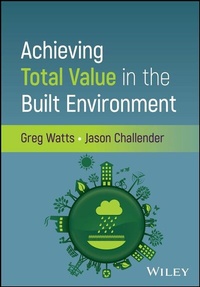
Achieving Total Value in the Built Environment
Description

Provides clear and comprehensive guidance to embedding total value across construction projects for sustainable societal impact
The construction industry is uniquely positioned to shape the social, economic, and environmental fabric of society. As scrutiny of large-scale projects intensifies, traditional measures of success such as cost, time, and quality are no longer sufficient. Increasingly, organisations are judged by the total value they deliver, which includes social, ethical, economic, sustainable, and reputational outcomes. Achieving Total Value in the Built Environment responds directly to this shift, offering a structured and accessible introduction to the evolving concept of total value and its significance in practice.
Divided into four parts, the book moves from strategy through to delivery and future challenges-describing how to design and procure for value, contract and measure outcomes, and communicate achievements effectively. Case studies illustrate real-world application, showing how value can be embedded across all project stages, whilst forward-looking chapters examine the role of technology, modern construction methods, and industry expectations yet to come. By weaving together theory, policy, and practice, the authors provide built environment professionals, students, and academics with the tools to understand, apply, and advocate for value-led approaches in their work.
Highlighting not just why value matters, but also how it can be practically realised on every project, Achieving Total Value in the Built Environment:
- Explains the concept of total value and how it extends beyond social value
- Examines legislative and policy contexts, including the Public Services (Social Value) Act
- Provides a structured framework for embedding value at every project stage
- Emphasises the role of technology and modern methods of construction in value creation
- Offers insights into leadership and organisational responsibilities in delivering value
Bridging theory and practice for both academic and professional audiences, Achieving Total Value in the Built Environment is ideal for undergraduate and postgraduate students in built environment disciplines, particularly those studying construction management, quantity surveying, and project management. It also serves as an essential reference for industry professionals, policy advisors, and leaders seeking to embed value-based approaches within construction projects.
More details
Other editions
Additional editions
Persons
Greg Watts is a Reader in Construction Management at Manchester Metropolitan University. With extensive experience in social value research and delivery, and wider business responsibility, Greg has contributed to BSI 8950 guidance and published widely across leading journals and textbooks. Prior to academia, Greg worked as a Senior Quantity Surveyor for major contractors, bringing both scholarly and industry perspectives to his writing.
Jason Challender is a Senior Lecturer of Building Surveying and Chair of the Property Industry Liaison Panel at Liverpool John Moores University. A Fellow and Board Director of the Royal Institution of Chartered Surveyors, he also serves as Visiting Professor and Advisory Board Chair at the University of Bolton. Challender has spoken at national and international conferences and brings practical leadership experience to his analysis of value in construction.
Content
About the Authors xi
Part I Value Strategy 1
1 Introduction 3
2 What Is Value? 7
2.1 Introduction to Chapter 7
2.2 The Notion of What Constitutes Value 8
2.3 A Brief History of Value 9
2.4 Explanation of the Different Types of Value 9
2.5 Financial Value 10
2.6 Corporate Value 11
2.7 Employee Value 12
2.8 Social Value 14
2.9 Cultural Value 16
2.10 Reputational Value 17
2.11 Stakeholder Value 19
2.12 Ethical Value 20
2.13 Sustainable Value 24
2.14 Well-being Value 25
2.15 Religious Value 25
2.16 Freewill Value 25
2.17 Leadership Value 26
2.18 The Interconnection of Value Types 26
2.19 Summary of Chapter 27
References 29
3 Value in the Built Environment 31
3.1 Introduction to Chapter 31
3.2 What Is the Construction Industry and What Makes It Bespoke? 32
3.3 Size, Shape, Impact and Workforce of the Construction Industry 34
3.4 Perceptions and Negative Impacts for the Industry and Attempts to Address These 34
3.5 Why the Industry Has Started to Adopt a More Values Focused Agenda 38
3.6 Legislation and Other Governance Mechanisms to Drive Value 40
3.7 Summary of Chapter 41
References 43
4 Aligning with Existing Frameworks 45
4.1 Introduction to the Chapter 45
4.2 Frameworks 45
4.3 The Sustainable Development Goals 46
4.4 The UK Government Social Value Model (PPN002) 48
4.5 The Social Value Maturity Model 50
4.6 Public Procurement Notices 52
4.7 B Corporation 53
4.8 Social Return on Investment 55
4.9 Total Value Model 57
4.10 Conclusion 58
References 59
5 The Theories to Help Understand Value 61
5.1 Introduction 61
5.2 Legitimacy Theory 61
5.3 Sensemaking Theory 63
5.4 Stakeholder Theory 65
5.5 Public Value Theory 69
5.6 Critical Urban Theory 71
5.7 Economic Value Theory 72
5.8 Social Constructivism 74
5.9 Total Value Theory 75
5.10 Conclusion 76
References 76
6 Technology and Value 77
6.1 Introduction 77
6.2 Technology Innovation 77
6.3 Technology Hardware 79
6.4 Technology Software 79
6.5 Artificial Intelligence and Machine Learning 81
6.6 Semiconductors 83
6.7 Quantum Computing 83
6.8 Cloud Computing 84
6.9 Digital Twinning 86
6.10 Metaverse 88
6.11 Blockchains 88
6.12 Cryptocurrency 89
6.13 Conclusion 90
Part II Value Action 91
7 Measuring Value 93
7.1 Introduction to Chapter 93
7.2 What Is Social Value Measurement? 93
7.3 Measuring Social Value: Current Measurement Techniques and Practices 94
7.4 Benefits of Measuring Social Value 94
7.5 Current Approaches to Measuring Social Value 95
7.6 Alternative Ways of Measuring Social Value 97
7.7 Summary 98
Reference 98
8 Communicating Value 99
8.1 Introduction 99
8.2 The Importance of Communicating Value 100
8.3 Value Communication Methods (Stakeholder Identification) 100
8.4 Why Value Is Communicated 102
8.5 How Value Is Communicated (the Methods) 103
8.6 What Is (and Is Not) Value Communication 104
8.7 Authentic Value Communications 104
8.8 Ambiguous and Precise Communications 105
8.9 The Advantages and Disadvantages Associated with Communicating Value 106
8.10 How to Communicate Value Effectively 107
8.11 'Greenwashing' in Social Value Communication 107
8.12 Conclusion 108
References 109
Part III Value Reflection 111
9 The Concept of Project Success 113
9.1 Introduction 113
9.2 Challenges for Project Success in the Global Construction Industry 113
9.3 What Constitutes Project Success? 114
9.4 The Meaning of Performance 115
9.5 What Are the Challenges Faced in Achieving Project Success and Performance? 115
9.6 Measuring Project Success 115
9.7 Critical Success Factors Influencing Project Success in the Construction Industry 121
9.8 Measuring Performance for Construction Sites 124
9.9 Summary 126
References 128
10 The Concept of Value Management 129
10.1 Introduction 129
10.2 Definition of Value Management 130
10.3 The History of Value Management 130
10.4 Value Management as a Tool for Improving Project Outcomes in the Construction Industry 130
10.5 Facilitating Value Management into Project Management Methodologies 131
10.6 Measuring the Outputs from Value Management Processes 131
10.7 Critical Success Factors for Value Management Implementation 132
10.8 Benefits of Value Management Processes 132
10.9 Critical Success Factors for Value Delivery 137
10.10 A Model for Identifying and Tracking Value 143
10.11 Value Frameworks for Capturing Project Success 144
10.12 Summary 144
References 145
11 Reflective Practice Around Value Achievement on Projects 147
11.1 Introduction 147
11.2 What Is Reflection? 148
11.3 The Principles of Reflection 148
11.4 The Purpose of Reflection for Project Teams 148
11.5 How to Reflect on Value Achievement 149
11.6 The Importance and Benefits of Reflective Practice for Projects 152
11.7 Suggestions for Reflective Practitioners on Projects 153
11.8 Implementation of Lessons Learnt on Projects 153
11.9 Barriers and Challenges to Dissemination of Knowledge on Projects Through Reflection and Lessons Learnt 154
11.10 Reflection Modes 155
11.11 Reflective Processes and Levels of Intensity Applied to Projects 156
11.12 Frequency and Extent of Reflection and Challenges Faced on Projects 157
11.13 Role of a Facilitator in the Reflection Process 158
11.14 Dilemma of Time Availability for Reflective Processes on Projects 159
11.15 Summary 159
References 161
12 Case Study of Reflective Practice Applied to the Construction Industry 163
12.1 Introduction 163
12.2 Context to the Background of Professor Challender 164
12.3 Personal Reflection 164
12.4 Research, Supporting Evidence and Justification 166
12.5 Planning and Devising the Project 167
12.6 Mapping Against Lifelong Learning UK (LLUK) Standards 169
12.7 Implementing the Project 170
12.8 Feedback, Evaluation and Personal/ Professional Development 171
References 175
Additional Reading 176
13 A History of Value in the Built Environment 177
13.1 Introduction 177
13.2 1950s 177
13.3 1960s 179
13.4 1970s 180
13.5 1980s 181
13.6 1990s 182
13.7 2000s 183
13.8 2010s 185
13.9 2020s 186
13.10 Conclusion 187
References 187
14 Practitioner and Student Examples 189
14.1 Introduction 189
14.2 Scenarios 189
14.3 Conclusion 198
Index 199
Chapter 1
Introduction
Value is ethics. It is behaving ethically to everyone. This could be a colleague, a neighbour, a consultant, a client or a contractor; it could be towards your employer and your employees. Extending to all suppliers and supply chain partners, as well as all those directly and indirectly impacted by your own decisions. Being aware of value, what it means, the types that exist, how it is created and how it can be damaged, is key to ensuring value can be maximised. These are all topics that feature in this book. This book is essentially about value in the Built Environment (the title may have given that away already). It reflects on how we (as an industry) have arrived at the position we are in - whereby we finally have a fourth criterion to challenge the historic triumvirate of cost, time and quality. This fourth criterion often takes on different personas and hides under different guises. It goes by different names. It has been called corporate social value, sustainability, social value, health and well-being, ethics, amongst others. For the purpose of this textbook, this is called 'Total Value'. Society generally is now expecting more from all public and private sector organisations, these additional diverse demands are driving organisations to consider how best they can evidence the value they deliver. Sometimes clients are prescriptive over the value type they desire, other times they leave the finer details of value delivery down to the organisations they are procuring. Either option ultimately results in the same outcome - the need for an organisation to create, deliver, and report on value.
This book also looks forward. It considers where this new value driven focus will lead us, as an industry, and how we all, as individuals and organisations, are best placed to respond to the challenges the future will present. Whatever terminology is used in future as concepts continue to evolve, a focus on the 'Total Value' organisations bring will be increasingly judged. It will be no longer acceptable for organisations to simply donate to good causes, publish standard and non-specific policy statements and view value creation as an 'added extra' to what they do, all the while maintaining a business as usual approach that causes more harm to society than good. Organisations will be judged on their complete contribution to society and the environment - on the 'Total Value' they bring.
In Chapter 2, the concept of value is introduced. It is complex and often misunderstood due to its subjective nature. Traditionally associated with project objectives like cost, time and quality, Value has evolved to reflect a broader set of interests including those of internal and external stakeholders. Because different stakeholders, such as clients, users, designers, contractors and subcontractors, perceive value differently, it can be interpreted in a variety of ways. Whilst environmental value arguably took precedence at the end of the last century, social value has recently emerged as the main focus. However, this is still evolving and a new concept is emerging, one of 'Total Value'. This includes (and encompasses): Well-being value, Financial value, Corporate value, Employee value, Social value, Cultural value, Environmental value, Sustainable value, Reputational value, Stakeholder value and Ethical value (amongst many others). Overall, as evolution continues, value today (and more importantly, tomorrow) encompasses much more than financial metrics, reflecting broader human, environmental and ethical considerations.
Chapter 3 discusses value in the built environment. The built environment encompasses all aspects of managed space and infrastructure development, from design and construction to facility management and property investment. Unlike manufacturing, the construction industry operates through temporary teams (designers, consultants, workers, etc.) assembled for specific projects. This fragmented nature can hinder relationship-building and trust. Globally, the construction industry is significant in terms of employment and economic contribution. However, despite its scale, the industry is often berated for its struggles to modernise, which are often hampered by a focus on cost, time and quality (the 'iron triangle'), and marred by unethical practices and a poor reputation. This chapter discusses the context of the construction industry, some of its inherent problems and measures to consider value as the mechanism to drive future improvements. The legislation, some recent reforms and other governance mechanisms to drive value and act as a catalyst for improvements are then outlined.
Chapter 4 is still part of the 'value strategy' section of this textbook. The chapter introduces frameworks as a concept, how the term is used to describe multiple similar structures and also how the term is used more widely to describe a set of governance and best practice rules. A series of frameworks are then presented and discussed, with a focus on the different types of value creation each of the frameworks aligns with. The benefits and drawbacks of aligning with the different frameworks are also discussed, as are the limitations of the frameworks themselves. However, ultimately, selecting the right framework can help bring an understanding of value-based decision-making to all interested stakeholders.
In Chapter 5, the relationship between total value and a range of theoretical lenses is explored. By utilising a theoretical lens, the achievement of total value can be better understood in the context of stakeholders and how it is perceived, why it is considered legitimate (and how this legitimacy can be abused), as well as the positive contribution it can make to broader society as well as the wider economy. A new theoretical concept of Total Value theory is proposed to help better understand the modern day interaction and expectations between organisations and society. Total Value theory describes when there is a societal or market based shift from simply viewing value as an 'addition' to the 'core' function of a contract and where the entire organisation is reviewed for its overall value creation, from all its actions undertaken.
Chapter 6 discusses a few of the technologies that are currently impacting the Built Environment and will impact the built environment in future. Despite the varied use and application of the technologies, they all have many similarities. Most notably they all have the potential for industry changing Total Value creation. If developed and utilised correctly, each technology described can create efficient, effective and revolutionary value on a local and global scale. However, all the technologies come with both immediate and longer-term risks. Risks that may undermine any value achieved in other areas. The technologies are also often interrelated which brings both advantages, such as how progress in one area can support progress in another, but also disadvantages in that a failure in one area of technology development could undermine the value created by all other technology developments.
Chapter 7 is the start of part II (Value Action) and is focused on the measurement of value. It seeks to understand and capture the importance individuals, groups or organisations place on well-being-related changes resulting from specific actions. This then enables businesses to assess the impact of their decisions, demonstrating value for money and ensuring that outcomes are meaningful and effective. Due to its maturity and contemporary focus, social value is discussed on how it focuses on long-term, life-improving outcomes, which are often referred to as 'soft outcomes' due to their intangible nature. Various methods are used to measure social value of both a qualitative and quantitative nature. These tools help justify spending and attract funding but many fail to capture the essence of social value and instead provide a set of proxy values that actually serve to undermine social value creation and measurement.
Chapter 8 outlines how communicating value is as essential as creating it, especially in today's competitive, value-driven environment. Success often hinges not on the scale of impact alone, but on an organisation's ability to clearly and authentically express the benefits it delivers. However, missteps, such as unclear messaging, poor platform choices or inaccurate measurements, can undermine efforts. The most damaging of these is greenwashing, which not only erodes trust but risks discrediting organisations genuinely committed to delivering environmental or social value. Ultimately, this chapter reinforces that meaningful value exists not only in high-profile projects but also in consistent, everyday practices, so long as they are communicated truthfully. By applying the principles and strategies outlined here, organisations can ensure that their value is not only created but also recognised, understood and celebrated across all relevant stakeholder groups.
Chapter 9 introduces part III: value reflection and explores the key challenges affecting project success in the global construction industry, such as its fragmented, temporary nature and the complexities introduced by differing international regulations, cultures and behaviours. The chapter then examines the difficulties in achieving and measuring success, particularly due to differing stakeholder perspectives. Alternative models for evaluating project success are presented, focusing on project efficiency, customer impact, business outcomes and future readiness. Key...
