

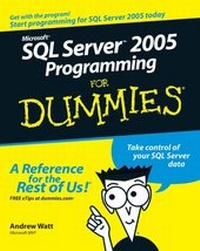
Microsoft SQL Server 2005 Programming For Dummies
Published on 5. July 2007
416 pages
978-0-470-12859-6 (ISBN)
Description

Create and modify databases and keep them secure
Get up to speed on using T-SQL to store and manipulate data
SQL Server 2005 improves an already great database managementsystem. This book shows you how to put it to work in a hurry.You'll find out how to use the SQL Server Management Studio and theSQLCMD utility to write T-SQL code, retrieve data from single ormultiple SQL Server tables, add data using the INSERT statement,and much more.
* Create queries to retrieve data
* Ensure SQL Server security
* Use Visual Studio(r) 2005 with SQL Server
* Create tables, views, and indexes
* Work with Common Language Runtime
* Query XML data
Get up to speed on using T-SQL to store and manipulate data
SQL Server 2005 improves an already great database managementsystem. This book shows you how to put it to work in a hurry.You'll find out how to use the SQL Server Management Studio and theSQLCMD utility to write T-SQL code, retrieve data from single ormultiple SQL Server tables, add data using the INSERT statement,and much more.
* Create queries to retrieve data
* Ensure SQL Server security
* Use Visual Studio(r) 2005 with SQL Server
* Create tables, views, and indexes
* Work with Common Language Runtime
* Query XML data
More details
Other editions
Additional editions
Book
03/2007
1st Edition
Wiley
€25.90
Article exhausted; check different version
Person
Andrew Watt wrote his first computer programs back in 1985.He is an independent consultant, experienced author, and MicrosoftMVP (Most Valuable Professional) for SQL Server. His areas ofinterest and expertise include SQL Server 2005, Windows PowerShell,XML, and Microsoft InfoPath.
Andrew first used SQL Server in version 7.0 and was an activeparticipant in the SQL Server 2005 beta program from August2003.
Among the books Andrew has written, or co-written, are SQLServer 2005 For Dummies, Beginning Regular Expressions,Beginning XML (3rd edition), Beginning RSS & AtomProgramming, Professional XML (2nd edition), andDesigning SVG Web Graphics.
Andrew is often seen answering questions in Microsoft's SQLServer and other newsgroups. Feel free to get involved in thecommunity there. He can be contacted direct atSVGDeveloper@aol.com. Due to the volume of e-mail he receives, hecan't guarantee to respond to every e-mail.
Andrew first used SQL Server in version 7.0 and was an activeparticipant in the SQL Server 2005 beta program from August2003.
Among the books Andrew has written, or co-written, are SQLServer 2005 For Dummies, Beginning Regular Expressions,Beginning XML (3rd edition), Beginning RSS & AtomProgramming, Professional XML (2nd edition), andDesigning SVG Web Graphics.
Andrew is often seen answering questions in Microsoft's SQLServer and other newsgroups. Feel free to get involved in thecommunity there. He can be contacted direct atSVGDeveloper@aol.com. Due to the volume of e-mail he receives, hecan't guarantee to respond to every e-mail.
Content
Introduction.
Part I: Get Started Using the SQL Server 2005 DevelopmentEnvironment.
Chapter 1: The Joy of SQL Server 2005 Programming.
Chapter 2: Understanding Database Fundamentals.
Chapter 3: Getting to Know the SQL Server Toolset.
Part II: Retrieving Data Using Transact-SQL.
Chapter 4: Retrieving Data Using the SELECT Statement.
Chapter 5: Creating Joins.
Chapter 6: Creating Advanced Queries.
Chapter 7: Manipulating Data.
Part III: Creating Databases and Database Objects withTransact-SQL.
Chapter 8: Designing, Creating, and Altering DatabaseObjects.
Chapter 9: Designing, Creating, and Changing Tables.
Chapter 10: Applying Constraints.
Chapter 11: Creating Views.
Chapter 12: Using Stored Procedures.
Chapter 13: Using Triggers.
Chapter 14: Creating Functions.
Chapter 15: Creating Indexes.
Chapter 16: Handling Errors Using TRY . . . CATCH.
Part IV: Programming SQL Server Security.
Chapter 17: Adding Logins and Users.
Chapter 18: Creating Database-Level Security.
Chapter 19: Securing Data Using Encryption.
Part V: Beyond Transact-SQL Programming.
Chapter 20: Working with XML.
Chapter 21: Working with the Common Language Runtime.
Chapter 22: Using Visual Studio 2005.
Chapter 23: Working with SQL Server Management Objects.
Part VI: The Part of Tens.
Chapter 24: Ten Tips to Program Like a Pro.
Chapter 25: Ten Sources for More Information on SQL Server2005.
Index.
Part I: Get Started Using the SQL Server 2005 DevelopmentEnvironment.
Chapter 1: The Joy of SQL Server 2005 Programming.
Chapter 2: Understanding Database Fundamentals.
Chapter 3: Getting to Know the SQL Server Toolset.
Part II: Retrieving Data Using Transact-SQL.
Chapter 4: Retrieving Data Using the SELECT Statement.
Chapter 5: Creating Joins.
Chapter 6: Creating Advanced Queries.
Chapter 7: Manipulating Data.
Part III: Creating Databases and Database Objects withTransact-SQL.
Chapter 8: Designing, Creating, and Altering DatabaseObjects.
Chapter 9: Designing, Creating, and Changing Tables.
Chapter 10: Applying Constraints.
Chapter 11: Creating Views.
Chapter 12: Using Stored Procedures.
Chapter 13: Using Triggers.
Chapter 14: Creating Functions.
Chapter 15: Creating Indexes.
Chapter 16: Handling Errors Using TRY . . . CATCH.
Part IV: Programming SQL Server Security.
Chapter 17: Adding Logins and Users.
Chapter 18: Creating Database-Level Security.
Chapter 19: Securing Data Using Encryption.
Part V: Beyond Transact-SQL Programming.
Chapter 20: Working with XML.
Chapter 21: Working with the Common Language Runtime.
Chapter 22: Using Visual Studio 2005.
Chapter 23: Working with SQL Server Management Objects.
Part VI: The Part of Tens.
Chapter 24: Ten Tips to Program Like a Pro.
Chapter 25: Ten Sources for More Information on SQL Server2005.
Index.
