

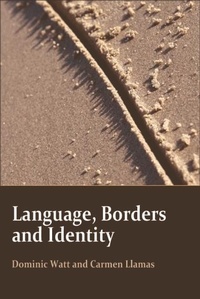
Language, Borders and Identity
Description

A wide-ranging and multi-disciplinary discussion of the connections between language, borders and identities
Identifying and examining political, socio-psychological and symbolic borders, Language, Borders and Identity encompasses a broad, geographically diverse spectrum of border contexts, taking a multi-disciplinary approach by combining sociolinguistics research with human geography, anthropology and social psychology. The book illustrates a representative range of methodological approaches used by researchers in the field and examines regional and local borders alongside the political borders that divide monoglossic and heteroglossic territories.
Using international case studies and examples throughout, this book also looks to symbolic borders, which are often encoded in the semiotic manipulation of the linguistic landscape. It further assesses the linguistic implications of the presence of borders in applied contexts, including language planning and policy (e.g. in multilingual education or for the protection of minority languages) and border control.
By casting its net wide, Language, Borders and Identity develops and refines models of how language is used to construct borders, and to indicate on which side of border speakers situate themselves. This book brings into focus the dual reactive and proactive functions that language serves in this respect, exploring the tensions between essentialist and constructionist approaches to identity, and offers a valuable resource for advanced students and researchers in sociolinguistics and the sociology of language.
- Covers political, socio-psychological and symbolic borders
- Takes a multi-disciplinary approach by combining sociolinguistic research with human geography, anthropology and social psychology
- Uses international case studies and examples throughout
More details
Other editions
Additional editions
Content
- Intro
- Title page
- Copyright
- Contents
- Acknowledgements
- List of Tables, Figures and Extracts
- Notes on Contributors
- Introduction
- 1 Language and Identity on the Scottish/English Border
- 2 Where North Meets South? Contact, Divergence and the Routinisation of the Fenland Dialect Boundary
- 3 Borders in North American English
- 4 Spanish Language Variation and Ethnic Identity in New Mexico: Internal and External Borders
- 5 Language Use and Attitudes as Stimuli for Phonological Change in Border Uruguayan Spanish
- 6 Religion on the Border: The Effect of Utah English on English and Spanish Use in the Mexican Mormo
- 7 Borders within Borders: Contexts of Language Use and Local Identity Configuration in Southern Gali
- 8 Perceptual Ideology across the Scottish/English Border
- 9 Wales and Welsh: Boundedness and Peripherality
- 10 The Political Border and Linguistic Identities in Ireland: What Can the Linguistic Landscape Te
- 11 Multilingual Luxembourg: Language and Identity at the Romance/Germanic Language Border
- 12 What Counts as a Linguistic Border, for Whom and with What Implications? Exploring Occitan and F
- 13 Constructing National and International Deaf Identity: Perceived Use of American Sign Language
- 14 Borders, Variation and Identity: Language Analysis for the Determination of Origin (LADO)
- References
- Index
