

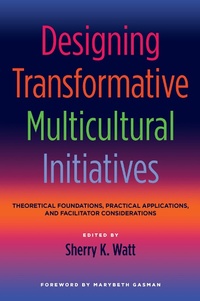
Designing Transformative Multicultural Initiatives
Theoretical Foundations, Practical Applications, and Facilitator Considerations
1st Edition
Published on 3. July 2023
270 pages
978-1-000-97459-1 (ISBN)
Description

Higher education is facing a perfect storm as it contends with changing demographics, shrinking budgets and concerns about access and cost, while underrepresented groups - both in faculty ranks and students - are voicing dissatisfaction with campus climate and demanding changes to structural inequities.This book argues that, to address the inexorable changes ahead, colleges and universities need both to centralize the value of diversity and inclusion and employ a set of strategies that are enacted at all levels of their institutions. It argues that individual and institutional change efforts can only be achieved by implementing "diversity as a value" - that is embracing social change efforts as central and additive rather than episodic and required - and provides the research and theoretical frameworks to support this approach, as well as tools and examples of practice that accomplish change.The contributors to this book identify the elements that drive successful multicultural initiatives and that strengthen the effectiveness of campus efforts to dismantle systemic oppression, as well as the individual and organization skills needed to manage difference effectively. Among these is developing the capacity of administrators, faculty and student affairs professionals as conscious scholar practitioners to sensitively manage conflicts on campus, deconstruct challenging structures and reconstruct the environment intentionally to include in respectful ways experiences of historically marginalized groups and non-dominant ways of being in the world. The books' focus on developing capacities for multicultural competence aligns with higher education's increasing emphasis on civic engagement and institutional goals promote skills to interact in meaningful and responsible ways around difference, whether of people, ideas or identities.Designing Transformative Multicultural Initiatives provides guiding principles and practical strategies to successfully transform higher education to become fully inclusive and advance the success of all constituents and stakeholders.
Reviews / Votes
"Sherry K. Watt has assembled talented "conscious scholar practitioners" to address the growing need to design university policies, programming, and classroom pedagogies that address difference. This book addresses both the theoretical and practical aspects of multicultural teaching. As the preferred term "conscious scholar practitioners" suggests, both aspects are vital for developing multicultural policies and teaching practices.For those scholars who want to deepen and center difference in their classroom and across their university this book strikes me as incredibly valuable. For departments of theology and religious studies seeking to form stronger links with other departments, staff members, and administrators, this volume can provide a common vocabulary and methodology."
Reflective Teaching (Wabash Center)
"Dr. Watt and her talented cast of authors dissolve dualities between privilege and oppression, person and institution, and defensiveness and empathy to offer liberatory strategies in the spirit of Friere and hooks that offer real hope for realizing higher education's democratic mission. Rooted in the conceptual (like the AAFES Method and Privilege Identity Exploration Model), Designing Transformative Multicultural Initiatives provides an urgently needed pragmatic map for addressing the stubborn realities confronting college campuses around equity and justice. It is truly an outstanding contribution to the field."
Tracy L. Davis, Ph.D.,Professor and College Student Personnel Program Coordinator, Director, Center for the Study of Masculinities & Men's Development
Educational and Interdisciplinary Studies, Western Illinois University
"'How can I help create a space where people can bring their whole selves?' is just one of the many poignant questions raised and addressed in this comprehensive text. The chapter authors offer guidance on multicultural initiatives that integrate with strategic plans and institution missions, and on how to deal with the politics of intersectional identities and the assessment of multicultural initiatives, often in a toxic campus environment. Within each chapter, they weave examples, experiences, models, and metaphors that nurture readers to design transformative multicultural initiatives; all the time differentiating between 'diversity as good' versus the more complex and honorable 'diversity as value.' This is not just a book one reads, but rather it is a book that demands contemplation and reflection, and ultimately thoughtful action."
Jan Arminio, Director of the Higher Education Program
George Mason University
"If we want to humanize our organizations and promote positive social change, much depends on our capacity to engage each other across lines of difference. In this important book, Dr. Sherry Watt offers a set of healing and life-giving strategies for embracing diversity and moving toward inclusion. The book is a clarion call for campus and community leaders to find the wisdom and courage to help us build a better world."
Parker J. Palmer (author of "Healing the Heart of Democracy," "The Courage to Teach" and "Let Your Life Speak")
"Watt's timely compilation provides an innovative approach toward addressing and embracing multiculturalism on college campuses. Through a balance of theory, personal narratives, research, and action, the book offers implementable ideas for students, scholars, and administrators in higher education. This book is an important read for anyone interested in diversity in higher education. The chapters are is incisive, honest, and compassionate."
Rachelle Winkle-Wagner, Associate Professor, Educational Leadership and Policy Analysis
University of Wisconsin-Madison
"Sherry Watt and company present an intelligently crafted guidebook that shows how to construct and implement multicultural initiatives that are truly transformative of campus environments and the individuals who populate them that goes well beyond the usual chronicle of multicultural issues and sample programs. Using a comprehensive definition of Difference, and grounded in the time-tested theories of Paulo Freire and bell hooks, Watt reviews her Privilege Identity Exploration Model and the Authentic Action-Oriented Framing for Environment Shifts Method as tools every practitioner needs to learn to use liberally. In teaching us to use these tools, the authors provide useful guiding principles to design transformative multicultural initiatives, offer sample multicultural initiative techniques that produce successful outcomes, and share examples of varying types of tested multicultural initiatives. The book also carefully explores a number of difficult, but critical, challenges at the convergence of inequities of identity, power and, privilege (politics, hostile environments, racism, and difficulty teaching these concepts) that must be addressed before multicultural initiatives can result in meaningful campus organizational change."
Michael J. Cuyjet, Ed.D., Professor Emeritus
University of Louisville
"Designing Transformative Multicultural Initiatives accelerates and advances the conversation about how to affect the paradigm shifts necessary for sustainable equity and inclusion of difference across U.S. colleges and universities. Using Freire's framework of 'education as the practice of freedom', further explicated by bell hooks, Sherry Watt has brought together an impressive array of conscious scholar practitioners whose critical reflections and research reports lead readers on a journey toward fundamental organizational change in higher education. This is truly a phenomenal text."
Dafina-Lazarus Stewart, Associate Professor of Higher Education and Student Affairs
Bowling Green State University
"Unlike many other works on multicultural initiatives within the higher education setting that are only theoretical, Watt and her contributors include many strategies with real possibilities for change; they also anticipate the roadblocks that often strangle much needed change in the area of diversity.
Perhaps what I enjoyed most about thus book are the multitude of perspectives under one cover. Watt includes the voices of those that approach diversity efforts theoretically - for example, those that use Critical Race Theory - but also includes voices from the National Science Foundation - where diversity is a significant challenge and has such vital importance but is far from theoretical. Likewise, Watt presents the perspectives of student affairs professionals as well as those teaching - helping readers to understand how diversity manifests - and more importantly - could manifest within a multitude of settings.
Designing Transformative Multicultural Initiatives is a book for many audiences and has the potential - if the strategies are adopted - to make meaningful change in our colleges and universities."
Marybeth Gasman, Professor
University of Pennsylvania
More details
Edition
1. Auflage
Language
English
Place of publication
London
United Kingdom
Publishing group
Taylor & Francis Ltd
Target group
College/higher education
Professional and scholarly
ISBN-13
978-1-000-97459-1 (9781000974591)
Copyright in bibliographic data and cover images is held by Nielsen Book Services Limited or by the publishers or by their respective licensors: all rights reserved.
Schweitzer Classification
Other editions
Additional editions
Sherry K. Watt
Designing Transformative Multicultural Initiatives
Theoretical Foundations, Practical Applications, and Facilitator Considerations
Book
06/2015
1st Edition
Stylus Publishing
€206.60
Shipment within 3-4 weeks
Sherry K. Watt
Designing Transformative Multicultural Initiatives
Theoretical Foundations, Practical Applications, and Facilitator Considerations
Book
06/2015
1st Edition
Stylus Publishing
€51.40
Shipment within 3-4 weeks
Person
Sherry K. Watt, Ph.D., NCC, LPC is a professor in the Higher Education and Student Affairs program the University of Iowa. She is also the co-creator of the Multicultural Initiatives (MCI) Research Team. Prior to becoming a faculty member, she worked as a residence life director and a career counselor at the University of North Carolina at Greensboro, North Carolina State University, and Shaw University. She earned a bachelor's degree in Communication Studies from University of North Carolina at Greensboro and masters and doctoral degrees in Counselor Education, with an emphasis in student affairs, from North Carolina State University. She is also founder of The Being Institute (thebeinginstitute.org). Sherry is a facilitator prepared by the Center for Courage and Renewal. She is the editor of Designing Transformative Multicultural Initiatives: Theoretical Foundations, Practical Applications, and Facilitator Considerations (Stylus, 2015). She has over 25 years of experience in designing and leading educational experiences that involve strategies to engage participants in dialogue that is meaningful, passionate, and self-awakening. Marybeth Gasman is the Samuel DeWitt Proctor Endowed Chair in Education and a Distinguished Professor at Rutgers University. She serves as the Executive Director of the Samuel DeWitt Proctor Institute for Leadership, Equity & Justice and the Executive Director of the Rutgers Center for Minority Serving Institutions. Prior to joining the faculty at Rutgers, Marybeth was the Judy & Howard Berkowitz Endowed Professor in the Graduate School of Education at the University of Pennsylvania. While at Penn, Marybeth also served as the founding director of the Penn Center for Minority Serving Institutions (MSIs). Her areas of expertise include the history of American higher education, Minority Serving Institutions (with an emphasis on Historically Black Colleges and Universities), racism and diversity, fundraising and philanthropy, and hig
Content
Foreword Acknowledgements Introduction Part One. Guiding Principles for Transformative Multicultural Initiatives (What are some useful guiding principles that help conscious scholar practitioners design transformative multicultural initiatives?. 1. Multicultural Initiatives as a Practice of Freedom-Sherry K. Watt 2. Authentic, Action-Oriented Framing for Environmental Shifts (AAFES. Method-Sherry K. Watt 3. Privilege Identity Exploration (PIE. Model Revisited. Strengthening Skills for Engaging Difference-Sherry K. Watt Part Two. Designing Multicultural Initiatives. A How to Manual (What techniques do conscious scholar practitioners use to develop a multicultural initiative that will lead to a successful outcome?. 4. Multicultural Initiatives as Bridges. Structures Necessary for Successful Facilitation-Cindy Ann Kilgo and Richard Barajas 5. In Pursuit of a Strong, Clear Vision. Initiating and Sustaining Multicultural Change in Higher Education Organizations-Lacretia Johnson Flash 6. Sharing Power and Privilege through the Scholarly Practice of Assessment-Wayne Jacobson Part Three. Scholarly Examples of Multicultural Initiatives in Teaching, Higher Education Administration, and Student Affairs Practice (What are examples of the varying types of multicultural initiatives in higher education and student affairs?. 7. Teaching Contemporary Leadership. Advancing Students' Capacities to Engage With Difference-John P. Dugan and Daviree Velazquez 8. Aligning Actions With Core Values. Reflections of a Chief Diversity Officer and National Science Foundation ADVANCE Director on Advancing Faculty Diversity-Paulette Granberry Russell and Melissa McDaniels 9. Creating Inclusive Organizations. One Student Affairs Division's Efforts to Create Sustainable, Systemic Change-Kathy Obear and Shelly Kerr 10. Dialogue Matters. Applying Critical Race Theory to Conversations About Race-Sherri Edvalson Erkel 11. Confronting Systems of Privilege and Power Through Classroom Discussion. Uses of Power- Bridget Turner Kelly and Joy Gaston Gayles 12. The Transformational Potential of Academic Affairs and Student Affairs Partnerships for Enacting Multicultural Initiatives-Lucy A. LePeau Part Four. Conscious Scholar Practitioners' Reflections on Identity, Power, and Privilege (How do conscious scholar practitioners face the challenges within the convergence of identity, power, and privilege that are inherent to multicultural initiatives and campus organizational change?. 13. Politics of Intersecting Identities-John A. Mueller and Craig S. Pickett 14. Toxic Environments. Perseverance in the Face of Resistance-Mary F. Howard-Hamilton 15. Facing the Proverbial Lion of Racism-Jodi L. Linley and Sherry K. Watt 16. The Art of Reflective Teaching-Ellen E. Fairchild 17. Daring Greatly. A Reflective Critique of the Authentic, Action-Oriented Framing for Environmental Shifts (AAFES. Method-Tracy Robinson-Wood and Sherry K. Watt About the Editor and Contributors Index
