

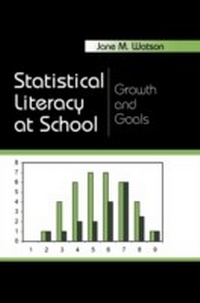
Statistical Literacy at School
Growth and Goals
1st Edition
Published on 13. May 2013
320 pages
978-1-136-50115-9 (ISBN)
Description

This book reveals the development of students' understanding of statistical literacy. It provides a way to "see" student thinking and gives readers a deeper sense of how students think about important statistical topics. Intended as a complement to curriculum documents and textbook series, it is consistent with the current principles and standards of the National Council of Teachers of Mathematics.
The term "statistical literacy" is used to emphasize that the purpose of the school curriculum should not be to turn out statisticians but to prepare statistically literate school graduates who are prepared to participate in social decision making. Based on ten years of research--with reference to other significant research as appropriate--the book looks at students' thinking in relation to tasks based on sampling, graphical representations, averages, chance, beginning inference, and variation, which are essential to later work in formal statistics. For those students who do not proceed to formal study, as well as those who do, these concepts provide a basis for decision making or questioning when presented with claims based on data in societal settings.
Statistical Literacy at School: Growth and Goals:
*establishes an overall framework for statistical literacy in terms of both the links to specific school curricula and the wider appreciation of contexts within which chance and data-handling ideas are applied;
*demonstrates, within this framework, that there are many connections among specific ideas and constructs;
*provides tasks, adaptable for classroom or assessment use, that are appropriate for the goals of statistical literacy;
*presents extensive examples of student performance on the tasks, illustrating hierarchies of achievement, to assist in monitoring gains and meeting the goals of statistical literacy; and
*includes a summary of analysis of survey data that suggests a developmental hierarchy for students over the years of schooling with respect to the goal of statistical literacy.
Statistical Literacy at School: Growth and Goals is directed to researchers, curriculum developers, professionals, and students in mathematics education as well those across the curriculum who are interested in students' cognitive development within the field; to teachers who want to focus on the concepts involved in statistical literacy without the use of formal statistical techniques; and to statisticians who are interested in the development of student understanding before students are exposed to the formal study of statistics.
The term "statistical literacy" is used to emphasize that the purpose of the school curriculum should not be to turn out statisticians but to prepare statistically literate school graduates who are prepared to participate in social decision making. Based on ten years of research--with reference to other significant research as appropriate--the book looks at students' thinking in relation to tasks based on sampling, graphical representations, averages, chance, beginning inference, and variation, which are essential to later work in formal statistics. For those students who do not proceed to formal study, as well as those who do, these concepts provide a basis for decision making or questioning when presented with claims based on data in societal settings.
Statistical Literacy at School: Growth and Goals:
*establishes an overall framework for statistical literacy in terms of both the links to specific school curricula and the wider appreciation of contexts within which chance and data-handling ideas are applied;
*demonstrates, within this framework, that there are many connections among specific ideas and constructs;
*provides tasks, adaptable for classroom or assessment use, that are appropriate for the goals of statistical literacy;
*presents extensive examples of student performance on the tasks, illustrating hierarchies of achievement, to assist in monitoring gains and meeting the goals of statistical literacy; and
*includes a summary of analysis of survey data that suggests a developmental hierarchy for students over the years of schooling with respect to the goal of statistical literacy.
Statistical Literacy at School: Growth and Goals is directed to researchers, curriculum developers, professionals, and students in mathematics education as well those across the curriculum who are interested in students' cognitive development within the field; to teachers who want to focus on the concepts involved in statistical literacy without the use of formal statistical techniques; and to statisticians who are interested in the development of student understanding before students are exposed to the formal study of statistics.
More details
Series
Language
English
Place of publication
London
United Kingdom
Publishing group
Taylor & Francis Ltd
Target group
Professional and scholarly
Product notice
Reflowable
File size
25,99 MB
ISBN-13
978-1-136-50115-9 (9781136501159)
Copyright in bibliographic data and cover images is held by Nielsen Book Services Limited or by the publishers or by their respective licensors: all rights reserved.
Schweitzer Classification
Other editions
Additional editions
Book
06/2006
1st Edition
Routledge
€262.60
Shipment within 10-20 days
Book
06/2006
1st Edition
Routledge
€83.10
Shipment within 10-20 days
Person
Jane M. Watson
Content
Contents: Preface. Purpose and Foundations. Sampling: A Good Start. Graphs: How Best to Represent the Data. Average: What Does It Tell Us? Chance: Precursor to Probability. Beginning Inference: Supporting a Conclusion. Variation: The Underlying Phenomenon. Statistical Literacy: A Global Goal.
