

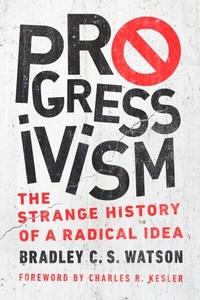
Progressivism
The Strange History of a Radical Idea
1st Edition
Published on 28. February 2020
276 pages
978-0-268-10699-7 (ISBN)
Description

At its core this book is intellectual history, tracing the work of progressive historians as they in turn wrote the history of progressivism.
In Progressivism: The Strange History of a Radical Idea, Bradley C. S. Watson presents an intellectual history of American progressivism as a philosophical-political phenomenon, focusing on how and with what consequences the academic discipline of history came to accept and propagate it. This book offers a meticulously detailed historiography and critique of the insularity and biases of academic culture. It shows how the first scholarly interpreters of progressivism were, in large measure, also its intellectual architects, and later interpreters were in deep sympathy with their premises and conclusions. Too many scholarly treatments of the progressive synthesis were products of it, or at least were insufficiently mindful of two central facts: the hostility of progressive theory to the Founders' Constitution and the tension between progressive theory and the realm of the private, including even conscience itself. The constitutional and religious dimensions of progressive thought-and, in particular, the relationship between the two-remained hidden for much of the twentieth century. This pathbreaking volume reveals how and why this scholarly obfuscation occurred. The book will interest students and scholars of American political thought, the Progressive Era, and historiography, and it will be a useful reference work for anyone in history, law, and political science.
In Progressivism: The Strange History of a Radical Idea, Bradley C. S. Watson presents an intellectual history of American progressivism as a philosophical-political phenomenon, focusing on how and with what consequences the academic discipline of history came to accept and propagate it. This book offers a meticulously detailed historiography and critique of the insularity and biases of academic culture. It shows how the first scholarly interpreters of progressivism were, in large measure, also its intellectual architects, and later interpreters were in deep sympathy with their premises and conclusions. Too many scholarly treatments of the progressive synthesis were products of it, or at least were insufficiently mindful of two central facts: the hostility of progressive theory to the Founders' Constitution and the tension between progressive theory and the realm of the private, including even conscience itself. The constitutional and religious dimensions of progressive thought-and, in particular, the relationship between the two-remained hidden for much of the twentieth century. This pathbreaking volume reveals how and why this scholarly obfuscation occurred. The book will interest students and scholars of American political thought, the Progressive Era, and historiography, and it will be a useful reference work for anyone in history, law, and political science.
Reviews / Votes
"This book leaves the reader with a deep suspicion of several generations of progressive historians who wrote without being fully honest or fully aware of the tensions between progressivism and the American founders. Beyond that, [it] requires us to think about the challenges of progressive thought to the legitimacy of American institutions and to the American regime as a whole. By provoking these questions, Watson leads us to the deepest level of American politics which is nothing other than a continuous dialogue and critical engagement with the American Founders." -VoegelinView"In this new offering from Watson, Progressivism is put under the microscope and examined during its 20th-century development. . . . The book proceeds chronologically through the 20th century to the current day, which gives readers a solid accounting of how Progressive ideas evolved and then merged with still later ideas." -Choice
"Bradley C. S. Watson's new book Progressivism: The Strange History of a Radical Idea points scholars in new and productive directions regarding the political thought of the Progressive Era. Watson writes with vigor and verve, making the book of great appeal to anyone trying to take the true measure of the legacy of Progressive political thought in American history." -Public Discourse
"The book is more than an extended review of the literature . . . ; it is an indictment. And it is hard not to agree with Watson's assessment that these historians were guilty of obscuring as much as they illuminated about the Progressives." -Law and Liberty
"Watson has crafted, not so much a historical genealogy of Progressivism, as its historiography. . . . Along the line of Watson's march appear some of the brightest stars in the firmament of American historical writing (and political-history writing) in the 20th century: Richard Hofstadter, . . . Henry Steele Commager, Daniel Boorstin, C. Vann Woodward, David Potter, Louis Hartz, Arthur Link, Gabriel Kolko, Henry F. May, and Robert Wiebe." -Claremont Review of Books
"This is a singularly original contribution. I know of no such comprehensive review of the historiography of progressivism." -Paul Moreno, author of Black Americans and Organized Labor
"Progressivism is novel because neither is it in thrall to progressivism nor does it consider progressivism as inevitable and inevitably domesticated. Rather, the author is capable of criticizing progressivism at a fundamental level." -Johnathan O'Neill, author of Originalism in American Law and Politics
All prices
More details
Language
English
Place of publication
Notre Dame IN
United States
Target group
Professional and scholarly
Product notice
Reflowable
File size
1,05 MB
ISBN-13
978-0-268-10699-7 (9780268106997)
Copyright in bibliographic data and cover images is held by Nielsen Book Services Limited or by the publishers or by their respective licensors: all rights reserved.
Schweitzer Classification
Other editions
Additional editions

Book
02/2020
University of Notre Dame Press
€42.90
Shipment within 10-20 days
Persons
Bradley C. S. Watson teaches at the Van Andel Graduate School of Government at Hillsdale College in Washington, D.C.. He is the author and editor of numerous books, including Living Constitution, Dying Faith: Progressivism and the New Science of Jurisprudence and Progressive Challenges to the American Constitution: A New Republic.
Charles R. Kesler is the Dengler-Dykema Distinguished Professor of Government at Claremont McKenna College and Claremont Graduate University. He is editor of the Claremont Review of Books.
Charles R. Kesler is the Dengler-Dykema Distinguished Professor of Government at Claremont McKenna College and Claremont Graduate University. He is editor of the Claremont Review of Books.
Content
Foreword by Charles R. Kesler
Acknowledgments
Introduction
1. The Revolt against the Constitution
2. The Real Presence of Christ
3. Gray in Gray: The Strange History of Progressive History in the 1940s and 1950s
4. Progressive Historiography in a Countercultural Age
5. Intellectual Consolidation and Counterattack: Conservatism and Revisionism from the 1980s to the Present
6. The Shades of History
Notes
Index
Acknowledgments
Introduction
1. The Revolt against the Constitution
2. The Real Presence of Christ
3. Gray in Gray: The Strange History of Progressive History in the 1940s and 1950s
4. Progressive Historiography in a Countercultural Age
5. Intellectual Consolidation and Counterattack: Conservatism and Revisionism from the 1980s to the Present
6. The Shades of History
Notes
Index
