

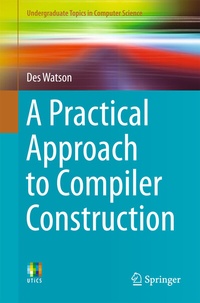
A Practical Approach to Compiler Construction
Description

Des Watson works in the field of compiler design and development. He has extensive experience in research and both undergraduate and postgraduate teaching in programming language design and implementation at the University of Sussex, UK. He also works with commercial organisations, particularly in the field of compiler optimisation of code for embedded systems.
Reviews / Votes
"I found this book easy to read, with relevant examples and a good set of references. For me, its most interesting feature is the strategy used to support a particular audience: people who need to process text but will not write production compilers. The material itself has been standard for 30 years." (Computing Reviews, August, 2017)"The book is an excellent resource for anyone who is looking for an introduction to the basic structure and concepts of a compiler. Better-suited works are available for an in-depth analysis." (Jonas Devlieghere, Computing Reviews , February, 16, 2018)
More details
Other editions
Additional editions
Person
Des Watson works in the field of compiler design and development. He has extensive experience in research and both undergraduate and postgraduate teaching in programming language design and implementation at the University of Sussex, UK. He also works with commercial organisations, particularly in the field of compiler optimisation of code for embedded systems.
