

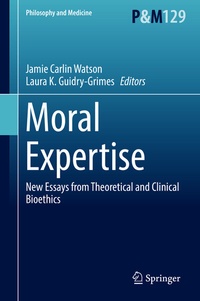
Moral Expertise
Description

This collection addresses whether ethicists, like authorities in other fields, can speak as experts in their subject matter. Though ethics consultation is a growing practice in medical contexts, there remain difficult questions about the role of ethicists in professional decision-making. Contributors examine the nature and plausibility of moral expertise, the relationship between character and expertise, the nature and limits of moral authority, how one might become a moral expert, and the trustworthiness of moral testimony. This volume engages with the growing literature in these debates and offers new perspectives from both academics and practitioners. The readings will be of particular interest to bioethicists, clinicians, ethics committees, and students of social epistemology. These new essays promise to advance discussions in the professionalization and accreditation of ethics consultation.
More details
Other editions
Additional editions
Persons
Jamie Carlin Watson, Ph.D. is Assistant Professor of Medical Humanities and Bioethics at University of Arkansas for Medical Sciences (UAMS) and a clinical ethicist at UAMS and Arkansas Children's Hospital. He is also a plain language writer with the Center for Health Literacy at UAMS. His primary research is in epistemology and applied ethics in the areas of epistemic authority and expertise. His current work is on role of clinical ethics consultants in medical decision-making and the scope of expert authority. He has co-written four textbooks on philosophy, ethics, and critical thinking, and he is the author of Winning Votes by Abusing Reason: Responsible Belief and Political Rhetoric (Lexington Press, 2017).
Laura K. Guidry-Grimes, Ph.D. is Assistant Professor of Medical Humanities and Bioethics at University of Arkansas for Medical Sciences (UAMS) and a clinical ethicist at UAMS and Arkansas Children's Hospital. She has a secondary appointment in Psychiatry and an affiliated position with the Center for Health Literacy at UAMS. She previously worked as a full-time clinical ethicist at MedStar Washington Hospital Center in Washington, DC. She uses her philosophy background and clinical experience to research the dimensions of vulnerability, the challenges of shared decision-making in mental health contexts, and quality standards for ethics consultation.
Content
Part 1. The Concept of Moral Expertise.- Chapter 1. Moral Expertise and Theory Neutrality (Michael Cholbi).- Chapter 2. Credentials for Moral Expertise (Eric Vogelstein).- Chapter 3. Can Moral Authorities be Hypocrites? (Marcela Herdova).- Part 2. Clinical Ethics Expertise.- Chapter 4. Clinical Ethics Experts and the Short Step to Hubris (Autumn Fiester).- Chapter 5. Moral Expertise in the Context of Clinical Ethics Consultation (Stephen Wear).- Chapter 6. Moral Expertise in Medical Ethics (Matthew Butkus).- Chapter 7. TBD (Stella Reiter-Theil).- Chapter 8. TBD (Evan DeRenzo).- Chapter 9. The Nature of Ethical Expertise in Bioethics and Implications for Training of Clinical Ethics Consultants (Johan Christiaan Bester).
