

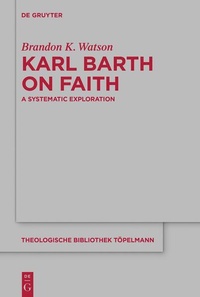
Karl Barth on Faith
Description

The present volume examines an underdeveloped component in the theology of Karl Barth. Specifically, the work asks: how, and to what extent, can faith be understood as ontologically proper to the trinitarian becoming of God? The work argues for an ontological grounding of faith in the becoming of God. To do so, Watson performs an in-depth examination of Barth's understanding of the concept of faith. Using Barth's threefold movement of revelation, the work contends God can be thought of as the subject ( Glaubender ), predicate ( Glaube ), and object ( Geglaubte ) of faith. Barth's theological exposition of Jesus as subject and object of election offers a promising proposal for how faith is ontologically understood. At the same time, the argument brings to the fore a crucial component of Barth's theological program, namely, the concept of recognition ( Anerkennung ). God's recognizing faith is then conceived as the condition of the possibility of human faith. Drawing on Barth's entire oeuvre, Watson offers an understanding of the divine becoming of faith that opens possibilities for thinking systematically about the realization of the corresponding human faith.
More details
Other editions
Additional editions
Person
Content
- Intro
- Acknowledgements
- Contents
- Abbreviations
- 1 The Trajectory of Faith
- 2 Faith's Dialectical Background
- 3 Christology and Pneumatology
- 4 The Electing God and Elected Human
- 5 A Revealed Faith
- 6 Conclusion
- Appendix 1
- Appendix 2
- Appendix 3
- Bibliography
- Subject Index
