

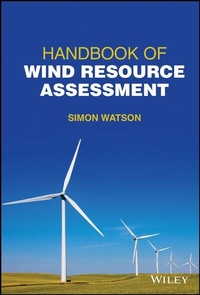
Handbook of Wind Resource Assessment
1st Edition
Published on 14. March 2023
320 pages
978-1-119-05530-3 (ISBN)
Description

HANDBOOK OF WIND RESOURCE ASSESSMENT
Useful reference text underpinning the theory behind wind resource assessment along with its practical application
Handbook of Wind Resource Assessment provides a comprehensive description of the background theory, methods, models, applications, and analysis of the discipline of wind resource assessment, covering topics such as climate variability, measurement, wind distributions, numerical modeling, statistical modeling, reanalysis datasets, applications in different environments (onshore and offshore), wind atlases, and future climate.
The text provides an up-to-date assessment of the tools available for wind resource assessment and their application in different environments. It also summarizes our present understanding of the wind climate and its variability, with a particular focus on its relevance to wind resource assessment.
Written by a highly qualified professional in the fields of wind resource assessment, wind turbine condition monitoring, and wind turbine wake modeling, sample topics included in Handbook of Wind Resource Assessment are as follows:
* Climate variability, covering temporal scales of variation, power spectrum, short term variation and turbulence, the spectral gap, and long-term variation
* Measurement, covering history of wind speed measurement, types of measurement, terrestrial measurements, anemometers, wind vanes, lidars, sodars and remote sensing
* Distributions, covering synoptic scale wind distributions, turbulent scale distributions, contrast between mean and extreme values, and extreme value statistics
* Physical modeling, covering spatial scales of variability, the governing equations, models of varying complexity, mass consistent models, linearized models and semi-empirical models
* Statistical modeling, covering the use of measure-correlate-predict (MCP), wind indices and spatial interpolation
Handbook of Wind Resource Assessment serves as a comprehensive text that brings together the different aspects of wind resource assessment in one place. It is an essential resource for anyone who wishes to understand the underlying science, models, or applications of wind resources, including postgraduates, academics, and wind resource professionals.
Useful reference text underpinning the theory behind wind resource assessment along with its practical application
Handbook of Wind Resource Assessment provides a comprehensive description of the background theory, methods, models, applications, and analysis of the discipline of wind resource assessment, covering topics such as climate variability, measurement, wind distributions, numerical modeling, statistical modeling, reanalysis datasets, applications in different environments (onshore and offshore), wind atlases, and future climate.
The text provides an up-to-date assessment of the tools available for wind resource assessment and their application in different environments. It also summarizes our present understanding of the wind climate and its variability, with a particular focus on its relevance to wind resource assessment.
Written by a highly qualified professional in the fields of wind resource assessment, wind turbine condition monitoring, and wind turbine wake modeling, sample topics included in Handbook of Wind Resource Assessment are as follows:
* Climate variability, covering temporal scales of variation, power spectrum, short term variation and turbulence, the spectral gap, and long-term variation
* Measurement, covering history of wind speed measurement, types of measurement, terrestrial measurements, anemometers, wind vanes, lidars, sodars and remote sensing
* Distributions, covering synoptic scale wind distributions, turbulent scale distributions, contrast between mean and extreme values, and extreme value statistics
* Physical modeling, covering spatial scales of variability, the governing equations, models of varying complexity, mass consistent models, linearized models and semi-empirical models
* Statistical modeling, covering the use of measure-correlate-predict (MCP), wind indices and spatial interpolation
Handbook of Wind Resource Assessment serves as a comprehensive text that brings together the different aspects of wind resource assessment in one place. It is an essential resource for anyone who wishes to understand the underlying science, models, or applications of wind resources, including postgraduates, academics, and wind resource professionals.
More details
Other editions
Additional editions
S Watson
Handbook of Wind Resource Assessment
Book
04/2023
1st Edition
Wiley-Blackwell
€143.61
Shipment within 15-20 days
S. Watson
Handbook of Wind Resource Assessment
Software
03/2023
Wiley
€191.66
Article exhausted; check different version
Person
Simon Watson is Head of the Wind Energy Section for the Faculty of Aerospace Engineering, Delft University of Technology. He has been working in the field of wind energy for over 30 years and is the Editor-in-Chief of the Wiley Wind Energy journal.
Content
Preface ix
Acknowledgements xi
About the Author xiii
1 Introduction 1
2 The Atmospheric Boundary Layer 11
3 Measurement 33
4 Wind Speed Variability and Distributions 85
5 Numerical Modelling 111
6 Wind Resource Estimation in Complex Terrain, Offshore, and in Urban Areas 157
7 Orographic Test Cases 179
8 Statistical Methods 199
9 Atmospheric Reanalyses and Wind Atlases 227
10 Mesoscale Phenomena 263
11 Long-term Wind Climate Trends 281
Index 291
