

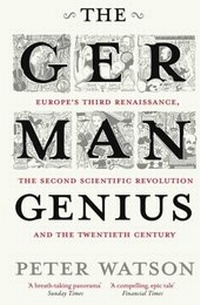
The German Genius
Europe's Third Renaissance, the Second Scientific Revolution and the Twentieth Century
1st Edition
Published on 16. September 2010
992 pages
978-0-85720-324-3 (ISBN)
Description

From the end of the Baroque age and the death of Bach in 1750 to the rise of Hitler in 1933, Germany was transformed from a poor relation among western nations into a dominant intellectual and cultural force more influential than France, Britain, Italy, Holland, and the United States. In the early decades of the 20th century, German artists, writers, philosophers, scientists, and engineers were leading their freshly-unified country to new and undreamed of heights, and by 1933, they had won more Nobel prizes than anyone else and more than the British and Americans combined. But this genius was cut down in its prime with the rise and subsequent fall of Adolf Hitler and his fascist Third Reich-a legacy of evil that has overshadowed the nation's contributions ever since.
Yet how did the Germans achieve their pre-eminence beginning in the mid-18th century? In this fascinating cultural history, Peter Watson goes back through time to explore the origins of the German genius, how it flourished and shaped our lives, and, most importantly, to reveal how it continues to shape our world. As he convincingly demonstarates, while we may hold other European cultures in higher esteem, it was German thinking-from Bach to Nietzsche to Freud-that actually shaped modern America and Britain in ways that resonate today.
Yet how did the Germans achieve their pre-eminence beginning in the mid-18th century? In this fascinating cultural history, Peter Watson goes back through time to explore the origins of the German genius, how it flourished and shaped our lives, and, most importantly, to reveal how it continues to shape our world. As he convincingly demonstarates, while we may hold other European cultures in higher esteem, it was German thinking-from Bach to Nietzsche to Freud-that actually shaped modern America and Britain in ways that resonate today.
More details
Other editions
Additional editions
Peter Watson
The German Genius
Europe's Third Renaissance, the Second Scientific Revolution and the Twentieth Century
Book
08/2011
Simon & Schuster
€15.50
Available immediately
Person
Peter Watson is a journalist, television presenter and historian of ideas. He was a senior editor of the Sunday Times, New York correspondent of The Times and a columnist for the Observer. He has written for multiple publications, including the New York Times and Spectator. His books, which have been translated into more than 25 languages, include Ideas: A History from Fire to Freud, The German Genius, The French Mind and Convergence: The Idea at the Heart of Science.
Content
- Intro
- Half-title page
- Also By Peter Watson
- Title page
- Copyright page
- Contents page
- Author's Note
- Introduction: Blinded by the Light: Hitler, the Holocaust, and 'the Past That Will Not Pass Away'
- PART ONE THE GREAT TURN IN GERMAN LIFE
- 1. Germanness Emerging
- 2. Bildung and the Inborn Drive toward Perfection
- PART TWO A THIRD RENAISSANCE, BETWEEN DOUBT AND DARWIN
- 3. Winckelmann, Wolf, and Lessing: the Third Greek Revival and the Origins of Modern Scholarship
- 4. The Supreme Products of the Age of Paper
- 5. New Light on the Structure of the Mind
- 6. The High Renaissance in Music: The Symphony as Philosophy
- 7. Cosmos, Cuneiform, Clausewitz
- 8. The Mother Tongue, the Inner Voice, and the Romantic Song
- 9. The Brandenburg Gate, the Iron Cross, and the German Raphaels
- PART THREE THE RISE OF THE EDUCATED MIDDLE CLASS: THE ENGINES AND ENGINEERS OF MODERN PROSPERITY
- 10. Humboldt's Gift: The Invention of Research and the Prussian (Protestant) Concept of Learning
- 11. The Evolution of Alienation
- 12. German Historicism: 'A Unique Event in the History of Ideas'
- 13. The Heroic Age of Biology
- 14. Out from 'The Wretchedness of German Backwardness'
- 15. 'German Fever' in France, Britain, and the United States
- 16. Wagner's Other Ring--Feuerbach, Schopenhauer, Nietzsche
- 17. Physics Becomes King: Helmholtz, Clausius, Boltzmann, Riemann
- 18. The Rise of the Laboratory: Siemens, Hofmann, Bayer, Zeiss
- 19. Masters of Metal: Krupp, Benz, Diesel, Rathenau
- 20. The Dynamics of Disease: Virchow, Koch, Mendel, Freud
- PART FOUR THE MISERIES AND MIRACLES OF MODERNITY
- 21. The Abuses of History
- 22. The Pathologies of Nationalism
- 23. Money, the Masses, the Metropolis: The 'First Coherent School of Sociology'
- 24. Dissonance and the Most-Discussed Man in Music
- 25. The Discovery of Radio, Relativity, and the Quantum
- 26. Sensibility and Sensuality in Vienna
- 27. Munich/Schwabing: Germany's 'Montmartre'
- 28. Berlin Busybody
- 29. The Great War between Heroes and Traders
- 30. Prayers for a Fatherless Child: The Culture of the Defeated
- 31. Weimar: 'Unprecedented Mental Alertness'
- 32. Weimar: The Golden Age of Twentieth-Century Physics, Philosophy, and History
- 33. Weimar: 'A Problem in Need of a Solution'
- PART FIVE SONGS OF THE REICH: HITLER AND THE 'SPIRITUALIZATION OF THE STRUGGLE'
- 34. Nazi Aesthetics: The 'Brown Shift'
- 35. Scholarship in the Third Reich: 'No Such Thing as Objectivity'
- 36. The Twilight of the Theologians
- 37. The Fruits, Failures, and Infamy of German Wartime Science
- 38. Exile, and the Road into the Open
- PART SIX BEYOND HITLER: CONTINUITY OF THE GERMAN TRADITION UNDER ADVERSE CONDITIONS
- 39. The 'Fourth Reich': The Effect of German Thought on America
- 40. 'His Majesty's Most Loyal Enemy Aliens'
- 41. 'Divided Heaven': From Heidegger to Habermas to Ratzinger
- 42. Cafe Deutschland: 'A Germany Not Seen Before'
- Conclusion: German Genius: The Dazzle, Deification, and Dangers of Inwardness
- Appendix: Thirty-five Underrated Germans
- Notes and References
- Index
