

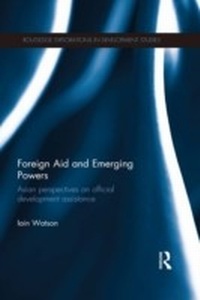
Foreign Aid and Emerging Powers
Asian Perspectives on Official Development Assistance
1st Edition
Published on 11. July 2014
268 pages
978-1-317-92833-1 (ISBN)
Description

Current debates on emerging powers as foreign aid donors often fail to examine the myriad geopolitical, geoeconomic and geocultural tensions that influence policies of Official Development Assistance (ODA).
This book advocates a regional geopolitical approach to explaining donor-donor relationships and provides a multidisciplinary critical assessment of the contemporary debates on emerging powers and foreign aid, bringing together economic and geopolitical approaches in the light of the 2015 completion of the Millennium Development Goals (MDGs). Moving away from established debates assessing the advantages and disadvantages of foreign aid, this book challenges the current geopolitical assumptions of the emerging powers concerning issues such as 'south-south' solidarity, shared development experience and 'multipolarity'. It analyses how donor governments 'sell' aid to recipients through enabling different cultural assumptions and soft power narratives of national identity and provides empirical evidence on agendas such as aid effectiveness, aid for trade, public-private partnerships, and green growth aid. The book examines the role of, and relationships between, the leading traditional and emerging power Asian donors specifically, and explores the different and contested perspectives and patterns of ODA policy through an alternative account of emerging power foreign aid to leading African and Asian recipients.
This book provides a valuable resource for postgraduate students and practitioners across disciplines such as development economics and geopolitics of development, uniquely approaching the debate from the perspective of emerging powers and donors.
This book advocates a regional geopolitical approach to explaining donor-donor relationships and provides a multidisciplinary critical assessment of the contemporary debates on emerging powers and foreign aid, bringing together economic and geopolitical approaches in the light of the 2015 completion of the Millennium Development Goals (MDGs). Moving away from established debates assessing the advantages and disadvantages of foreign aid, this book challenges the current geopolitical assumptions of the emerging powers concerning issues such as 'south-south' solidarity, shared development experience and 'multipolarity'. It analyses how donor governments 'sell' aid to recipients through enabling different cultural assumptions and soft power narratives of national identity and provides empirical evidence on agendas such as aid effectiveness, aid for trade, public-private partnerships, and green growth aid. The book examines the role of, and relationships between, the leading traditional and emerging power Asian donors specifically, and explores the different and contested perspectives and patterns of ODA policy through an alternative account of emerging power foreign aid to leading African and Asian recipients.
This book provides a valuable resource for postgraduate students and practitioners across disciplines such as development economics and geopolitics of development, uniquely approaching the debate from the perspective of emerging powers and donors.
More details
Series
Language
English
Place of publication
London
United Kingdom
Publishing group
Taylor & Francis Ltd
Target group
College/higher education
Product notice
Reflowable
Illustrations
19 s/w Abbildungen, 19 s/w Tabellen
19 Tables, black and white; 19 Illustrations, black and white
File size
1,29 MB
ISBN-13
978-1-317-92833-1 (9781317928331)
Copyright in bibliographic data and cover images is held by Nielsen Book Services Limited or by the publishers or by their respective licensors: all rights reserved.
Schweitzer Classification
Other editions
Additional editions
Book
12/2015
1st Edition
Routledge
€71.60
Shipment within 10-20 days
Book
07/2014
1st Edition
Routledge
€241.10
Shipment within 15-20 days
Person
Iain Watson is Assistant Professor at the Department of International Development and Cooperation, Graduate School of International Studies, Ajou University, South Korea. He was visiting fellow at the Centre on Migration, Policy and Society (COMPAS), Oxford University, UK, from January to March 2013.
Content
Introduction 1. The Contemporary Foreign Aid Debate: Emerging Powers 2. International Relations Perspectives: Emerging Powers and the Contemporary Geopolitics of Asia 3. Geopolitics and Asian Donors: China, Japan and South Korea in Africa 4. Asian ODA: Assessing Emerging Donors in the Asian Region 5. Emerging Powers, Asian Foreign Aid and the Greening of Geopolitics 6. From Aid Effectiveness to Public-Private Partnerships (PPPs): New Agendas in Asian ODA Conclusion
