

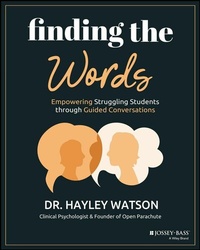
Finding the Words
Description

Boost your confidence in supporting the mental health of all students
Educators can't always fix or change students' challenging situations, but with Dr. Hayley Watson's Finding the Words, they can create compassionate, safe spaces to truly make a difference to student wellbeing. As educators, we are in a position where we can help students break out of cycles of anxiety, low mood, and peer struggles, without needing to be a mental health expert. This book shows you how to support students with issues like parental loss, low body image, bullying, addiction, and more-with practical language that you can use anytime you are on-the-spot with a struggling student. This language helps you set boundaries to protect your own wellbeing, by guiding your students towards self-reliance and resilience.
In Finding the Words, author and clinical psychologist Hayley Watson offers practical advice with a personal, self-reflective, and relatable tone. In each chapter, you'll explore the topics students struggle with most, including hot-button issues like consent and prejudice. You'll learn how to talk to kids about these issues in a way that helps them make positive changes in their lives. With this book, you will feel like you have a psychologist on hand to support you in those moments when you know your response could mean the world to a struggling student.
- Understand the common issues your students face-anxiety, low body image, acting out, and beyond
- Read first-person accounts from youth ages 5-19, showing how appropriate responses can nurture and support students through any challenge they face
- Gain specific, practical techniques and takeaways to use right away in your interactions with students
- Learn the most effective language to use when you are on-the-spot with a struggling student
This is a critical resource for school leaders, teacher leaders, classroom teachers and school staff. Any adults who work with youth can benefit from this insightful, expert advice on how to help in the moments when your students need you most.
More details
Other editions
Additional editions
Person
Dr. Hayley Watson is a clinical psychologist specializing in children and adolescents and the founder of Open Parachute, a video-based school mental health program using documentary stories of real students sharing their experiences of overcoming struggle. The platform reaches more than half a million students and educators worldwide.
Content
Acknowledgments xv
Introduction xvii
Chapter 1 understanding student mental health 1
Shadow qualities and the true self 1
Section 1 rejecting/acceptance (remembering love) 11
Chapter 2 finding the words with students who are in rejecting behavior patterns 13
What can I do to help students who are rejecting? 15
Chapter 3 encouraging students who are disengaged from school 17
Why do students disengage from school? 17
What can I do to help a student who is disengaged from school? 18
How will I have a constructive conversation with a student who is disengaged from school? 18
Chapter 4 supporting students who face abuse and domestic violence 25
Why does abuse and domestic violence impact students? 25
What can I do to help a student who has faced abuse or domestic violence? 26
How will I have a constructive conversation with a student who has faced abuse or domestic violence? 26
chapter 5 coaching students who bully or are aggressive/violent 33
Why do students act with aggression or bully others? 33
What can I do to help a student who is being aggressive or bullying others? 34
How will I have a constructive conversation with a student who has been aggressive or bullied others? 34
Chapter 6 helping gender diverse students feel included 41
Why do many students with gender diversity struggle so much? 41
What can I do to help a student who is gender diverse and struggling to feel accepted? 42
How will i have a constructive conversation with a student who is struggling with their experience of gender? 42
Section 2 controlling/spontaneity (remembering safety) 49
Chapter 7 finding the words with students who are in controlling behavior patterns 51
What can I do to help students who are controlling? 52
Chapter 8 supporting students who are worried, anxious, or stressed 55
Why do students experience worries, anxiety, and stress? 55
What can I do to help a student who is experiencing worries, anxiety, or stress? 56
How will I have a constructive conversation with a student who is experiencing worries, anxiety, or stress? 56
Chapter 9 guiding students away from peer rivalry 61
Why do students get into rivalries with peers and siblings? 61
What can I do to help a student who is in a rivalry with a peer or sibling? 62
How will I have a constructive conversation with a student who is in a rivalry with a peer or sibling? 62
Chapter 10 talking to students about unhealthy eating habits 69
Why do students have disordered eating? 69
What can I do to help a student who has disordered eating? 70
How will I have constructive conversation with a student who has disordered eating? 70
Section 3 avoiding/openness (remembering courage) 79
Chapter 11 finding the words with students who are in avoiding behavior patterns 81
What can I do to help students who are avoiding? 82
Chapter 12 supporting students who self-harm 85
Why do students self-harm? 85
What can I do to help a student who is self-harming? 86
How will I have a constructive conversation with a student who is self-harming? 86
Chapter 13 helping students who people-please 95
Why do students develop people-pleasing behaviors? 95
What can I do to help a student who is people-pleasing? 96
How will I have a constructive conversation with a student who is people-pleasing? 96
Chapter 14 encouraging students who are depressed or apathetic 103
Why do students get depressed and become apathetic? 103
What can I do to help a student who is depressed or apathetic? 104
How will I have a constructive conversation with a student who is depressed or apathetic? 104
Chapter 15 guiding students who are caught in addictive patterns 119
Why do students become addicted? 119
What can I do to help a student who is in an addictive pattern? 120
How will I have a constructive conversation with a student who is in an addictive pattern? 120
Chapter 16 communicating with students who have faced loss 129
Why do students struggle to cope with loss/grief? 129
What can I do to help a student who is struggling with grief? 130
How will I have a constructive conversation with a student who is grieving? 130
Section 4 following/leadership (remembering identity) 141
Chapter 17 finding the words with students who are in following behavior patterns 143
What can I do to help students who are following? 144
Chapter 18 supporting students who are negatively impacted by gender norms 147
Why are gender norms impacting students? 147
What can I do to help a student who is impacted by gender norms? 148
How will I have a constructive conversation with a student about gender norms? 148
Chapter 19 guiding students to make healthy choices on social media 155
Why is social media impacting students? 155
What can I do to help a student who is impacted by social media? 156
How will I have a constructive conversation with a student about social media? 156
Chapter 20 supporting students with low body image 163
Why does body image impact students? 163
What can I do to help a student with low body image? 164
How will I have a constructive conversation with a student about body image? 164
Chapter 21 helping students stand up to peer pressure 171
Why does peer pressure impact students? 171
What can I do to help a student who is impacted by peer pressure? 172
How will I have a constructive conversation with a student about peer pressure? 172
Chapter 22 supporting students who are bullied 179
Why does being bullied impact students? 179
What can I do to help a student who is being bullied? 180
How will I have a constructive conversation with a student about being bullied? 180
Chapter 23 guiding students who violate consent 185
Why do students violate consent? 185
What can I do to help a student who has violated consent? 186
How will I have a constructive conversation with a student about consent violations? 186
Chapter 24 helping students who face prejudice 193
Why are students impacted by prejudice? 193
What can I do to help a student who is impacted by prejudice? 194
How will I have a constructive conversation with a student who is impacted by prejudice? 194
Section 5 repeating/freedom (remembering clarity) 201
Chapter 25 finding the words with students who are in repeating behavior patterns 203
What can I do to help students who are repeating? 204
Chapter 26 minimizing the influence of pornography and "rape culture" 207
Why are students impacted by pornography and why does "rape culture" exist? 207
What can I do to help a student who is impacted by pornography and involved in "rape culture"? 208
How will I have a constructive conversation with a student who is impacted by pornography and participating in "rape culture"? 208
Chapter 27 supporting students who experience intergenerational trauma 215
Why are students impacted by intergenerational trauma? 215
What can I do to help a student who has experienced intergenerational trauma? 216
How will I have a constructive conversation with a student who has experienced intergenerational trauma? 216
Chapter 28 helping students cope with being objectified 223
Why are students impacted by objectification? 223
What can I do to help a student who has experienced objectification? 224
How will I have a constructive conversation with a student who has been objectified? 224
Chapter 29 responding to students who share stories of parental conflict and separation 229
Why are students impacted by parental conflict and separation? 229
What can I do to help a student who is struggling with parental conflict or separation? 230
How will I have a constructive conversation with a student who is struggling with parental conflict or separation? 230
Chapter 30 what's next? 237
About the author 239
Index 241
Introduction
This book is unique in its approach. It is not a book about theories or analysis, it is a practical how-to handbook. It will provide you with guided conversations based on interviews with real students so that you can learn the specific language that will help you respond to the challenges your students face.
Mental health can be an overwhelming topic for educators. You hear the terrifying statistics. You know your students are struggling now more than ever. Mostly you might feel confident in your ability to help because you know your students and you're good at what you do. But right now, youth are in a mental health crisis, and sometimes you might get stuck when things are heavy or intense or on a scale you haven't yet experienced. Sometimes it's hard to know when to refer your students to a mental health professional and what you can say in those moments when there is no one else there but you.
This learning is essential for every educator, even if you don't want to speak about mental health at all with your students (which is completely understandable!). Think of it like CPR training. We aren't doctors, we don't know how to do surgery, but we all go through the training so that in the event that we are in front of someone whose heart has stopped, we can keep them alive until help arrives.
One of the hardest things about being an educator is that you are always "on." When you encounter student struggles and mental health challenges, it is on the fly, in the moment, and you often don't have the luxury of providing much more than a few words. Feeling on the spot with a student's reality and not being quite sure what you should or shouldn't say can be a stressful and challenging experience. This is part of what is leading to so much teacher burnout.
Being an educator, you are immersed in human connection, and the messiness this entails, and you are the first to see the ever-changing landscape of challenges that young people face. Even though you might not feel equipped to deal with some of the things your students are experiencing, you are. You care, and you want to help. Those are the fundamentals. You don't need to be a psychologist or a mental health "expert." All you need is a source of practical guidance that you can use to build on your already strong foundation to provide support for your students while also supporting yourself.
This book is that source. You can use the index to flip to any challenge you see occurring for your students, and in a matter of minutes, you will have an example of dialogue and language that you can draw on. This will help you move from your already strong foundation of connecting to and caring for your students to knowing precisely what to do in order to provide deep and meaningful mental health support. To provide the kind of support that builds resilience in students so they are more equipped to help themselves, and that creates a healthy boundary for you at the same time. When you know your words are helping, you are less likely to take the burden of what you hear in the classroom home with you, creating less stress in your life. These impactful conversations with struggling students will mean that you have more time, headspace, and energy to focus on teaching. And more specifically, teaching students who are mentally and emotionally ready to learn.
The information found in this book is based on my education in this field, which includes five academic degrees, my Ph.D. research into school bullying interventions, and my work as a clinical psychologist. But more than any of that, the greatest insights I have gained to advise my theoretical perspective are based on two things: First, my own therapeutic processing of the trauma that I faced in my early life, which allowed me to develop a deeply personal understanding of the theories I was presented with throughout my educational journey. By seeing my own patterns, changing some, and struggling to change others, I have become acutely aware of how our thoughts and feelings play out in the way we treat ourselves and each other on a daily basis. And second, the work I have done with schools and students over the past 20 years-some as a psychologist, some as a program developer, and some as a mentor and youth worker. Doing this work has given me a deep insight into the way mental health plays out in the real world, in school settings. The mental health challenges that educators are presented with are often confusing and multilayered, and there is usually a deficit of time to deal with the challenges of so many students in the midst of a busy school day. This is what led me to develop Open Parachute, which is a Tier 1 mental health curriculum program to assist teachers in delivering impactful mental health lessons to all of their students without needing to be a mental health "expert" themselves. Many of the teachers delivering these lessons all over the world have asked me a similar question: "If something comes up in class, what exactly do I say?" This book is an answer to that question, and is for all the brilliant educators out there who tirelessly (and often thanklessly) do the hard work every day to connect to and care for their students. In these pages, I hope you find the words that can help you navigate the challenges you face in your classroom every day.
What Is Really Going on with Students?
Every child is born with the wisdom to flourish. Every person inherently knows what they need to thrive. If they didn't, we wouldn't have survived so effectively as a species. And yet in today's world, many youth are struggling for a growing list of reasons. Many families face challenges that are beyond their control, and in many homes, the isolation and sudden changes of COVID exacerbated these challenges. Most students are in consistent contact with technology, and this can overwhelm and overstimulate them. While social media serves as a powerful tool for connection, it also increases many students' experiences of loneliness and decreases their self-esteem. With more and more image editing, increasing numbers of students feel ashamed of their bodies, which further diminishes their sense of self. Any student who does not quite fit in with their peers begins to see themselves as "less than," which impacts their agency and motivation to strive. There are so many ever-changing challenges that children and teenagers face in our world right now that it has become an impossible task for parents to protect them or prepare them adequately.
While this can all feel pretty bleak and disheartening, the good news is that there actually is something that we, as adults, can do to help. No, we don't have all the answers. No, we can't make their challenges go away. But what we can do is remind them that they have everything they need to find their way to the other side of whatever they are facing. It might not be easy, and it might take time, but they can learn to reflect on and understand their own experiences, and do things to actively build their support systems and support themselves. These steps will drastically improve any student's mental health, and these are things that we can coach and encourage them to do every single day.
Humans have the capacity to overcome seemingly insurmountable obstacles. This has been proven time and time again. When faced with struggle, we have the incredible ability to shift, change, and adapt to achieve greatness that we never would have imagined. When faced with 27 years in prison, Nelson Mandela cultivated the courage and open-heartedness to lead an entire nation to a peaceful revolution. When faced with starvation and isolation, Anne Frank found the wisdom to write words that would teach profound compassion to the world for generations to come. When brutally gunned down, Malala Yousafzai found the strength to speak with such a commanding presence that she started an educational revolution that gave millions of girls the opportunity to expand their minds. Each of these incredible people changed the course of history simply by facing a personal challenge. As they struggled, they dug deep within themselves, and in so doing, found their own unique brilliance that could help not only themselves, but the world around them.
Every one of us has within themselves that brilliance and power. We just don't always know how to access it.
And so instead of expanding to our fullest potential when we face adversity, many of us simply fall into despair and get caught up in our fears. We start to self-destruct. We are so lost in our reactions that we become disconnected from our natural internal motivation to thrive. This is what separates us from animals. Our incredible mind has the ability to make something out of nothing. So when we are connected to ourselves and the world around us, we can be courageous and compassionate beyond measure, inspiring the world to do what is right and good and fair for everyone. But when our mind is spinning away from us and we no longer have a grasp on who we are or what we're capable of, all that mental power becomes focused on escaping what we're feeling. At all costs.
In the classroom, this might look like daydreaming, persistent disruptive behavior, withdrawal, nonattendance, or overly dramatic responses. All of this flags a deeper issue that this student is facing.
Imagine walking along a mountain path that's clearly marked, so every time you come to a crossroads you can see an indication of the right direction to take. Maybe it takes you a while to...
