

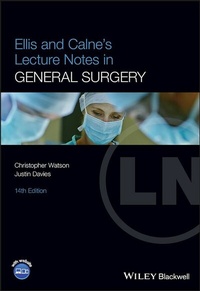
Ellis and Calne's Lecture Notes in General Surgery
Description

Ellis and Calne's Lecture Notes in General Surgery is a comprehensive guide that focuses on the fundamentals of general surgery while systematically covering all the clinical surgical problems that a student or doctor in training may encounter and about which they need to know.
The text includes principles of treatment that have been written at a level to inform the medical student and doctor in training. The text features color illustrations throughout and includes electronic access to a wide range of extra material including case studies, radiological and clinical images, and biographies.
Sample topics discussed in Ellis and Calne's Lecture Notes in General Surgery include:
- Surgical strategy, human factors in surgery, fluid and nutrition management, preoperative assessment, postoperative complications, acute infections, tumours, and shock
- Trauma surgery, burns, the skin and its adnexae, arterial disease, the heart and thoracic aorta, and the chest and lungs
- The brain and meninges, head injury, the spine, peripheral nerve injuries, the oral cavity and the salivary glands
- The oesophagus, stomach and duodenum, the surgery of obesity, the small intestine, the appendix, the colon, and the rectum and anal canal
- The kidney, ureter, bladder, testes and prostate
Trusted by generations of medical students, including the current authors, the clinical emphasis of Ellis and Calne's Lecture Notes in General Surgery makes this an essential reference for all those wishing to learn more about general surgery. It is also a perfect revision text for medical students and junior surgeons taking the MRCS examination.
For more information on the complete range of Wiley medical student and junior doctor publishing, please visit: www.wiley.com
To receive automatic updates on Wiley books and journals, join our email list. Sign up today at www.wiley.com/email
This new edition is also available as an e-book. For more details, please see http://www.wiley.com/buy/9781119862482
All content reviewed by students for students
Wiley Medical Education books are designed exactly for their intended audience. All of our books are developed in collaboration with students. This means that our books are always published with you, the student, in mind.
If you would like to be one of our student reviewers, go to www.reviewmedicalbooks.com to find out more.
More details
Other editions
Additional editions
Persons
Christopher Watson, MD BChir FRCS, Professor of Transplantation and Honorary Consultant, Addenbrooke's Hospital, Cambridge, UK.
Justin Davies, MA MChir FRCS FEBS, The department of Surgery, Addenbrooke Hospital, Cambridge University, UK.
Content
Author affiliations, vi
Preface, viii
Acknowledgements, ix
Abbreviations, x
About the companion website, xiv
1 Surgical strategy (Justin Davies), 1
2 Human factors in surgery (Peter A. Brennan), 5
3 Fluid and nutrition management (Lynsey Spillman), 12
4 Preoperative assessment (Hemantha Alawattegama), 20
5 Postoperative complications (Elizabeth Tweedle), 27
6 Acute infections (Christopher Watson), 49
7 Tumours (Christopher Watson), 55
8 Shock (Vijay Sujendran), 63
9 Trauma surgery (Jonathan Morton), 70
10 Burns (Ian Grant), 79
11 The skin and its adnexae (Amer J. Durrani), 86
12 Arterial disease (Patrick Coughlin), 101
13 The heart and thoracic aorta (David P. Jenkins), 119
14 The chest and lungs (Aman Singh Coonar), 129
15 Venous disorders of the lower limb (Manj Gohel), 140
16 The brain and meninges (Stephen Price), 147
17 Head injury (Stephen Price), 157
18 The spine (Rodney J. C. Laing), 170
19 Peripheral nerve injuries (Ian Grant), 182
20 The oral cavity (Kanwalraj Moar), 189
21 The salivary glands (Brian Fish), 203
22 The oesophagus (Peter Safranek), 208
23 The stomach and duodenum (Stavros Gourgiotis), 218
24 The surgery of obesity, (Christopher Pring), 240
25 The small intestine (Justin Davies), 245
26 The appendix (Ioanna G. Panagiotopoulou), 251
27 The colon (Justin Davies), 259
28 The rectum and anal canal (Justin Davies), 274
29 The acute abdomen (Constantinos Simillis), 289
30 Intestinal obstruction and paralytic ileus (Christopher Watson), 299
31 Hernia (Christopher Watson), 311
32 The liver (Raaj Kumar Praseedom), 323
33 The gallbladder and bile ducts (Anita Balakrishnan), 340
34 The pancreas (Raaj Kumar Praseedom), 351
35 The spleen (Christopher Watson), 364
36 The lymph nodes and lymphatics (Christopher Watson), 367
37 The breast (Eleftheria Kleidi), 371
38 The neck (Ekpemi Irune), 389
39 The thyroid (Brian Fish), 393
40 The parathyroids (Ekpemi Irune), 406
41 The thymus (Christopher Watson), 412
42 The adrenal glands (Vasilis Kosmoliaptsis), 414
43 The kidney and ureter (Alexandra J. Colquhoun), 425
44 The bladder (Alexandra J. Colquhoun), 444
45 The prostate (Arthur McPhee), 450
46 The male urethra (Arthur McPhee), 459
47 The penis (Arthur McPhee), 462
48 The testis and scrotum (Alexandra J. Colquhoun), 466
49 Transplantation surgery (Christopher Watson), 476
Index, 000
Abbreviations
ABPI ankle brachial pressure index ABG arterial blood gas ABLS Advanced Burns Life Support ACE angiotensin-converting enzyme ACTH adrenocorticotrophic hormone ADH antidiuretic hormone ADT androgen deprivation therapy AFP a-fetoprotein AIs aromatase inhibitors AIDS acquired immune deficiency syndrome AIN anal intraepithelial neoplasia AJCC American Joint Committee on Cancer ALK anaplastic lymphoma kinase ALP alkaline phosphatase ALT alanine transaminase ANC axillary node clearance ANS axillary node sampling ANUG acute necrotizing ulcerative gingivitis APFC acute peripancreatic fluid collection APACHE Acute Physiology and Chronic Health Evaluation APTT activated partial thromboplastin time APUD amine precursor uptake and decarboxylation ASA American Society of Anesthesiologists ASD atrial septal defect ASIA American Spinal Injury Association AST aspartate transaminase ATN acute tubular necrosis ATLS Advanced Trauma Life Support AXR abdominal X-ray ß-HCG ß-human chorionic gonadotrophin BCG bacille Calmette-Guérin BCS breast conserving surgery BMI body mass index BPH benign prostatic hyperplasia CABG coronary artery bypass graft CAPOX capecitabine and oxaliplatin CAR chimeric antigen receptor CaSR calcium sensing receptor CEA carcinoembryonic antigen CEAP Clinical, Etiological, Anatomical and Pathophysiological CHRPE congenital hypertrophy of the retinal pigment epithelium CMV cytomegalovirus CNS central nervous system COPD chronic obstructive pulmonary disease CPAP continuous positive airways pressure CPE carbapenemase-producing enterobacteriaceae CPPS chronic pelvic pain syndrome CRE carbopenem-resistant enterobacteriaceae CRP C-reactive protein CSF cerebrospinal fluid CT computed tomography CTLA4 cytotoxic lymphocyte-associated antigen 4 CTPA computed tomographic pulmonary angiography CVP central venous pressure CXR chest X-ray DBD donation after brain-stem death DCD donation after circulatory death DCIS ductal carcinoma in situ DCS damage control surgery DDAVP deamino-D-arginine vasopressin DHCA deep hypothermic circulatory arrest DIC disseminated intravascular coagultion DIOS distal intestinal obstruction syndrome DMSA dimercaptosuccinic acid DOPA dihydroxyphenyl alanine DST dexamethasone suppression test DTC differentiated thyroid cancer DTPA diethylene triamine penta-acetic acid DVT deep venous thrombosis EBV Epstein-Barr virus ECG electrocardiogram ECST European Carotid Surgery Trial EGFR epidermal growth factor receptor EGC early gastric cancer EMG electromyography EMR endoscopic mucosal resection EMSB Emergency Management of Severe Burns ER oestrogen receptor ERAS Enhanced Recovery After Surgery ERCP endoscopic retrograde cholangiopancreatography ESBL extended spectrum ß-lactamase ESD endoscopic submucosal dissection ESR erythrocyte sedimentation rate ESWL extracorporeal shock-wave lithotripsy EUS endoscopic or endoluminal ultrasound EVAR Endovascular Aneurysm Repair 5-FU 5-fluorouracil FAP familial adenomatous polyposis FAST focused abdominal sonography for trauma FBC full blood count FDG fluorodeoxyglucose FEV1 forced expiratory volume in 1 second FFP fresh frozen plasma FIT faecal immunochemical test FNAC fine-needle aspiration cytology FOLFOX folinic acid and oxaliplatin FSH follicle-stimulating hormone GABA ?-aminobutyric acid GANT gastrointestinal autonomic nervous tumour GCS Glasgow Coma Score GEP-NETs gastroenteropancreatic neuroendocrine tumours GFR glomerular filtration rate GGT ?-glutamyl transferase GI gastrointestinal GIM gastrointestinal metaplasia GIST gastrointestinal stromal tumour GLA ?-linolenic acid GOJ gastro-oesophageal junction GnRH gonadotrophin-releasing hormone GORD gastroesophageal reflux disease GPA granulomatosis with polyangiitis GTN glyceryl trinitrate HAART highly active antiretroviral treatment HALO haemorrhoidal artery ligation HALT hungry, anxious/angry, late, tired HAMN high-grade appendiceal mucinous neoplasms HbA1c glycosylated haemoglobin HCl hydrochloric acid HCC hepatocellular carcinoma HER2 human epidermal growth factor receptor 2 HGD high-grade dysplasia HHT hereditary haemorrhagic telangiectasia HHV human herpes virus ... HIPEC heated intraperitoneal chemotherapy
