

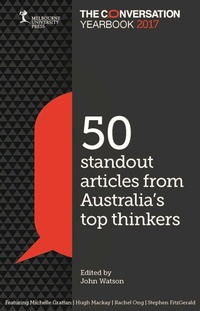
Conversation Yearbook 2017
50 articles that informed public debate
Published on 30. October 2017
264 pages
978-0-522-87267-5 (ISBN)
Description

In a time of heightened hostility towards experts, academics and scientists, the 2017 collection of the best Conversation articles and essays is a must-read. Articles range from a FactCheck of the claim that Indigenous Australians are the most incarcerated people on earth, to answering questions posed by curious children, to Hugh Mackay's observation that the state of the nation starts in your street. Joseph Paul Forgas writes on the surprising benefits of sadness and Stephen FitzGerald considers managing Australian foreign policy in a Chinese world.
If proof were needed that academia makes an essential contribution to public debate, you'll find it in these pages. Contributors include: Michelle Grattan, Hugh Mackay, Stephen FitzGerald, Denis Muller, Joseph Paul Forgas, Thalia Anthony, Alan Collins, Rachel Ong and Eileen Baldry.
If proof were needed that academia makes an essential contribution to public debate, you'll find it in these pages. Contributors include: Michelle Grattan, Hugh Mackay, Stephen FitzGerald, Denis Muller, Joseph Paul Forgas, Thalia Anthony, Alan Collins, Rachel Ong and Eileen Baldry.
More details
Other editions
Additional editions
Book
10/2017
Melbourne University Press
€14.50
Article not available at the moment
Person
John Watson joined The Conversation in December 2013 as politics & society editor. After two years in that role, he took up the new position of cities & policy editor. John has worked in the news media since he decided in the mid-1980s that a life tracking elephants (in the process of gaining an honours degree in ecology) was less interesting than being a journalist in apartheid-era South Africa. His residence was soon revoked and he returned to Australia. He joined The Conversation after nearly two decades with The Age as an editor, writer and columnist.
Content
- Intro
- Title
- Copyright
- Contents
- Foreword
- Chapter One Navigating an Age of Uncertainty
- If defeat comes, what then for the Liberals' succession?
- Climate change's signature was writ large on Australia's crazy summer of 2017
- What economics has to say about housing bubbles
- Note to Liberals: on the leadership front, best to keep calm and carry on
- The state of the nation starts in your street
- Chapter Two Making Sense of a World of Confusion
- Farewell John Clarke: in an absurd world we have never needed you more
- Dr Google probably isn't the worst place to get your health advice
- In defence of grammar pedantry
- Things you were taught at school that are wrong
- Mixed media: how Australia's newspapers became locked in a war of left versus right
- Managing Australian foreign policy in a Chinese world
- Who are you calling 'anti-science'? How science serves social and political agendas
- Why the media need to tread carefully when reporting research findings
- Chapter Three Learning from the Past
- A map that fills a 500-million-year gap in Earth's history
- The detective work behind the Budj Bim eel traps World Heritage bid
- Buried tools and pigments tell a new history of humans in Australia for 65,000 years
- Where the old things are: Australia's most ancient trees
- Roman gladiators were war prisoners and criminals,93 not sporting heroes
- Reading Germaine Greer's mail
- Lessons of 1967 referendum still apply to debates on constitutional recognition
- Chapter Four Brave New World
- How the internet knows if you're happy or sad
- Creative city, smart city . whose city is it?
- The economics of self-service checkouts
- The search to extend lifespan is gaining ground but can we truly reverse the biology of ageing?
- Our healthcare records outlive us-it's time to decide what happens to the data once we're gone
- Backyard skinny dippers lack effective laws to keep peeping drones at bay
- Chapter Five Please Explain
- Curious Kids: Does space go on forever?
- Was it four degrees hotter 110,000 years ago?
- Why bad moods are good for you: the surprising benefits of sadness
- Research Check: Can even moderate drinking cause brain damage?
- Here's why it's so hard to say whether inequality is going up or down
- Note to Margaret Court: the Bible isn't meant to be read that literally
- Chapter Six The Elusive Goal of a Just Society
- For renters, making housing more affordable is just the start
- Ban on sleeping rough does nothing to fix the problems of homelessness
- The passage of Gonski 2.0 is a victory for children over politics
- Why do we still make girls wear skirts and dresses as school uniform?
- Universities have a problem with sexual assault and harassment: here's how to fix it
- Witch-hunts and surveillance: the hidden lives of queer people in the military
- FactCheck Q&A: Are Indigenous Australians the most incarcerated people on Earth?
- Our big cities are engines of inequality, so how do we fix that?
- Chapter Seven How It All Adds Up
- FactCheck: Will 700,000 workers be 'ripped off' by penalty rate cuts, as Bill Shorten said?
- Australians are working longer so they can pay off their mortgage debt
- FactCheck: What are the facts on Australia's foreign aid spending?
- Budget bank levy: too big to fail, not too big to take a hit
- FactCheck Q&A: Is coal still cheaper than renewables as an energy source?
- Chapter Eight Sustaining Life on Our Overloaded Ark
- The world's coral reefs are in trouble, but don't give up on them yet
- Hazelwood power station: from modernist icon to greenhouse pariah
- Why you're almost certainly wasting time rinsing your recycling
- How many people can Australia feed?
- Five lessons from Tokyo, a city of 38 million people,241 for Australia, a nation of 24 million
