

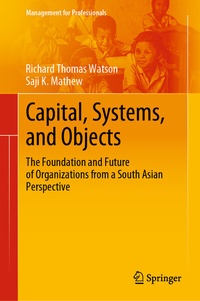
Capital, Systems, and Objects
Description

This book provides a set of integrated frameworks-capital, systems, and objects-that transcend managerial or technology hype by focusing on the long-term fundamentals that sustain organizational success, and it contains cases from South East Asia to elaborate this concept. Many organizations are currently addressing two important transformational issues: ecological sustainability and digitization. Sustainability is a goal, an end, and digitization is a process, a means to achieve a goal. This book introduces a flexible model that can be applied to current and future organizational challenges, including sustainability and digitization, because the fundamentals are constant.
This book is designed to serve two purposes for the readers: first, to present three conceptual foundations for designing and operating organizations (capital, systems, and objects (section 1)); and second, to provide a reference source for implementing these ideas in your organization (sections 2 and3). The first section of the book, chapters 1 through 7, sets forth the conceptual foundations. The chapters mix concepts and practical examples to give a new way of thinking about the setting in which one may work many days each year. The second section provides details and associated examples of every one of the thirty-six forms of capital conversion. It also illustrates how the five foundational systems support capital conversion in a variety of ways. Finally, the third section is about measuring capital and systems.
More details
Other editions
Additional editions
Persons
Richard Watson is a Regents Professor and the J. Rex Fuqua Distinguished Chair for Internet Strategy in the Terry College of Business at the University of Georgia. In 2011, he received the Association for Information Systems' LEO award for exceptional lifetime achievement in Information Systems. The University of Liechtenstein has established with government support a Consortium for Digital Capital Creation based on the ideas in this book.
Saji K. Mathew is currently a Professor at the Department of Management Studies, Indian Institute of Technology Madras. As a Fulbright Senior Scholar, he did his post-doctoral research on risk mitigation in offshore IT outsourcing at Emory University, Atlanta. He continues to work with corporations and academia on digital business strategy. He is one of the founding members of the Association for Information Systems, India chapter.