

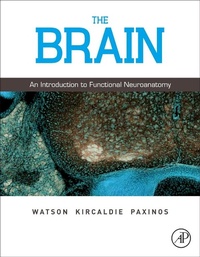
The Brain
An Introduction to Functional Neuroanatomy
Published on 20. September 2010
216 pages
978-0-08-092048-1 (ISBN)
Description

The authors of the most cited neuroscience publication, The Rat Brain in Stereotaxic Coordinates, have written this introductory textbook for neuroscience students. The text is clear and concise, and offers an excellent introduction to the essential concepts of neuroscience.
- Based on contemporary neuroscience research rather than old-style medical school neuroanatomy
- Thorough treatment of motor and sensory systems
- A detailed chapter on human cerebral cortex
- The neuroscience of consciousness, memory, emotion, brain injury, and mental illness
- A comprehensive chapter on brain development
- A summary of the techniques of brain research
- A detailed glossary of neuroscience terms
- Illustrated with over 130 color photographs and diagrams
This book will inspire and inform students of neuroscience. It is designed for beginning students in the health sciences, including psychology, nursing, biology, and medicine.
- Clearly and concisely written for easy comprehension by beginning students
- Based on contemporary neuroscience research rather than the concepts of old-style medical school neuroanatomy
- Thorough treatment of motor and sensory systems
- A detailed chapter on human cerebral cortex
- Discussion of the neuroscience of conscience, memory, cognitive function, brain injury, and mental illness
- A comprehensive chapter on brain development
- A summary of the techniques of brain research
- A detailed glossary of neuroscience terms
- Illustrated with over 100 color photographs and diagrams
More details
Other editions
Additional editions
Charles Watson | Matthew Kirkcaldie | George Paxinos
The Brain
An Introduction to Functional Neuroanatomy
Book
09/2010
Academic Press
€58.50
Shipment within 15-20 days
Persons
Charles Watson is a neuroscientist and public health physician. His qualifications included a medical degree (MBBS) and two research doctorates (MD and DSc). He is Professor Emeritus at Curtin University, and holds adjunct professorial research positions at the University of New South Wales, the University of Queensland, and the University of Western Australia. He has published over 100 refereed journal articles and 40 book chapters, and has co-authored over 25 books on brain and spinal cord anatomy. The Paxinos Watson rat brain atlas has been cited over 80,000 times. His current research is focused on the comparative anatomy of the hippocampus and the claustrum.He was awarded the degree of Doctor of Science by the University of Sydney in 2012 and received the Distinguished Achievement Award of the Australasian Society for Neuroscience in 2018.Matthew Kirkcaldie works in the School of Medicine, The University of Tasmania in Hobart, Australia.George Paxinos has written 62 books on the brain of humans, monkeys, rodents and birds. His first atlas, The Rat Brain in Stereotaxic Coordinates, is the most cited neuroscience publication. His Atlas of the Human Brain received The Award for Excellence in Publishing in Medical Science (Assoc American Publishers, 1997) and The British Medical Association Illustrated Book Award (2016). His eco-fiction book A River Divided (georgepaxinos.com.au) considers the question of whether the brain in the Goldilocks Zone - the right "size for survival.
Content
- Front Cover
- The Brain: An introduction to Functional Neuroanatomy
- Copyright Page
- Dedication
- Preface
- Acknowledgments
- Introduction
- Table of contents
- Chapter 1: Nerve cells and synapses
- Membrane potentials and action potentials
- Neurons and their connections
- Glia
- Chapter 2: Central nervous system basics-the brain and spinal cord
- Why study animal brains?
- The main parts of the brain
- External features of the brain
- The language of brain anatomy
- The spinal cord
- Chapter 3: A map of the brain
- Mini-atlas of the rat brain
- Chapter 4: Peripheral nerves
- Motor and sensory nerves
- Somatic and visceral motor and sensory elements
- Spinal nerves
- Spinal nerves supplying the limbs
- Cranial nerves
- Chapter 5: Command and control-the motor systems
- Command and control of skeletal muscles
- Areas of the motor cortex
- The role of non-cortical motor centers
- Survival skills: the hypothalamus
- Brainstem and spinal cord modules for control of organized movement
- Descending control pathways other than the corticospinal tract
- The role of the cerebellum in motor control
- The roles of the striatum and pallidum in motor control
- The final common pathway for all motor systems-the motor neuron
- Command and control of the viscera-the autonomic nervous system
- Command and control of the neuroendocrine system
- Chapter 6: Gathering information-the sensory systems
- Receptors
- Keeping sensory maps intact
- Interpretation and understanding
- Sensory areas in the cerebral cortex
- Vision
- Hearing
- Vestibular system
- Taste
- Smell
- Sensory processing outside the cortex
- An example: rolling an ankle
- Chapter 7: The human cerebral cortex
- The cerebral cortex-anatomy and histology
- Guiding principles of cortical structure and function
- The functional layout of the human cerebral cortex
- The cerebral cortex and behavior
- Chapter 8: Higher level functions-consciousness, learning, memory, and emotions
- Consciousness
- Memory
- Sleep
- Emotions and the amygdala
- Chapter 9: When things go wrong-brain disease and injury
- Infections of the brain and spinal cord
- Multiple sclerosis
- Parkinson's disease
- Stroke (cerebrovascular accident)
- Alzheimer's disease and dementia
- Epilepsy
- Brain trauma and brain death
- Mental illness
- The tragic history of the treatment of severe mental illness
- Chapter 10: The development of the brain and spinal cord
- Genes and brain development
- Early development of the brain and spinal cord
- Regional development of the nervous system-segmentation and organizing centers
- Formation of synapses
- Environmental influences on gene expression
- Critical periods
- Later processes that refine the structure of the brain
- Chapter 11: Techniques for studying the brain
- Cutting thin sections of the brain
- Staining brain sections
- Cell culture
- Hodology: using tracers to map connections
- Molecular genetics
- Non-invasive imaging techniques
- Functional imaging
- Electrophysiology
- Appendix A: Voltages, potentials, and cell membranes
- Appendix B
- Appendix C
- Supplementary reading
- Glossary
- Bibliography
- Index
