

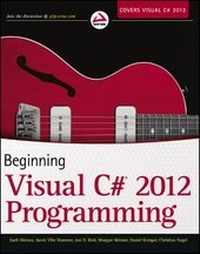
Beginning Visual C# 2012 Programming
Description

More details
Other editions
Additional editions
Persons
Content
INTRODUCTION
C# IS A RELATIVELY NEW LANGUAGE that was unveiled to the world when Microsoft announced the first version of its .NET Framework in July 2000. Since then its popularity has rocketed, and it has arguably become the language of choice for both desktop and web developers who use the .NET Framework. Part of the appeal of C# comes from its clear syntax, which derives from C/C++ but simplifies some things that have previously discouraged some programmers. Despite this simplification, C# has retained the power of C++, and there is now no reason not to move into C#. The language is not difficult and it's a great one to learn elementary programming techniques with. This ease of learning, combined with the capabilities of the .NET Framework, make C# an excellent way to start your programming career.
The latest release of C#, C# 5, which is included with version 4.5 of the .NET Framework, builds on the existing successes and adds even more attractive features. The latest release of Visual Studio (Visual Studio 2012) and the Visual Studio Express 2012 line of development tools also bring many tweaks and improvements to make your life easier and dramatically increase your productivity.
This book is intended to teach you about all aspects of C# programming, from the language itself, through desktop and web programming, to making use of data sources, and finally to some new and advanced techniques. You'll also learn about the capabilities of Visual Studio 2012, and all the ways that this product can aid your application development.
The book is written in a friendly, mentor-style fashion, with each chapter building on previous ones, and every effort is made to ease you into advanced techniques painlessly. At no point will technical terms appear from nowhere to discourage you from continuing; every concept is introduced and discussed as required. Technical jargon is kept to a minimum; but where it is necessary, it, too, is properly defined and laid out in context.
The authors of this book are all experts in their field, and are all enthusiastic in their passion for both the C# language and the .NET Framework. Nowhere will you find a group of people better qualified to take you under their collective wing and nurture your understanding of C# from first principles to advanced techniques. Along with the fundamental knowledge it provides, this book is packed full of helpful hints, tips, exercises, and full-fledged example code (available for download at p2p.wrox.com) that you will find yourself returning to repeatedly as your career progresses.
We pass this knowledge on without begrudging it, and hope that you will be able to use it to become the best programmer you can be. Good luck, and all the best!
WHO THIS BOOK IS FOR
This book is for everyone who wants to learn how to program in C# using the .NET Framework. It is for absolute beginners who want to give programming a try by learning a clean, modern, elegant programming language. But it also for people familiar with other programming languages who want to explore the .NET platform, as well as for existing .NET developers who want to give Microsoft's .NET flagship language a try.
WHAT THIS BOOK COVERS
The early chapters cover the language itself, assuming no prior programming experience. If you have programmed in other languages before, then much of the material in these chapters will be familiar. Many aspects of C# syntax are shared with other languages, and many structures are common to practically all programming languages (such as looping and branching structures). However, even if you are an experienced programmer you will benefit from looking through these chapters to learn the specifics of how these techniques apply to C#.
If you are new to programming, you should start from the beginning, where you will learn basic programming concepts and become acquainted with both C# and the .NET platform that underpins it. If you are new to the .NET Framework but know how to program, you should read Chapter 1 and then skim through the next few chapters before continuing with the application of the C# language. If you know how to program but haven't encountered an object-oriented programming language before, you should read the chapters from Chapter 8 onward.
Alternatively, if you already know the C# language, you might want to concentrate on the chapters dealing with the most recent .NET Framework and C# language developments, specifically the chapters on collections, generics, and C# language enhancements (Chapters 11 to 14), or skip the first section of the book completely and start with Chapter 15.
The chapters in this book have been written with a dual purpose in mind: they can be read sequentially to provide a complete tutorial in the C# language, and they can be dipped into as required reference material.
In addition to the core material, starting with Chapter 3 each chapter also includes a selection of exercises at the end, which you can work through to ensure that you have understood the material. The exercises range from simple multiple choice or true/false questions to more complex exercises that require you to modify or build applications. The answers to all the exercises are provided in Appendix A. You can also find these exercises as part of the wrox.com code downloads for this book at www.wrox.com/remtitle.cgi?isbn=9781118314418 on the Download Code tab.
This book also gives plenty of love and attention to coincide with the release of C# 5 and .NET 4.5. Every chapter received an overhaul, with less relevant material removed, and new material added. All of the code has been tested against the latest version of the development tools used, and all of the screenshots have been retaken in Windows 8 to provide the most current windows and dialog boxes.
Although we hate to admit our own fallibility, any errors from previous editions have been fixed, and many other reader comments have been addressed. Hopefully, we haven't introduced many new errors, but any that have slipped through our web of experts will be corrected online as soon as we find them.
New highlights of this edition include the following:
- Additional and improved code examples for you to try out
- A shift of focus in desktop applications from the old way of doing things (Windows Forms) to the new way (Windows Presentation Foundation), so you won't be left behind
- Coverage of everything that's new in C# 5 and .NET 4.5, including how to create Windows Store applications
- Streamlined coverage of advanced techniques to focus on those most appropriate to beginners without getting too obscure
HOW THIS BOOK IS STRUCTURED
This book is divided into six sections:
- Introduction-Purpose and general outline of the book's contents
- The C# Language-Covers all aspects of the C# language, from the fundamentals to object-oriented techniques
- Windows Programming-How to write and deploy desktop and Windows Store applications
- Web Programming-Web application development and deployment
- Data Access-How to use data in your applications, including data stored in files on your hard disk, data stored in XML format, and data in databases
- Additional Techniques-An examination of some extra ways to use C# and the .NET Framework, including Windows Communication Foundation (WCF) and Windows Workflow Foundation (WF)-technologies introduced with .NET 3.0 and enhanced for .NET 4 and .NET 4.5.
The following sections describe the chapters in the five major parts of this book.
The C# Language (Chapters 1-14)
Chapter 1 introduces you to C# and how it fits into the .NET landscape. You'll learn the fundamentals of programming in this environment, and how Visual Studio 2012 (VS) fit in.
Chapter 2 starts you off with writing C# applications. You'll look at the syntax of C# and put the language to use with sample command-line and Windows applications. These examples demonstrate just how quick and easy it can be to get up and running, and along the way you'll be introduced to the VS development environment and the basic windows and tools that you'll be using throughout the book.
Next you'll learn more about the basics of the C# language. You'll learn what variables are and how to manipulate them in Chapter 3. You'll enhance the structure of your applications with flow control (looping and branching) in Chapter 4, and see some more advanced variable types such as arrays in Chapter 5. In Chapter 6 you'll start to encapsulate your code in the form of functions, which make it much easier to perform repetitive operations and make your code much more readable.
By the beginning of Chapter 7 you'll have a handle on the fundamentals of the C# language, and will focus on debugging your applications. This involves looking at outputting trace information as your applications are executed, and at how VS can be used to trap errors and lead you to solutions for them with its powerful debugging environment.
From Chapter 8 onward you'll learn about object-oriented programming (OOP), starting with a look at what this term means, and an answer to the eternal question, "What is an object?" OOP can seem quite difficult at first. The whole of Chapter 8 is devoted to demystifying it and explaining what makes it so great, and you won't actually deal with much C# code until the very end of the...
