

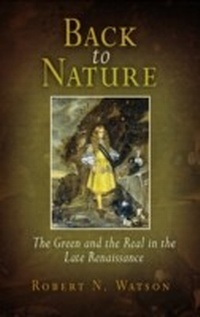
Back to Nature
The Green and the Real in the Late Renaissance
1st Edition
Published on 29. May 2013
448 pages
978-0-8122-0425-4 (ISBN)
Description

Selected by Choice magazine as an Outstanding Academic Title
Sweeping across scholarly disciplines, Back to Nature shows that, from the moment of their conception, modern ecological and epistemological anxieties were conjoined twins. Urbanization, capitalism, Protestantism, colonialism, revived Skepticism, empirical science, and optical technologies conspired to alienate people from both the earth and reality itself in the seventeenth century. Literary and visual arts explored the resulting cultural wounds, expressing the pain and proposing some ingenious cures. The stakes, Robert N. Watson demonstrates, were huge.
Shakespeare's comedies, Marvell's pastoral lyrics, Traherne's visionary Centuries, and Dutch painting all illuminate a fierce submerged debate about what love of nature has to do with perception of reality.
Sweeping across scholarly disciplines, Back to Nature shows that, from the moment of their conception, modern ecological and epistemological anxieties were conjoined twins. Urbanization, capitalism, Protestantism, colonialism, revived Skepticism, empirical science, and optical technologies conspired to alienate people from both the earth and reality itself in the seventeenth century. Literary and visual arts explored the resulting cultural wounds, expressing the pain and proposing some ingenious cures. The stakes, Robert N. Watson demonstrates, were huge.
Shakespeare's comedies, Marvell's pastoral lyrics, Traherne's visionary Centuries, and Dutch painting all illuminate a fierce submerged debate about what love of nature has to do with perception of reality.
Reviews / Votes
"Back to Nature is demanding, at times dizzying, in its range and boldness, the all-encompassing and often surprising nature of its conjunctions. . . . Sections of the book amount to the most powerful and wide-ranging 'green' reading of early modern literature that has yet emerged." (Jonathan Bate, University of Warwick) "One of the most impressive works of scholarship I have encountered in three decades of reading such material. To observe the skill with which the author applies his extraordinary mind to the interrelations of similar but not obviously connected ideas is alternately thrilling and humbling." (Russ McDonald, University of North Carolina, Greensboro) "Productively wide-ranging, yet well focused in scope, Watson's book illuminates multiple issues of current interest in Renaissance studies, including representations of nature and reality, the quest for truth, the body, game hunting, colonialism, the new science, religion, and language in readings of canonical writers. . . . This book of the Renaissance struggle to reconcile desire for 'human mastery with love for the natural world' should be ready by all who teach Renaissance literature and by specialists in sixteenth-century and seventeenth-century literature." (Sixteenth Century Journal)More details
Language
English
Place of publication
Pennsylvania
United States
Target group
College/higher education
Illustrations
51 illus.
51 illus.
ISBN-13
978-0-8122-0425-4 (9780812204254)
Copyright in bibliographic data and cover images is held by Nielsen Book Services Limited or by the publishers or by their respective licensors: all rights reserved.
Schweitzer Classification
Other editions
Additional editions
Book
12/2007
University of Pennsylvania Press
€37.50
Shipment within 10-20 days
Person
Robert N. Watson is Professor of English and Associate Vice-Provost for Educational Innovation at the University of California, Los Angeles. His previous books include The Rest Is Silence: Death as Annihilation in the English Renaissance, Ben Jonson's Parodic Strategy: Literary Imperialism in the Comedies, and Shakespeare and the Hazards of Ambition.
Content
- Cover
- Title
- Copyright
- Contents
- Part I: Introduction: The Green and the Real
- 1 Ecology, Epistemology, and Empiricism
- 2 Theology, Semiotics, and Literature
- Part II: Paradoxes: Alienation from Nature in English Literature
- 3 As You Liken It: Simile in the Forest
- 4 Shades of Green: Marvell's Garden and the Mowers
- Part III: Reformations: Protestant Politics, Poetics, and Paintings
- 5 Metaphysical and Cavalier Styles of Consciousness
- 6 The Retreat of God, the Passions of Nature, and the Objects of Dutch Painting
- 7 Nature in Two Dimensions: Perspective and Presence in Ryckaert, Vermeer, and Others
- Part IV: Solutions: The Consolations of Mediation
- 8 Metal and Flesh in The Merchant of Venice: Shining Substitutes and Approximate Values
- 9 Thomas Traherne: The World as Present
- Conclusion
- Notes
- Bibliography
- Index
- Acknowledgments
