

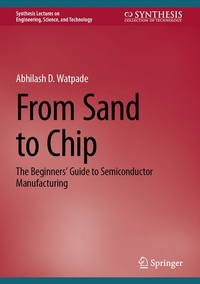
From Sand to Chip
Description

This beginner-friendly guide takes readers on a journey to transform raw sand into advanced microchips, explaining every step in clear, simple language. Packed with analogies, real examples, and insights from industry experts, it's an essential read for students, technicians, and anyone fascinated by the technology powering our lives. Discover how chips are made and why they matter.
More details
Other editions
Additional editions
Person
Abhilash Dinkar Watpade holds a degree in Mechanical and Aerospace Engineering from the Illinois Institute of Technology, Chicago, and is currently pursuing a PhD in Leadership Studies. As a Global Support Engineer at ASML, he works on cutting-edge High NA EUV machines, the most advanced in the semiconductor industry. With years of experience, he collaborates globally with chip manufacturers like TSMC, Intel, Samsung, SK Hynix, and Rapidus, providing technical problem-solving support and mentoring new engineers. His role involves traveling worldwide, solving complex problems, and bridging knowledge gaps, making him uniquely positioned to write an accessible guide for beginners.
Content
Introduction - The World in a Grain of Sand.- A Brief History of Semiconductor Manufacturing - From Tubes to Transistors to Today.- Semiconductor Fundamentals - Understanding the Material and the Transistor.- From Sand to Silicon Wafer - Raw Materials and Crystal Growth Inside the Fab - Cleanrooms and the Fabrication Environment.- Photolithography - Printing Patterns on Silicon.- Deposition - Building Layers Atom by Atom.- Etching - Carving Patterns into Silicon.- Doping - Putting the "Semi" in Semiconductor.- Interconnect - Wiring Up the Chip.- Chip Packaging - Encasing and Connecting the Chip to the World.- Yield, Defects, and Process Control - Making It Work, Every Time.- Advanced Node Challenges and Future Trends - Pushing the Limits.
