

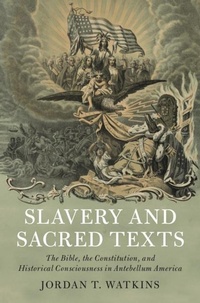
Slavery and Sacred Texts
The Bible, the Constitution, and Historical Consciousness in Antebellum America
Published on 16. June 2021
400 pages
978-1-108-80995-5 (ISBN)
Description

In the decades before the Civil War, Americans appealed to the nation's sacred religious and legal texts - the Bible and the Constitution - to address the slavery crisis. The ensuing political debates over slavery deepened interpreters' emphasis on historical readings of the sacred texts, and in turn, these readings began to highlight the unbridgeable historical distances that separated nineteenth-century Americans from biblical and founding pasts. While many Americans continued to adhere to a belief in the Bible's timeless teachings and the Constitution's enduring principles, some antislavery readers, including Theodore Parker, Frederick Douglass, and Abraham Lincoln, used historical distance to reinterpret and use the sacred texts as antislavery documents. By using the debate over American slavery as a case study, Jordan T. Watkins traces the development of American historical consciousness in antebellum America, showing how a growing emphasis on historical readings of the Bible and the Constitution gave rise to a sense of historical distance.
Reviews / Votes
'Watkins examines an impressively wide range of thinkers, white and Black, famous and forgotten, as they argued over whether Scripture and the Constitution (itself a kind of secular 'scripture') supported slavery - and if so, how opponents of slavery should respond. This important book not only illuminates the striking parallels between biblical criticism and constitutional interpretation, it will help Americans think through the racism at the root of so many of our institutions.' Dean Grodzins, author of American Heretic: Theodore Parker and Transcendentalism 'Watkins tells a fascinating story of conceptual change, an account as ironic as it is important. He vividly shows how a reverence for the past tangled with the moral crisis of human slavery to generate a new kind of historical consciousness. Some of modernity's most characteristic patterns of thought result from the history he has recovered.' David Frank Holland, Harvard Divinity School 'Watkins' comparison of debates over constitutional interpretation and biblical hermeneutics is revelatory at every turn. This book is an essential read for scholars of law, religion, and slavery - and for anyone seeking to understand how the past haunts the present in American life.' Margot Minardi, author of Making Slavery History: Abolitionism and the Politics of Memory in Massachusetts 'Watkins persuasively demonstrates how in shoring up the Bible and the Constitution for the debates over slavery, nineteenth-century Americans evoked an awareness of temporal distance, a new historical consciousness. Antebellum-era struggles with time and history come to life in this insightful and compelling study, which substantially propels our understanding of historicism.' Eran Shalev, University of Haifa 'The book makes clear contributions to the study of religion in America and US constitutional history, and is readable for a wider public.' John Fadden, Reading Religion '... the book ... makes a real contribution to our understanding of the antebellum slavery debates and their legacy in American public life since. Scholars who work on religion, law, and/or slavery will benefit from reading this book.' Paul J. Gutacker, Journal of Church and StateMore details
Series
Language
English
Place of publication
Cambridge
United Kingdom
Target group
Professional and scholarly
Illustrations
Worked examples or Exercises
File size
4,30 MB
ISBN-13
978-1-108-80995-5 (9781108809955)
Copyright in bibliographic data and cover images is held by Nielsen Book Services Limited or by the publishers or by their respective licensors: all rights reserved.
Schweitzer Classification
Other editions
Additional editions
Jordan T. Watkins
Slavery and Sacred Texts
The Bible, the Constitution, and Historical Consciousness in Antebellum America
Book
07/2021
Cambridge University Press
€67.90
Shipment within 15-20 days
Person
Content
Acknowledgements; Prologue; Introduction; 1. 'Recourse must be had to the history of those times'; 2. 'The ground will shake'; 3. 'Texts ... designed for local and temporary use'; 4. 'The further we recede from the birth of the constitution'; 5. 'The culture of cotton has healed its deadly wound'; 6. 'Times now are not as they were'; 7. 'We have to do not ... with the past, but the living present'; 8. A 'Modern crispus attucks'; Conclusion; Epilogue; Index.
