

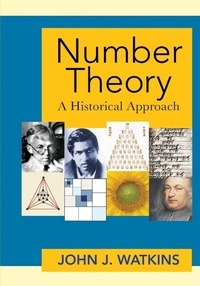
Number Theory
Description

An introductory textbook with a unique historical approach to teaching number theory
The natural numbers have been studied for thousands of years, yet most undergraduate textbooks present number theory as a long list of theorems with little mention of how these results were discovered or why they are important. This book emphasizes the historical development of number theory, describing methods, theorems, and proofs in the contexts in which they originated, and providing an accessible introduction to one of the most fascinating subjects in mathematics.
Written in an informal style by an award-winning teacher, Number Theory covers prime numbers, Fibonacci numbers, and a host of other essential topics in number theory, while also telling the stories of the great mathematicians behind these developments, including Euclid, Carl Friedrich Gauss, and Sophie Germain. This one-of-a-kind introductory textbook features an extensive set of problems that enable students to actively reinforce and extend their understanding of the material, as well as fully worked solutions for many of these problems. It also includes helpful hints for when students are unsure of how to get started on a given problem.
- Uses a unique historical approach to teaching number theory
- Features numerous problems, helpful hints, and fully worked solutions
- Discusses fun topics like Pythagorean tuning in music, Sudoku puzzles, and arithmetic progressions of primes
- Includes an introduction to Sage, an easy-to-learn yet powerful open-source mathematics software package
- Ideal for undergraduate mathematics majors as well as non-math majors
- Digital solutions manual (available only to professors)
More details
Other editions
Additional editions
Person
Content
- Cover
- Title
- Copyright
- Dedication
- Contents
- Preface
- 1 Number Theory Begins
- Pierre de Fermat *
- Pythagorean Triangles *
- Babylonian Mathematics
- Sexagesimal Numbers
- Regular Numbers
- Square Numbers
- Primitive Pythagorean Triples *
- Infinite Descent *
- Arithmetic Progressions
- Fibonacci's Approach
- Problems
- 2 Euclid
- Greek Mathematics *
- Triangular Numbers *
- Tetrahedral and Pyramidal Numbers
- The Axiomatic Method *
- Proof by Contradiction
- Euclid's Self-Evident Truths *
- Unique Factorization
- Pythagorean Tuning
- Problems
- 3 Divisibility
- The Euclidean Algorithm *
- The Greatest Common Divisor *
- The Division Algorithm *
- Divisibility *
- The Fundamental Theorem of Arithmetic
- Congruences *
- Divisibility Tests
- Continued Fractions
- Problems
- 4 Diophantus
- The Arithmetica
- Problems from the Arithmetica
- A Note in the Margin *
- Diophantine Equations *
- Pell's Equation
- Continued Fractions
- Problems
- 5 Fermat
- Christmas Day, 1640 *
- Fermat's Little Theorem *
- Primes as Sums of Two Squares *
- Sums of Two Squares *
- Perfect Numbers *
- Mersenne Primes
- Fermat Numbers
- Binomial Coefficients *
- "Multi Pertransibunt et Augebitur Scientia"
- Problems
- 6 Congruences
- Fermat's Little Theorem *
- Linear Congruences *
- Inverses *
- The Chinese Remainder Theorem
- Wilson's Theorem *
- Two Quadratic Congruences
- Lagrange's Theorem
- Problems
- 7 Euler and Lagrange
- A New Beginning *
- Euler's Phi Function *
- Primitive Roots *
- Euler's Identity *
- Quadratic Residues *
- Lagrange
- Lagrange's Four Squares Theorem *
- Sums of Three Squares
- Waring's Problem
- Fermat's Last Theorem *
- Problems
- 8 Gauss
- The Young Gauss
- Quadratic Residues *
- The Legendre Symbol *
- Euler's Criterion *
- Gauss's Lemma *
- Euler's Conjecture
- The Law of Quadratic Reciprocity *
- Problems
- 9 Primes I
- Factoring *
- The Quadratic Sieve Method
- Is n Prime? *
- Pseudoprimes *
- Absolute Pseudoprimes
- A Probabilistic Test
- Can n Divide 2n-1 or 2n+1?
- Mersenne Primes + *
- Problems
- 10 Primes II
- Gaps Both Large and Small *
- The Twin Prime Conjecture *
- The Series Sp 1/p
- Bertrand's Postulate
- Goldbach's Conjecture *
- Arithmetic Progressions *
- Problems
- 11 Sophie Germain
- Monsieur LeBlanc *
- Germain Primes *
- Germain's Grand Plan
- Fermat's Last Theorem *
- Problems
- 12 Fibonacci Numbers
- Fibonacci *
- The Fibonacci Sequence *
- The Golden Ratio
- Fibonacci Numbers in Nature
- Binet's Formula *
- Tiling and the Fibonacci Numbers
- Fibonacci Numbers and Divisibility
- Generating Functions
- Problems
- 13 Cryptography
- Secret Codes on Mount Everest
- Caesar and Vigenère Ciphers *
- Unbreakable Ciphers
- Public-Key Systems *
- Problems
- 14 Continued Fractions
- The Golden Ratio Revisited
- Finite Continued Fractions *
- Infinite Continued Fractions *
- Approximation
- Pell's Equation
- Problems
- 15 Partitions
- Euler *
- Generating Functions
- Euler's Pentagonal Number Theorem
- Ferrers Graphs
- Ramanujan
- Problems
- Hints for Selected Problems
- Solutions to Selected Problems
- Brief Introduction to Sage
- Suggestions for Further Reading
- Pronunciation Guide
- Table of Primes
- Index
