

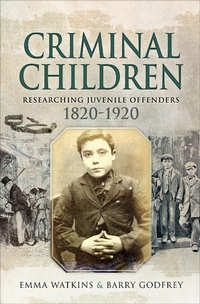
Criminal Children
Researching Juvenile Offenders, 1820-1920
Published on 20. February 2019
168 pages
978-1-5267-3809-7 (ISBN)
Description

A history of juvenile crime, punishment, and reform in England in the years before, during, and after the era of Charles Dickens.
How were juvenile delinquents dealt with in the nineteenth and early twentieth centuries? What dire circumstances led to their behavior? Were the efforts to curb their criminal tendencies successful? From 1820-1920, ideas about youth and transgression changed dramatically in the United Kingdom. Criminal Children delves into this period to uncover fascinating insight into the neglected subject of childhood crime and punishment, and the "invention" of juvenile delinquency.
Drawing on the life stories of twenty-four "bad seeds," true crime journalists Emma Watkins and Barry Godfrey explore every aspect of these young and desperate lives: their experiences in prisons, reformatory schools, industrial schools, borstals, and female factories; their trials and criminal petitions; and the harrowing transport to Australia-considered the last resort for adult convicts and children alike.
Including resources for researching one's own criminal forebears, Criminal Children is "an interesting book to anybody who wants to know more about juvenile offenders in England" (Nell Darby, author of Life on the Victorian Stage).
How were juvenile delinquents dealt with in the nineteenth and early twentieth centuries? What dire circumstances led to their behavior? Were the efforts to curb their criminal tendencies successful? From 1820-1920, ideas about youth and transgression changed dramatically in the United Kingdom. Criminal Children delves into this period to uncover fascinating insight into the neglected subject of childhood crime and punishment, and the "invention" of juvenile delinquency.
Drawing on the life stories of twenty-four "bad seeds," true crime journalists Emma Watkins and Barry Godfrey explore every aspect of these young and desperate lives: their experiences in prisons, reformatory schools, industrial schools, borstals, and female factories; their trials and criminal petitions; and the harrowing transport to Australia-considered the last resort for adult convicts and children alike.
Including resources for researching one's own criminal forebears, Criminal Children is "an interesting book to anybody who wants to know more about juvenile offenders in England" (Nell Darby, author of Life on the Victorian Stage).
More details
Other editions
Additional editions
Book
10/2018
Pen & Sword Family History
€19.00
Shipment within 10-20 days
Persons
Emma Watkins is a PhD candidate and a research assistant working on the Digital Panopticon at the University of Liverpool. She has a special interest in criminal juveniles in nineteenth-century England.Professor Barry Godfrey is Professor of Social Justice at the University of Liverpool and Honorary Professor of Xi'an Jiaotong Liverpool University, China. Among his many publications are _Crime, Wartime and Control: Protecting the Population of a Blitzed City, 1939-1945_ (with P. Adey and David Cox), _Victorian Convicts: 100 Criminal Lives_ (with Helen Johnston and David Cox) and _Crime and Justice Since 1750_ (with Paul Lawrence).
Content
- Intro
- Title
- Copyright
- Contents
- 1. Introduction
- 2. The Concept of 'Juvenile Delinquency'
- The Legal Definition of Childhood
- Good and Bad Children
- The Youth 'Crisis' of the Early to Mid-Nineteenth Century
- The 'Invention' or the 'Discovery' of Juvenile Delinquency?
- Juvenile Gangs
- The Best Kind of Boy - the 'Hooligan'
- Girls and Young Women
- Into the 1920s and 1930s
- 3. Dealing with Wayward Children
- Early Nineteenth-Century Imprisonment
- Transportation
- Parkhurst
- The Female Factories
- Reformatory and Industrial Schools
- Borstal
- 4. Researching Children's Lives
- Juveniles on Trial
- Transported Young Convicts
- Confined Juveniles
- Children in Reformatory and Industrial Schools and Young Adults in Borstal
- Criminal Petitions
- Non-Criminal Records
- Newspapers
- Non-Criminal Institutions
- Recreating Children's Lives
- Telling the Story
- What Can We Learn?
- Ethics
- 5. Life Stories
- 1. John Hudson (b.1774) and William Gadsby (b.1822)
- 2. Letitia Padwick (b.1815)
- 3. William Asgill (1824-1875)
- 4. Ellen Miles (alias Smith/Jackson) (b.1827)
- 5. James McAllister (1827-1855)
- 6. John Lee (b.1829)
- 7. John Press (b.1831)
- 8. Eliza White (1832-1847) and Elizabeth Jones aka Walford (1828-1905)
- 9. Hannah Mary Dowse (b.1833) and Pleasance Temperance Neale (b.1832)
- 10. Horatio Nelson Branch (b.1836)
- 11. Ann Gill (b.1842)
- 12. Anthony Kehoe (1844-c.1901)
- 13. Stanley Charles Selway aka Sillivay (1844-1927)
- 14. James Bradley (b.1853) and William Brown (b.1853)
- 15. Thomas Priest (1854-1890)
- 16. Joseph Tomlinson (1860-1920)
- 17. Lottie Gallon (b.1867) and Elizabeth Arnold (b.1848)
- 18. Stephen Swain (1870-1933)
- 19. William Brisbane (1882-1976)
- 20. Thomas Henry Platt (1884)
- 21. Elizabeth Barratt (b.1896), Alice Midgley (b.1902) and Henry Burrows (b.1881)
- 22. John O'Sullivan (1896-1916)
- 23. George Edwards (1904-1927)
- 24. Walter Davenport (1906-1976)
- 25. Jane Jones (b.1908)
- 26. Brendan Behan (1923-1964)
- 6. Conclusion
- Further Reading
