

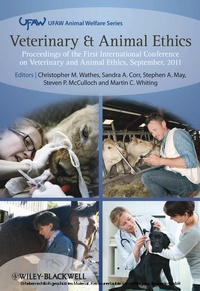
Veterinary and Animal Ethics
Description

The first International Conference on Veterinary and Animal Ethics (ICVAE) held in September 2011 saw leading experts from across the world come together to discuss the most important issues of animal welfare in contemporary veterinary practice and research. This is the extended proceedings of that conference, enabling all those interested in this increasingly significant subject to benefit from the insights of those discussions.
The conference was divided into four sessions: Principles of veterinary and animal ethics; Justifying ends - the morality of animal use; Ethical analyses of animal use; and Cultural, political, legal and economic considerations. Each session contained four or five papers, and these are presented here in full, as well as the transcribed question and answer sessions at the end of each paper, and a short post-presentation reflection from each author. Also included is the debate on the motion ‘Is it better to have lived and lost than never to have lived at all?’ which records three prepared responses to the question as well as registrants’ comments from the floor.
KEY FEATURES
• Contributions from the leading thinkers in veterinary and animal ethics today
• Includes stimulating, challenging, thought-provoking and sometimes controversial discussions
• Addresses key questions on the role of the veterinarian and the morality of animal use, as well as our impact on wildlife
• Provides guidance on the practical application of ethical principles and the problems encountered
Published as part of the UFAW Animal Welfare book series. See www.wiley.com/go/ufaw for more details.
More details
Other editions
Additional editions
Content
- Intro
- Veterinary & Animal Ethics: Proceedings of the First International Conference on Veterinary and Animal Ethics, September 2011
- Copyright
- Contents
- Contributors
- Foreword
- Preface
- I Principles of Veterinary and Animal Ethics
- 1 The History of Veterinary Ethics in Britain, ca.1870-2000
- 1.1 Introduction
- 1.2 Professional Conduct and the Relief of Animal Suffering, 1870-1919
- 1.3 The Ethical Nature of Veterinary Work, 1919-1948
- 1.4 The Eclipse of Animal Ethics, 1948-1975
- 1.5 The Reshaping of Veterinary Ethical Thought, 1975-2000
- 1.6 Conclusion
- 2 The Idea of Animal Welfare - Developments and Tensions
- 2.1 Background - The Modern Idea of Animal Welfare and the Brambell Report
- 2.2 Conclusions
- 3 Lessons from Medical Ethics
- 3.1 What Can Veterinary Ethics Learn from Medical Ethics (and Vice Versa)?
- 3.2 The Relevance of Medical/Veterinary Ethics and Its Place in the Undergraduate Curriculum
- 3.3 Role of Medical Ethics in Driving Legal Change
- 3.4 Professional Ethics - Behaviour and Regulation
- 3.5 Ethical Approaches to Dilemmas Confronting the Modern Veterinarian - Can We Learn from Clinical Ethics Frameworks?
- 4 Veterinary Ethics, Professionalism and Society
- 4.1 Introduction
- 4.2 The Nature of the Modern Profession
- 4.3 Veterinary Professional Ethics - More than Etiquette!
- 4.4 The Effect of the Societal Context on the Profession and Its Members
- 4.5 Professionalism and Physician Agency
- 4.6 Lessons for Veterinary Education
- 4.7 Continued Relevance to Society of the Professional Model
- 4.8 Conclusion
- II Justifying Ends - The Morality of Animal Use
- 5 Justice of Animal Use in the Veterinary Profession
- 5.1 Societal Relationships with Animals
- 5.2 The Different Uses of Animals and Their Moral Status
- 5.3 The Separation of Animals from Humans
- 5.4 Justice as Understood by the Medical Profession
- 5.5 Veterinarians and Animal Justice
- 5.6 Conclusion
- 6 Telos
- 6.1
- 6.2
- 7 Agriculture, Animal Welfare and Climate Change
- 7.1 Introduction
- 7.2 The Link between Agriculture and Climate Change
- 7.3 Sustainable Intensification
- 7.4 Livestock Intensification and Animal Welfare Problems
- 7.5 The Ethics of Genetic Modification
- 7.6 Radical Naturalism: An Alternative to Sustainable Intensification
- 7.7 Discussion
- 7.8 Conceptions of Human Nature
- 7.9 Summary
- 8 Ethics and Ethical Analysis in Veterinary Science: The Development and Application of the Ethical Matrix Method
- 8.1 Introduction
- 8.2 Professional Ethics and Animals
- 8.3 Ethical Tools: The Role of the Ethical Matrix
- 8.4 Original Development and Application of the Ethical Matrix
- 8.5 Further Development of the Ethical Matrix
- 8.6 Development of the Ethical Matrix and Its Use in Veterinary Practice
- 9 The Ethics of Animal Enhancement
- 9.1 Introduction
- 9.2 What Is Enhancement?
- 9.3 Normalcy
- 9.4 Terms of Reference for the Future Debate on Animal Enhancement
- 9.5 Animal Welfare Implications
- III Ethical Analyses of Animal Use
- 10 Wildlife Medicine, Conservation and Welfare
- 10.1 Introduction
- 10.2 Anthropogenic Threats to Wild Animal Conservation
- 10.3 To Which Wild Animals Do Welfare Concerns Apply?
- 10.4 Anthropogenic Threats to Wild Animal Welfare
- 10.5 Responsibility for Wildlife Welfare
- 10.6 Interventions for Wildlife Welfare
- 10.7 Welfare/Conservation Conflicts
- 10.8 Dealing with Welfare/Conservation Conflicts
- 10.9 Concluding Comments
- 11 Veterinary Ethics and the Use of Animals in Research: Are They Compatible?
- 11.1 Historical Perspectives
- 11.2 Scale of Usage
- 11.3 Public Perceptions
- 11.4 Ethical Standpoints
- 11.5 Measuring Harms and Benefits
- 11.6 The Rise of the 3Rs
- 11.7 Ethics and the Drug Discovery Process
- 11.8 Openness
- 11.9 Conclusion: The Role of the Veterinary Profession
- 12 Production Animals: Ethical and Welfare Issues Raised by Production-focused Management of Newborn Livestock
- 12.1 Introduction
- 12.2 Production-Orientated Neonatal Management Issues
- 12.3 Ethical and Animal Welfare Issues
- 13 Companion Animals
- 13.1 Introduction
- 13.2 Domestication of Cats and Dogs
- 13.3 The Role of Cats and Dogs in the Family: The Human-Companion Animal Bond ( CAB)
- 13.4 Ethical Issues Arising from a Shared Lifestyle
- 13.5 Ethical Issues Arising from Pets as 'Furry Children': The Importance of the Individual
- 13.6 Euthanasia
- 13.7 Conclusion
- 14 Ethical Analysis of the Use of Animals for Sport
- 14.1 Introduction
- 14.2 Welfare Issues of Animals in Sport
- 14.3 The Ethics of Using Animals for Sport
- 14.4 Conclusion
- IV Cultural, Political, Legal and Economic Considerations
- 15 Global Cultural Considerations of Animal Ethics
- 15.1 Introduction
- 15.2 Variation within a Culture
- 15.3 Variation between European Countries
- 15.4 Variation between Continents
- 15.5 Variation between Specific Cultures
- 15.6 Working Together
- 16 Animal Ethics and the Government's Policy: 'To Guard and Protect'
- 16.1 Historical Perspective on English Law and Its Regard for Animals
- 16.2 Development of Government Policy on bTB: A Wicked Problem
- 16.3 Animal Ethics, Animal Welfare and Government Policy-making Today
- 16.4 Conclusions
- 17 Veterinary Ethics and Law
- 17.1 Introduction
- 17.2 Disciplinary Proceedings against Veterinarians
- 17.3 Handling Complaints
- 17.4 Defects in the Complaints Procedure
- 17.5 Disciplinary Appeals
- 17.6 The Case for Reform
- 18 Ethical Citizenship
- 18.1 Introduction
- 18.2 Citizens Want More Ethical Treatment of Animals
- 18.3 Problems for Citizens and Consumers
- 18.4 Responsibility of the Citizen/Consumer
- 18.5 Conclusion
- 19 Principles, Preference and Profit: Animal Ethics in a Market Economy
- 19.1 Introduction
- 19.2 The Basic Model of Economic Activity
- 19.3 Animals in Economic Activity
- 19.4 Ethics and Market Behaviour
- 19.5 Moral versus Economic Value
- Debate: 'Is It Better to Have Lived and Lost than Never to Have Lived at All?'
- Index
