

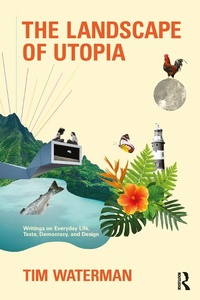
The Landscape of Utopia
Writings on Everyday Life, Taste, Democracy, and Design
1st Edition
Published on 27. February 2022
234 pages
978-1-000-53849-6 (ISBN)
Description

A collection of short interludes, think pieces, and critical essays on landscape, utopia, philosophy, culture, and food, all written in a highly original and engaging style by academic and theorist Tim Waterman.
Exploring power and democracy, and their shaping of public space and public life, taste, etiquette, belief and ritual, and foodways in community and civic life, the book provides a much-needed critical approach to landscape imaginaries. It discusses landscape in its broadest sense, as a descriptor of the relationship between people and place that occurs everywhere on land, from cities to countryside, suburb to wilderness.
With over fifty black and white illustrations interspersing the twenty-six chapters, this is a book for professionals, academics, and students to dive into and spark discussion on new modes of thinking in the wake of unfolding global crises, such as COVID-19, climate change, fascism 2.0, and beyond.
Exploring power and democracy, and their shaping of public space and public life, taste, etiquette, belief and ritual, and foodways in community and civic life, the book provides a much-needed critical approach to landscape imaginaries. It discusses landscape in its broadest sense, as a descriptor of the relationship between people and place that occurs everywhere on land, from cities to countryside, suburb to wilderness.
With over fifty black and white illustrations interspersing the twenty-six chapters, this is a book for professionals, academics, and students to dive into and spark discussion on new modes of thinking in the wake of unfolding global crises, such as COVID-19, climate change, fascism 2.0, and beyond.
Reviews / Votes
"This collection, like all Tim Waterman's work, is a delight. He combines reflections on the relationship between place, space and social process with a drive towards imagining better lives and the conditions that might generate them - thus towards utopia. The varied pieces, written with elegance and grace, are thought-provoking, engaging and at times deeply moving." - Ruth Levitas, author, Utopia as Method, Professor Emerita, School of Sociology, Politics and International Studies, University of Bristol, UK"The Landscape of Utopia delivers a rich new contribution to utopian theory and lively reflections and meditations on what it means to think and practice better ways of living and being in very particular places. Tim finds utopian promise and provocation in practice and imagination; what is and what might be; the ordinary and the fantastic. With its extensive range of reference, sociological curiosity, agile thinking and inviting prose, the book returns us refreshed to familiar landscapes and invites us to keep hold of transgressive hope for changing them." - Lisa Garforth, author, Green Utopias, Senior Lecturer in Sociology, Newcastle University, UK
"Intelligent and perceptive, Waterman draws on local stories from a wide range of places and times, weaving the narrative in and out of the subject, landscape, with insight and humour. The book is timely because it comes at a point when the discourse on 'landscape' is expanding, gaining interest by scholars and professionals across disciplines to address global concerns, climate change, cultural heritage, food security and issues of identity. Many of these concerns are addressed in the 26 chapters, some a single paragraph and others several pages, a statement, a reflection and food for thought. Waterman keeps his citation to a minimum, introducing key landscape scholars in an offhand manner to pique the reader and avoid the 'stuffiness' of academic writing. The fresh narrative of 'landscape' will be of interest to non-academics, architects and landscape architects, anyone interested in the environment, culture and shifting world politics and how they affect popular taste and ordinary citizens." - Jala Makhzoumi, editor of The Right to Landscape, Adjunct Professor of Landscape Architecture, American University of Beirut, President, Lebanese Landscape Association, Lebanon
More details
Edition
1. Auflage
Language
English
Place of publication
London
United Kingdom
Publishing group
Taylor & Francis Ltd
Target group
College/higher education
Professional and scholarly
Product notice
Reflowable
Illustrations
1 Line drawings, black and white; 58 Halftones, black and white; 59 Illustrations, black and white
ISBN-13
978-1-000-53849-6 (9781000538496)
Copyright in bibliographic data and cover images is held by Nielsen Book Services Limited or by the publishers or by their respective licensors: all rights reserved.
Schweitzer Classification
Other editions
Additional editions
Book
02/2022
1st Edition
Routledge
€179.81
Shipment within 15-20 days
Book
02/2022
1st Edition
Routledge
€42.15
Shipment within 15-20 days
Person
Tim Waterman is Associate Professor of Landscape Theory at the Bartlett School of Architecture, UCL, UK. His research explores the interconnections between food, taste, place, and democratic civil society. His research addresses imaginaries: moral, political, social, ecological, radical, and utopian.
Content
Foreword by Tom Moylan Preface: The Landscape(s) of Utopia(s) 1. Introduction: Taste, Democracy, and Everyday Life in Landscape Imaginaries 2. Thailand, Highland, and Secret Island: Landscape and Power in Bond Films 3. A Word... 'Blang' 4. The Flavour of the Place: Eating and Drinking in Pajottenland 5. The Global Cucumber: on the Milan Expo 2015 6. A Word... 'Theatre' 7. Feasting is a Project 8. At Liberty: The Place de la Republique 9. A Word... 'Profession' 10. Situating the Digital Commons: A Conversation with Ruth Catlow 11. Dining at a Distance: Performing the Commons Across Space and Time (with Ruth Catlow) 12. On Astronauts, LSD, and Landscape Architecture 13. A Word... 'Vast' 14. Making Meaning: Minds, Bodies, and Media in Architectural Design 15. Other Stranger's Paths 16. Democracy and Trespass 17. A Word... 'Habitat' 18. It's About Time: The Genius Temporum of Marti Franch's Girona Landscapes 19. Despot, Martyr, and Fool: An Obituary for the Garden Bridge 20. Notes from the First Days of London's Lockdown 21. During and After the Pandemic Our Streets Need More Democracy 22. A Word... 'Inevitable' 23. Two London Squares and a Theory of the Beige Hole 24. A Word... 'Storytelling' 25. National Progress 26. The Tasty City: Democratic Life and the Fulfilment of Desire
