

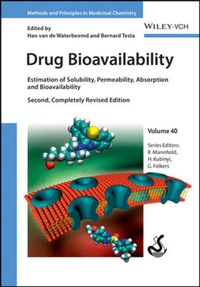
Drug Bioavailability
Estimation of Solubility, Permeability, Absorption and Bioavailability
2nd Edition
Published on 18. September 2009
XXV, 624 pages
978-3-527-62387-7 (ISBN)
Description

The gold standard for industrial research now completely revised in line with current trends in the field, with all contributions extensively updated or rewritten.
In 21 chapters readers can benefit from the key working knowledge of today's leading pharmaceutical companies, including Pfizer, AstraZeneca, and Roche. Drug developers from industry and academia present all the factors governing drug bioavailability, complete with practical examples and real-life data.
Part I focuses on in vitro and in vivo measurements of physicochemical properties, such as membrane permeability and ionization. Part II discusses solubility and gastrointestinal absorption, while the third part is devoted to metabolism and excretory mechanisms. The much revised and expanded part IV surveys current in silico approaches to predict drug properties needed to estimate the bioavailability of any new drug candidate. The final part shows how poor bioavailability may be improved by various approaches during the development process.
No other publication offers the same level of treatment on this crucial topic in modern drug development.
In 21 chapters readers can benefit from the key working knowledge of today's leading pharmaceutical companies, including Pfizer, AstraZeneca, and Roche. Drug developers from industry and academia present all the factors governing drug bioavailability, complete with practical examples and real-life data.
Part I focuses on in vitro and in vivo measurements of physicochemical properties, such as membrane permeability and ionization. Part II discusses solubility and gastrointestinal absorption, while the third part is devoted to metabolism and excretory mechanisms. The much revised and expanded part IV surveys current in silico approaches to predict drug properties needed to estimate the bioavailability of any new drug candidate. The final part shows how poor bioavailability may be improved by various approaches during the development process.
No other publication offers the same level of treatment on this crucial topic in modern drug development.
More details
Other editions
Additional editions
H. van de Waterbee
Drug Bioavailability - Estimation of Solubility, Permeability, Absorption and Bioavailability 2e
Software
11/2009
Wiley-VCH
€371.74
No shipping information available
Han van de Waterbeemd | Bernard Testa
Drug Bioavailability
Estimation of Solubility, Permeability, Absorption and Bioavailability
Book
10/2008
2nd Edition
Wiley-VCH
€269.00
Article exhausted; check different version
Previous edition
Han van de Waterbeemd | Hans Lennernäs | Per Artursson
Drug Bioavailability
Estimation of Solubility, Permeability, Absorption and Bioavailability
E-Book
03/2006
1st Edition
Wiley-VCH
€120.99
Available for download
Persons
Han van de Waterbeemd studied physical organic chemistry at the Technical University of Eindhoven, and gained his PhD in medicinal chemistry from the University of Leiden. After an academic career at the University of Lausanne with Bernard Testa, he worked for 20 years in the pharmaceutical industry for Roche, Pfizer and AstraZeneca. His research interests are in optimizing compound quality using measured and predicted physicochemical and DMPK properties. He has contributed to 145 research papers and book chapters, and (co-)edited 13 books, and was involved in organizing conferences and courses to promote medicinal chemistry, with a focus on physicochemistry and predictive approaches in drug design. Dr. van de Waterbeemd is on the editorial board of several journals and of Methods and Principles in Medicinal Chemistry.
Bernard Testa is Emeritus Professor of the University of Lausanne, having served there for 25 years as a full professor and head of medicinal chemistry. He has written 5 books and edited 33 others, and (co)-authored well over 450 research and review articles in the fields of drug design and drug metabolism. Between 1994 and 1998, he was the European Editor of Pharmaceutical Research, and is now a senior editor of Chemistry and Biodiversity, as well as serving on the editorial boards of several leading journals. Professor Testa holds honorary doctorates from the universities of Milan, Montpellier and Parma, and is a recipient of the Nauta Award on Pharmacochemistry given by the European Federation for Medicinal Chemistry.
Bernard Testa is Emeritus Professor of the University of Lausanne, having served there for 25 years as a full professor and head of medicinal chemistry. He has written 5 books and edited 33 others, and (co)-authored well over 450 research and review articles in the fields of drug design and drug metabolism. Between 1994 and 1998, he was the European Editor of Pharmaceutical Research, and is now a senior editor of Chemistry and Biodiversity, as well as serving on the editorial boards of several leading journals. Professor Testa holds honorary doctorates from the universities of Milan, Montpellier and Parma, and is a recipient of the Nauta Award on Pharmacochemistry given by the European Federation for Medicinal Chemistry.
Content
Introduction
Part I. Physicochemical Aspects of Drug Dissolution and Solubility
Aqueous Solubility in Discovery Chemistry, DMPK and Biological Assays
Gastrointestinal Dissolution and Absorption of Class II Drugs
In Silico Prediction of Aqueous Solubility
Part II. Physicochemical and Biological Studies of Membrane Permeability and Oral Absorption
Physico-chemical Approaches to Drug Absorption
High-throughput Measurement of Physicochemical Properties (pKa, solubility, log D, permeability)
Cell Cultures for Permeability Assessment in Drug Discovery
Use of Animals for the Determination of Absorption and Bioavailability
In vivo Permeability Studies in the GI Tract of Humans
Part III Role of Transporters and Metabolism in Oral Absorption
Transporters in the GI Tract
Hepatic Drug Transport
The Importance of Gut Wall Metabolism in Determining Drug Bioavailability
Modified Cell Lines to Assess Active Transport and Metabolism during Absorption
Part IV Computational Approaches to Drug Absorption and Bioavailability
Calculated Molecular Properties and Multivariate Statistical Analysis
Computational Absorption Prediction
In Silico Prediction of Bioavailability
Simulation of Absorption, Metabolism, and Bioavailability
P-Glycoprotein Structure-Activity Relationships
Part V Drug Development Issues
Application of the Biopharmaceutical Classification System Now and in the Future
Prodrugs
Modern Delivery Strategies: Physiological Considerations for Orally Administered Medications
The Promise of Nanotechnology in Drug Delivery
Part I. Physicochemical Aspects of Drug Dissolution and Solubility
Aqueous Solubility in Discovery Chemistry, DMPK and Biological Assays
Gastrointestinal Dissolution and Absorption of Class II Drugs
In Silico Prediction of Aqueous Solubility
Part II. Physicochemical and Biological Studies of Membrane Permeability and Oral Absorption
Physico-chemical Approaches to Drug Absorption
High-throughput Measurement of Physicochemical Properties (pKa, solubility, log D, permeability)
Cell Cultures for Permeability Assessment in Drug Discovery
Use of Animals for the Determination of Absorption and Bioavailability
In vivo Permeability Studies in the GI Tract of Humans
Part III Role of Transporters and Metabolism in Oral Absorption
Transporters in the GI Tract
Hepatic Drug Transport
The Importance of Gut Wall Metabolism in Determining Drug Bioavailability
Modified Cell Lines to Assess Active Transport and Metabolism during Absorption
Part IV Computational Approaches to Drug Absorption and Bioavailability
Calculated Molecular Properties and Multivariate Statistical Analysis
Computational Absorption Prediction
In Silico Prediction of Bioavailability
Simulation of Absorption, Metabolism, and Bioavailability
P-Glycoprotein Structure-Activity Relationships
Part V Drug Development Issues
Application of the Biopharmaceutical Classification System Now and in the Future
Prodrugs
Modern Delivery Strategies: Physiological Considerations for Orally Administered Medications
The Promise of Nanotechnology in Drug Delivery
