

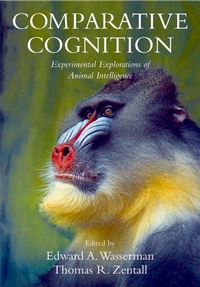
Comparative Cognition
Experimental Explorations of Animal Intelligence
1st Edition
Published on 8. April 2009
719 pages
978-0-19-970340-1 (ISBN)
Description

This volume celebrates comparative cognition's first quarter century with a state-of-the-art collection of chapters covering the broad realm of the scientific study of animal intelligence. Comparative Cognition will be an invaluable resource for students and professional researchers in all areas of psychology and neuroscience.
More details
Other editions
Additional editions
Edward A. Wasserman | Thomas R. Zentall
Comparative Cognition
Experimental Explorations of Animal Intelligence
Book
05/2009
Oxford University Press Inc
€123.90
Shipment within 15-20 days
Book
04/2006
Oxford University Press Inc
€90.37
Withdrawn from sale
Content
- Intro
- Contents
- Contributors
- Comparative Cognition: A Natural Science Approach to the Study of Animal Intelligence
- I. Perception and Illusion
- 1. Grouping and Segmentation of Visual Objects by Baboons (Papio papio) and Humans (Homo sapiens)
- 2. Seeing What Is Not There: Illusion, Completion, and Spatiotemporal Boundary Formation in Comparative Perspective
- 3. The Cognitive Chicken: Visual and Spatial Cognition in a Nonmammalian Brain
- 4. The Comparative Psychology of Absolute Pitch
- II. Attention and Search
- 5. Reaction-Time Explorations of Visual Perception, Attention, and Decision in Pigeons
- 6. Selective Attention, Priming, and Foraging Behavior
- 7. Attention as It Is Manifest Across Species
- III. Memory Processes
- 8. The Questions of Temporal and Spatial Displacement in Animal Cognition
- 9. Memory Processing
- IV. Spatial Cognition
- 10. Arthropod Navigation: Ants, Bees, Crabs, Spiders Finding Their Way
- 11. Comparative Spatial Cognition: Processes in Landmark- and Surface-Based Place Finding
- 12. Properties of Time-Place Learning
- V. Timing and Counting
- 13. Behavioristic, Cognitive, Biological, and Quantitative Explanations of Timing
- 14. Sensitivity to Time: Implications for the Representation of Time
- 15. Time and Number: Learning, Psychophysics, Stimulus Control, and Retention
- VI. Conceptualization and Categorization
- 16. Relational Discrimination Learning in Pigeons
- 17. A Modified Feature Theory as an Account of Pigeon Visual Categorization
- 18. Category Structure and Typicality Effects
- 19. Similarity and Difference in the Conceptual Systems of Primates: The Unobservability Hypothesis
- 20. Rule Learning, Memorization Strategies, Switching Attention Between Local and Global Levels of Perception, and Optimality in Avian Visual Categorization
- 21. Responses and Acquired Equivalence Classes
- VII. Pattern Learning
- 22. Spatial Patterns: Behavioral Control and Cognitive Representation
- 23. The Structure of Sequential Behavior
- 24. Truly Random Operant Responding: Results and Reasons
- 25. The Simultaneous Chain: A New Look at Serially Organized Behavior
- VIII. Tool Fabrication and Use
- 26. Cognitive Adaptations for Tool-Related Behavior in New Caledonian Crows
- 27. What Is Challenging About Tool Use? The Capuchin's Perspective
- IX. Problem Solving and Behavioral Flexibility
- 28. Intelligences and Brains: An Evolutionary Bird's Eye View
- 29. How Do Dolphins Solve Problems?
- 30. The Comparative Cognition of Caching
- 31. The Neural Basis of Cognitive Flexibility in Birds
- X. Social Cognition Processes
- 32. Chimpanzee Social Cognition in Early Life: Comparative-Developmental Perspective
- 33. Stimuli Signaling Rewards That Follow a Less-Preferred Event Are Themselves Preferred: Implications for Cognitive Dissonance
- Postscript: An Essay on the Study of Cognition in Animals
- Author Index
- A
- B
- C
- D
- E
- F
- G
- H
- I
- J
- K
- L
- M
- N
- O
- P
- Q
- R
- S
- T
- U
- V
- W
- X
- Y
- Z
- Subject Index
- A
- B
- C
- D
- E
- F
- G
- H
- I
- J
- K
- L
- M
- N
- O
- P
- R
- S
- T
- U
- V
- W
