

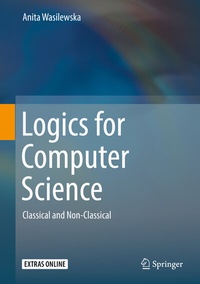
Logics for Computer Science
Classical and Non-Classical
Published on 3. November 2018
X, 535 pages
978-3-319-92591-2 (ISBN)
Description

Providing an in-depth introduction to fundamental classical and non-classical logics, this textbook offers a comprehensive survey of logics for computer scientists.
Logics for Computer Science
contains intuitive introductory chapters explaining the need for logical investigations, motivations for different types of logics and some of their history. They are followed by strict formal approach chapters. All chapters contain many detailed examples explaining each of the introduced notions and definitions, well chosen sets of exercises with carefully written solutions, and sets of homework.
While many logic books are available, they were written by logicians for logicians, not for computer scientists. They usually choose one particular way of presenting the material and use a specialized language. Logics for Computer Science discusses Gentzen as well as Hilbert formalizations, first order theories, the Hilbert Program, Godel's first and second incompleteness theorems and their proofs. It also introduces and discusses some many valued logics, modal logics and introduces algebraic models for classical, intuitionistic, and modal S4 and S5 logics. The theory of computation is based on concepts defined by logicians and mathematicians. Logic plays a fundamental role in computer science, and this book explains the basic theorems, as well as different techniques of proving them in classical and some non-classical logics. Important applications derived from concepts of logic for computer technology include Artificial Intelligence and Software Engineering. In addition to Computer Science, this book may also find an audience in mathematics and philosophy courses, and some of the chapters are also useful for a course in Artificial Intelligence.
While many logic books are available, they were written by logicians for logicians, not for computer scientists. They usually choose one particular way of presenting the material and use a specialized language. Logics for Computer Science discusses Gentzen as well as Hilbert formalizations, first order theories, the Hilbert Program, Godel's first and second incompleteness theorems and their proofs. It also introduces and discusses some many valued logics, modal logics and introduces algebraic models for classical, intuitionistic, and modal S4 and S5 logics. The theory of computation is based on concepts defined by logicians and mathematicians. Logic plays a fundamental role in computer science, and this book explains the basic theorems, as well as different techniques of proving them in classical and some non-classical logics. Important applications derived from concepts of logic for computer technology include Artificial Intelligence and Software Engineering. In addition to Computer Science, this book may also find an audience in mathematics and philosophy courses, and some of the chapters are also useful for a course in Artificial Intelligence.
Reviews / Votes
"This textbook is intended to serve as a first introduction to logic for undergraduate students, especially for those majoring in computer science or a related field. . The text is very reader-friendly, with plenty of explanations. . The problems will provide readers with ample opportunity to hone their skills." (Katalin Bimbó, Mathematical Reviews, October, 2019)More details
Other editions
Additional editions
Book
11/2018
Springer
€139.09
Shipment within 10-15 days
Person
Professor Anita Wasilewska has been teaching a "logic for computer science" class for many years, using presentation slides for ease of comprehension. She earned her Master Degree in Computer Science and Ph.D. in Mathematics from Warsaw University, where she consequently was a faculty of the Mathematics Department from 1967 to 1983. She came to the United States in 1980 as a visiting Assistant Professor in Mathematics at Wesleyan and Yale Universities in Connecticut, before joining Stony Brook's Department of Computer Science in 1986.
She has also published papers, books, and edited books in many domains ranging from Classical and Non-Classical Logics, Automated Theorem Proving, Formal Languages, Theory of Programs, Foundations of Rough Sets in which she was one of the pioneers, to generalized Fuzzy and Rough sets, and Machine Learning.
She has also published papers, books, and edited books in many domains ranging from Classical and Non-Classical Logics, Automated Theorem Proving, Formal Languages, Theory of Programs, Foundations of Rough Sets in which she was one of the pioneers, to generalized Fuzzy and Rough sets, and Machine Learning.
Content
1: Introduction: Paradoxes and Puzzles.- 2: Introduction to Classical Logic.- 3: Propositional Semantics: Classical and Many Valued.- 4: General Proof Systems: Syntax and Semantics.- 5: Hilbert Proof Systems: Deduction and Completeness Theorems for Classical Propositional Logic.- 6: Automated Proof Systems.- 7: Introduction to Intuitionistic and Modal Logics.- 8: Classical Predicate Semantics and Proof Systems.- 9: Completeness and Deduction Theorems for Classical Predicate Logic.- 10: Predicate Automated Proof Systems.- 11: Formal Theories and Godel Theorems.
